
Cookie preferences
This website uses cookies, which are necessary for the technical operation of the website and are always set. Other cookies, which increase the comfort when using this website, are used for direct advertising or to facilitate interaction with other websites and social networks, are only set with your consent.
Configuration
Technically required
These cookies are necessary for the basic functions of the shop.
"Allow all cookies" cookie
"Decline all cookies" cookie
CSRF token
Cookie preferences
Currency change
Customer-specific caching
FACT-Finder tracking
Individual prices
Selected shop
Session
Comfort functions
These cookies are used to make the shopping experience even more appealing, for example for the recognition of the visitor.
Note
Show the facebook fanpage in the right blod sidebar
Statistics & Tracking
Affiliate program
Conversion and usertracking via Google Tag Manager
Track device being used

| Item number | Size | Datasheet | Manual | SDS | Delivery time | Quantity | Price |
|---|---|---|---|---|---|---|---|
| Cay41306-100 | 100 µg | - |
6 - 10 business days* |
438.00€
|
If you have any questions, please use our Contact Form.
You can also order by e-mail: info@biomol.com
Larger quantity required? Request bulk
You can also order by e-mail: info@biomol.com
Larger quantity required? Request bulk
Tau is a member of the microtubule-associated protein (MAP) family that facilitates microtubule... more
Product information "Tau 1N4R (human, recombinant)"
Tau is a member of the microtubule-associated protein (MAP) family that facilitates microtubule formation in axons. It is primarily expressed in neurons and localized to axons, but trace amounts have been observed in glial cells and several peripheral tissues, including kidney, lung, and testis. Tau is composed of an N-terminal projection domain that interacts with neurofilaments, cytoplasmic organelles, and neuronal cell membranes and a C-terminal microtubule-binding domain that facilitates microtubule polymerization and stabilization. It is encoded by MAPT in humans, a 16-exon gene that produces six isoforms via alternative mRNA splicing, which differ from each other based on the presence of zero (0N), one (1N), or two (2N) inserts at the amino terminus and the number of microtubule-binding repeat (MTBR) domains at the C-terminus (3R or 4R for three and four repeats, respectively). Tau is subject to post-translational modifications, including phosphorylation, and hyperphosphorylation of tau is associated with the formation of neurofibrillary tangles and neuronal cell death in postmortem brains from patients with Alzheimer's disease. Mutations in MAPT lead to changes in expression of tau isoforms and the formation of insoluble protein aggregates that cause familial frontotemporal dementia (FTD) and parkinsonism linked to chromosome 17 (FTDP-17). Transgenic mice expressing wild-type human tau 1N4R exhibit motor and spatial memory impairments, and postmortem brain levels of insoluble tau 1N4R are increased in patients with Parkinson's disease.. Protein function: Promotes microtubule assembly and stability, and might be involved in the establishment and maintenance of neuronal polarity. The C-terminus binds axonal microtubules while the N-terminus binds neural plasma membrane components, suggesting that tau functions as a linker protein between both. Axonal polarity is predetermined by TAU/MAPT localization (in the neuronal cell) in the domain of the cell body defined by the centrosome. The short isoforms allow plasticity of the cytoskeleton whereas the longer isoforms may preferentially play a role in its stabilization. [The UniProt Consortium]
| Keywords: | MAPTL, PHF-tau, Paired helical filament-tau, Neurofibrillary tangle protein, Microtubule-associated protein tau |
| Supplier: | Cayman Chemical |
| Supplier-Nr: | 41306 |
Properties
| Conjugate: | No |
| Host: | E.coli |
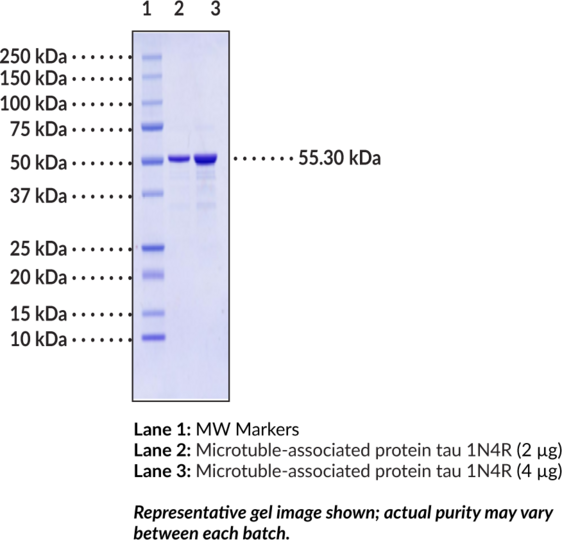
| Purity: | >90% (SDS-PAGE) |
| Format: | Solution |
Database Information
| KEGG ID : | K04380 | Matching products |
| UniProt ID : | P10636 | Matching products |
| Gene ID : | GeneID 4137 | Matching products |
Handling & Safety
| Storage: | -80°C |
| Shipping: | -80°C (International: -80°C) |
Caution
Our products are for laboratory research use only: Not for administration to humans!
Our products are for laboratory research use only: Not for administration to humans!
Information about the product reference will follow.
more
You will get a certificate here
Viewed