
Cookie preferences
This website uses cookies, which are necessary for the technical operation of the website and are always set. Other cookies, which increase the comfort when using this website, are used for direct advertising or to facilitate interaction with other websites and social networks, are only set with your consent.
Configuration
Technically required
These cookies are necessary for the basic functions of the shop.
"Allow all cookies" cookie
"Decline all cookies" cookie
CSRF token
Cookie preferences
Currency change
Customer-specific caching
FACT-Finder tracking
Individual prices
Selected shop
Session
Comfort functions
These cookies are used to make the shopping experience even more appealing, for example for the recognition of the visitor.
Note
Show the facebook fanpage in the right blod sidebar
Statistics & Tracking
Affiliate program
Conversion and usertracking via Google Tag Manager
Track device being used

| Item number | Size | Datasheet | Manual | SDS | Delivery time | Quantity | Price |
|---|---|---|---|---|---|---|---|
| CSB-CF361018SHZ.20 | 20 µg | - |
10 - 14 business days* |
799.00€
|
|||
| CSB-CF361018SHZ.100 | 100 µg | - |
10 - 14 business days* |
1,280.00€
|
If you have any questions, please use our Contact Form.
You can also order by e-mail: info@biomol.com
Larger quantity required? Request bulk
You can also order by e-mail: info@biomol.com
Larger quantity required? Request bulk
Organism: Sindbis virus (SINV). Source: in vitro E.coli expression system. Expression Region:... more
Product information "Structural polyprotein, partial, Sindbis virus, recombinant"
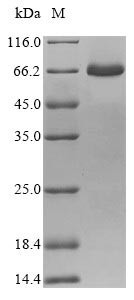
Organism: Sindbis virus (SINV). Source: in vitro E.coli expression system. Expression Region: 807-1245aa. Protein Length: Partial. Tag Info: N-terminal 10xHis-SUMO-tagged and C-terminal Myc-tagged. Target Protein Sequence: YEHATTVPNV PQIPYKALVE RAGYAPLNLE ITVMSSEVLP STNQEYITCK FTTVVPSPKI KCCGSLECQP AAHADYTCKV FGGVYPFMWG GAQCFCDSEN SQMSEAYVEL SADCASDHAQ AIKVHTAAMK VGLRIVYGNT TSFLDVYVNG VTPGTSKDLK VIAGPISASF TPFDHKVVIH RGLVYNYDFP EYGAMKPGAF GDIQATSLTS KDLIASTDIR LLKPSAKNVH VPYTQASSGF EMWKNNSGRP LQETAPFGCK IAVNPLRAVD CSYGNIPISI DIPNAAFIRT SDAPLVSTVK CEVSECTYSA DFGGMATLQY VSDREGQCPV HSHSSTATLQ ESTVHVLEKG AVTVHFSTAS PQANFIVSLC GKKTTCNAEC KPPADHIVST PHKNDQEFQA AISKTSWSWL FALFGGASSL LIIGLMIFAC SMMLTSTRR. Purity: Greater than 85% as determined by SDS-PAGE. Endotoxin: Not test. Biological Activity: n/a. Form: Liquid or Lyophilized powder. Buffer: If the delivery form is liquid, the default storage buffer is Tris/PBS-based buffer, 5%-50% glycerol. If the delivery form is lyophilized powder, the buffer before lyophilization is Tris/PBS-based buffer, 6% Trehalose, pH 8.0. Reconstitution: We recommend that this vial be briefly centrifuged prior to opening to bring the contents to the bottom. Please reconstitute protein in deionized sterile water to a concentration of 0.1-1.0 mg/mL.We recommend to add 5-50% of glycerol (final concentration) and aliquot for long-term storage at -20 °C/-80 °C. Our default final concentration of glycerol is 50%. Customers could use it as reference. Storage: The shelf life is related to many factors, storage state, buffer ingredients, storage temperature and the stability of the protein itself. Generally, the shelf life of liquid form is 6 months at -20 °C/-80 °C. The shelf life of lyophilized form is 12 months at -20 °C/-80 °C. Notes: Repeated freezing and thawing is not recommended. Store working aliquots at 4 °C for up to one week. Relevance: Capsid protein possesses a protease activity that results in its autocatalytic cleavage from the nascent structural protein. Following its self-cleavage, the capsid protein transiently associates with ribosomes, and within several minutes the protein binds to viral RNA and rapidly assembles into icosaedric core particles. The resulting nucleocapsid eventually associates with the cytoplasmic domain of E2 at the cell membrane, leading to budding and formation of mature virions. New virions attach to target cells, and after clathrin-mediated endocytosis their membrane fuses with the host endosomal membrane. This leads to the release of the nucleocapsid into the cytoplasm, followed by an uncoating event necessary for the genomic RNA to become accessible. The uncoating might be triggered by the interaction of capsid proteins with ribosomes. Binding of ribosomes would release the genomic RNA since the same region is genomic RNA-binding and ribosome-binding. Reference: "A single nucleotide change in the E2 glycoprotein gene of Sindbis virus affects penetration rate in cell culture and virulence in neonatal mice." Davis N.L., Fuller F.J., Dougherty W.G., Olmsted R.A., Johnston R.E. Proc. Natl. Acad. Sci. U.S.A. 83:6771-6775(1986). Function: Capsid protein
| Keywords: | Recombinant Sindbis virus Structural polyprotein, partial |
| Supplier: | Cusabio |
| Supplier-Nr: | CF361018SHZ |
Properties
| Application: | Activity not tested |
| Conjugate: | No |
| Host: | E.coli in vitro |
| Species reactivity: | Sindbis virus (SINV) |
| MW: | 67.4 kD |
| Purity: | >85% (SDS-PAGE) |
Database Information
| KEGG ID : | K19288 | Matching products |
| UniProt ID : | P03316 | Matching products |
Handling & Safety
| Storage: | -20°C |
| Shipping: | +4°C (International: +4°C) |
Caution
Our products are for laboratory research use only: Not for administration to humans!
Our products are for laboratory research use only: Not for administration to humans!
You will get a certificate here
Viewed