
Cookie preferences
This website uses cookies, which are necessary for the technical operation of the website and are always set. Other cookies, which increase the comfort when using this website, are used for direct advertising or to facilitate interaction with other websites and social networks, are only set with your consent.
Configuration
Technically required
These cookies are necessary for the basic functions of the shop.
"Allow all cookies" cookie
"Decline all cookies" cookie
CSRF token
Cookie preferences
Currency change
Customer-specific caching
FACT-Finder tracking
Individual prices
Selected shop
Session
Comfort functions
These cookies are used to make the shopping experience even more appealing, for example for the recognition of the visitor.
Note
Show the facebook fanpage in the right blod sidebar
Statistics & Tracking
Affiliate program
Conversion and usertracking via Google Tag Manager
Track device being used

If you have any questions, please use our Contact Form.
You can also order by e-mail: info@biomol.com
Larger quantity required? Request bulk
You can also order by e-mail: info@biomol.com
Larger quantity required? Request bulk
Organism: Mus musculus (Mouse). Source: E.coli. Expression Region: 141-480aa. Protein Length:... more
Product information "Serine protease HTRA1 (Htra1), partial, mouse, recombinant"
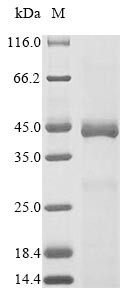
Organism: Mus musculus (Mouse). Source: E.coli. Expression Region: 141-480aa. Protein Length: Partial. Tag Info: C-terminal 6xHis-tagged. Target Protein Sequence: KLRQPPVIVL QRGACGQGQE DPNSLRHKYN FIADVVEKIA PAVVHIELYR KLPFSKREVP VASGSGFIVS EDGLIVTNAH VVTNKNRVKV ELKNGATYEA KIKDVDEKAD IALIKIDHQG KLPVLLLGRS SELRPGEFVV AIGSPFSLQN TVTTGIVSTT QRGGKELGLR NSDMDYIQTD AIINYGNSGG PLVNLDGEVI GINTLKVTAG ISFAIPSDKI KKFLTESHDR QAKGKAVTKK KYIGIRMMSL TSSKAKELKD RHRDFPDVLS GAYIIEVIPD TPAEAGGLKE NDVIISINGQ SVVTANDVSD VIKKENTLNM VVRRGNEDIV ITVIPEEIDP. Purity: Greater than 85% as determined by SDS-PAGE. Endotoxin: Not test. Biological Activity: n/a. Form: Liquid or Lyophilized powder. Buffer: If the delivery form is liquid, the default storage buffer is Tris/PBS-based buffer, 5%-50% glycerol. If the delivery form is lyophilized powder, the buffer before lyophilization is Tris/PBS-based buffer, 6% Trehalose, pH 8.0. Reconstitution: We recommend that this vial be briefly centrifuged prior to opening to bring the contents to the bottom. Please reconstitute protein in deionized sterile water to a concentration of 0.1-1.0 mg/mL.We recommend to add 5-50% of glycerol (final concentration) and aliquot for long-term storage at -20 °C/-80 °C. Our default final concentration of glycerol is 50%. Customers could use it as reference. Storage: The shelf life is related to many factors, storage state, buffer ingredients, storage temperature and the stability of the protein itself. Generally, the shelf life of liquid form is 6 months at -20 °C/-80 °C. The shelf life of lyophilized form is 12 months at -20 °C/-80 °C. Notes: Repeated freezing and thawing is not recommended. Store working aliquots at 4 °C for up to one week. Relevance: Serine protease with a variety of targets, including extracellular matrix proteins such as fibronectin. HTRA1-generated fibronectin fragments further induce synovial cells to up-regulate MMP1 and MMP3 production. May also degrade proteoglycans, such as aggrecan, decorin and fibromodulin. Through cleavage of proteoglycans, may release soluble FGF-glycosaminoglycan complexes that promote the range and intensity of FGF signals in the extracellular space. Regulates the availability of insulin-like growth factors (IGFs) by cleaving IGF-binding proteins. Inhibits signaling mediated by TGF-beta family members. This activity requires the integrity of the catalytic site, but it is unclear whether it leads to the proteolytic degradation of TGF-beta proteins themselves or not. By acting on TGF-beta signaling, may regulate many physiological processes, including retinal angiogenesis and neuronal survival and maturation during development. Intracellularly, degrades TSC2, leading to the activation of TSC2 downstream targets. Reference: "Mouse insulin-like growth factor binding protein 5-directed endopeptidase: structural assessment, evolutionary analysis, ovarian expression, hormonal regulation and cellular localization." Hourvitz A., Hennebold J.D., King G., Negishi H., Erickson G.F., Roby J.A., Mayo K.E., Adashi E.Y. Submitted (AUG-1999). Function: Serine protease with a variety of targets, including extracellular matrix proteins such as fibronectin. HTRA1-generated fibronectin fragments further induce synovial cells to up-regulate MMP1 and MMP3 production. May also degrade proteoglycans, such as aggrecan, decorin and fibromodulin. Through cleavage of proteoglycans, may release soluble FGF-glycosaminoglycan complexes that promote the range and intensity of FGF signals in the extracellular space. Regulates the availability of insulin-like growth factors (IGFs) by cleaving IGF-binding proteins. Inhibits signaling mediated by TGF-beta family members. This activity requires the integrity of the catalytic site, but it is unclear whether it leads to the proteolytic degradation of TGF-beta proteins themselves
| Keywords: | Htra, Htra1, EC=3.4.21.-, Serine protease 11, Serine protease HTRA1, High-temperature requirement A serine peptidase 1, Recombinant Mouse Serine protease HTRA1 (Htra1), partial |
| Supplier: | Cusabio |
| Supplier-Nr: | EP879501MO1 |
Properties
| Application: | Activity not tested |
| Conjugate: | No |
| Host: | E.coli |
| Species reactivity: | mouse |
| MW: | 39.0 kD |
| Purity: | >85% (SDS-PAGE) |
Database Information
| KEGG ID : | K08784 | Matching products |
| UniProt ID : | Q9R118 | Matching products |
| Gene ID : | GeneID 56213 | Matching products |
Handling & Safety
| Storage: | -20°C |
| Shipping: | +4°C (International: +4°C) |
Caution
Our products are for laboratory research use only: Not for administration to humans!
Our products are for laboratory research use only: Not for administration to humans!
You will get a certificate here
Viewed