
Cookie preferences
This website uses cookies, which are necessary for the technical operation of the website and are always set. Other cookies, which increase the comfort when using this website, are used for direct advertising or to facilitate interaction with other websites and social networks, are only set with your consent.
Configuration
Technically required
These cookies are necessary for the basic functions of the shop.
"Allow all cookies" cookie
"Decline all cookies" cookie
CSRF token
Cookie preferences
Currency change
Customer-specific caching
FACT-Finder tracking
Individual prices
Selected shop
Session
Comfort functions
These cookies are used to make the shopping experience even more appealing, for example for the recognition of the visitor.
Note
Show the facebook fanpage in the right blod sidebar
Statistics & Tracking
Affiliate program
Conversion and usertracking via Google Tag Manager
Track device being used

NEW
| Item number | Size | Datasheet | Manual | SDS | Delivery time | Quantity | Price |
|---|---|---|---|---|---|---|---|
| ABS-PP-25309-L.20 | 20 µg | - | - |
10 - 14 business days* |
115.00€
|
||
| ABS-PP-25309-L.100 | 100 µg | - | - |
10 - 14 business days* |
205.00€
|
If you have any questions, please use our Contact Form.
You can also order by e-mail: info@biomol.com
Larger quantity required? Request bulk
You can also order by e-mail: info@biomol.com
Larger quantity required? Request bulk
Tag: C-His. Modification: unmodified. Start Site: Asp31. End Site: Val120. Coverage: 0.4.... more
Product information "Recombinant Human HLA-DRB3 Protein"
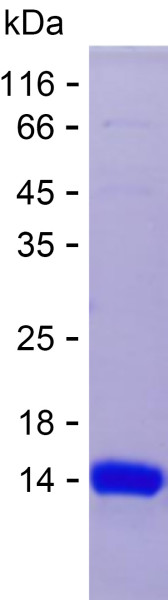
Tag: C-His. Modification: unmodified. Start Site: Asp31. End Site: Val120. Coverage: 0.4. Isoelectric Point: 8.5. Core Sequence: DTRPRFLELR KSECHFFNGT ERVRYLDRYF HNQEEFLRFD SDVGEYRAVT ELGRPVAESW NSQKDLLEQK RGRVDNYCRH NYGVGESFTV. Homologies: Highest protein sequence identity to the following orthologs: Mouse - 71%, Rat - 63%, Pig - 76%, Cynomolgus monkey - 92%, Protein Function: A beta chain of antigen-presenting major histocompatibility complex class II (MHCII) molecule. In complex with the alpha chain HLA-DRA, displays antigenic peptides on professional antigen presenting cells (APCs) for recognition by alpha-beta T cell receptor (TCR) on HLA-DRB3-restricted CD4-positive T cells. This guides antigen-specific T-helper effector functions, both antibody-mediated immune response and macrophage activation, to ultimately eliminate the infectious agents and transformed cells. Typically presents extracellular peptide antigens of 10 to 30 amino acids that arise from proteolysis of endocytosed antigens in lysosomes (PubMed:16148104, PubMed:19531622, PubMed:19830726, PubMed:20368442, PubMed:22929521, PubMed:23569328, PubMed:2463305, PubMed:2788702, PubMed:30282837, PubMed:31020640, PubMed:31308093, PubMed:31333679). In the tumor microenvironment, presents antigenic peptides that are primarily generated in tumor-resident APCs likely via phagocytosis of apoptotic tumor cells or macropinocytosis of secreted tumor proteins (By similarity). Presents peptides derived from intracellular proteins that are trapped in autolysosomes after macroautophagy, a mechanism especially relevant for T cell selection in the thymus and central immune tolerance (By similarity). The selection of the immunodominant epitopes follows two processing modes: 'bind first, cut/trim later' for pathogen-derived antigenic peptides and 'cut first, bind later' for autoantigens/self-peptides. The anchor residue at position 1 of the peptide N-terminus, usually a large hydrophobic residue, is essential for high affinity interaction with MHCII molecules (By similarity) , ALLELE DRB3*01:01: Exclusively presents several immunogenic epitopes derived from C.tetani neurotoxin tetX, playing a significant role in immune recognition and long-term protection (PubMed:19830726, PubMed:2463305, PubMed:2788702). Presents viral epitopes derived from HHV-6B U11, TRX2/U56 and U85 antigens to polyfunctional CD4-positive T cells with cytotoxic activity implicated in control of HHV-6B infection (PubMed:31020640) , ALLELE DRB3*02:02 Exclusively presents several immunogenic epitopes derived from C.tetani neurotoxin tetX, playing a significant role in immune recognition and long-term protection (PubMed:19830726, PubMed:2788702). Upon EBV infection, presents to CD4-positive T cells latent antigen EBNA2 (PRSPTVFYNIPPMPLPPSQL) and lytic antigen BZLF1 (LTAYHVSTAPTGSWF) peptides, driving oligoclonal expansion and selection of virus-specific memory T cell subsets with cytotoxic potential to directly eliminate virus-infected B cells (PubMed:23569328, PubMed:31308093). Presents viral epitopes derived from HHV-6B U11, gB/U39 and gH/U48 antigens to polyfunctional CD4-positive T cells with cytotoxic activity implicated in control of HHV-6B infection (PubMed:31020640). Plays a minor role in CD4-positive T cell immune response against Dengue virus by presenting conserved peptides from capsid and non-structural NS3 proteins (PubMed:31333679). Displays peptides derived from IAV matrix protein M, implying a role in protection against IAV infection (PubMed:19830726). In the context of tumor immunesurveillance, may present to T-helper 1 cells an immunogenic epitope derived from tumor-associated antigen WT1 (KRYFKLSHLQMHSRKH), likely providing for effective antitumor immunity in a wide range of solid and hematological malignancies (PubMed:22929521). Presents to Vbeta2-positive T-helper 1 cells specifically an immunodominant peptide derived from tumor antigen CTAG1A/NY-ESO-1(PGVLLKEFTVSGNILTIRLTAADHR) and confers protective memory response (PubMed:19531622, PubMed:20368442). In metastatic epithelial tumors, presents to intratumoral CD4-positive T cells a TP53 neoantigen (HYNYMCNSSCMGSMNRRPILTIITL) carrying G245S hotspot driver mutation and may mediate tumor regression (PubMed:30282837) , ALLELE DRB3*03:01: Presents a series of conserved peptides derived from the M.tuberculosis PPE family of proteins, in particular PPE29 and PPE33, known to be highly immunogenic (PubMed:32341563). Presents immunogenic epitopes derived from C.tetani neurotoxin tetX, playing a role in immune recognition and long-term protection (PubMed:2788702). Displays immunodominant viral peptides from HCV non-structural protein NS2, as part of a broad range T-helper response to resolve infection (PubMed:16148104) [The Uniprot Consortium]
| Keywords: | HLA-DRB3, MHC class II antigen DRB3, HLA class II histocompatibility antigen, DR beta 3 chain |
| Supplier: | Absea |
| Supplier-Nr: | PP-25309-L |
Properties
| Conjugate: | No |
| Host: | E.coli |
| Species reactivity: | human |
| MW: | 12.5 kD |
| Format: | Lyophilized |
Database Information
| KEGG ID : | K06752 | Matching products |
| UniProt ID : | P79483 | Matching products |
| Gene ID : | GeneID 3125 | Matching products |
Handling & Safety
| Storage: | -20°C (protect from light & moisture) |
| Shipping: | +4°C (International: +4°C) |
Caution
Our products are for laboratory research use only: Not for administration to humans!
Our products are for laboratory research use only: Not for administration to humans!
You will get a certificate here
Viewed