
Cookie preferences
This website uses cookies, which are necessary for the technical operation of the website and are always set. Other cookies, which increase the comfort when using this website, are used for direct advertising or to facilitate interaction with other websites and social networks, are only set with your consent.
Configuration
Technically required
These cookies are necessary for the basic functions of the shop.
"Allow all cookies" cookie
"Decline all cookies" cookie
CSRF token
Cookie preferences
Currency change
Customer-specific caching
FACT-Finder tracking
Individual prices
Selected shop
Session
Comfort functions
These cookies are used to make the shopping experience even more appealing, for example for the recognition of the visitor.
Note
Show the facebook fanpage in the right blod sidebar
Statistics & Tracking
Affiliate program
Conversion and usertracking via Google Tag Manager
Track device being used

NEW
| Item number | Size | Datasheet | Manual | SDS | Delivery time | Quantity | Price |
|---|---|---|---|---|---|---|---|
| ABS-PP-26042.20 | 20 µg | - | - |
10 - 14 business days* |
90.00€
|
||
| ABS-PP-26042.100 | 100 µg | - | - |
10 - 14 business days* |
180.00€
|
If you have any questions, please use our Contact Form.
You can also order by e-mail: info@biomol.com
Larger quantity required? Request bulk
You can also order by e-mail: info@biomol.com
Larger quantity required? Request bulk
Tag: C-His. Modification: unmodified. Start Site: Gln91. End Site: Lys340. Coverage: 0.74.... more
Product information "Recombinant Human AIM2 Protein"
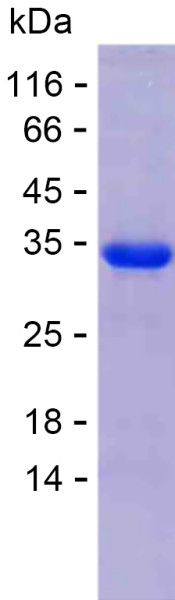
Tag: C-His. Modification: unmodified. Start Site: Gln91. End Site: Lys340. Coverage: 0.74. Isoelectric Point: 10.5. Core Sequence: QYKSVTKPKP LSQAEMSPAA SAAIRNDVAK QRAAPKVSPH VKPEQKQMVA QQESIREGFQ KRCLPVMVLK AKKPFTFETQ EGKQEMFHAT VATEKEFFFV KVFNTLLKDK FIPKRIIIIA RYYRHSGFLE VNSASRVLDA ESDQKVNVPL NIIRKAGETP KINTLQTQPL GTIVNGLFVV QKVTEKKKNI LFDLSDNTGK MEVLGVRNED TMKCKEGDKV RLTFFTLSKN GEKLQLTSGV HSTIKVIKAK. Homologies: Highest protein sequence identity to the following orthologs: Mouse - 58%, Pig - 47%, Cynomolgus monkey - 91%, Protein Function: Sensor component of the AIM2 inflammasome, which mediates inflammasome activation in response to the presence of double-stranded DNA (dsDNA) in the cytosol, leading to subsequent pyroptosis (PubMed:17726700, PubMed:19158675, PubMed:19158676, PubMed:19158679, PubMed:20566831, PubMed:23530044, PubMed:26197926, PubMed:26583071, PubMed:29440442, PubMed:33980849, PubMed:37364111). Inflammasomes are supramolecular complexes that assemble in the cytosol in response to pathogens and other damage-associated signals and play critical roles in innate immunity and inflammation (PubMed:17726700, PubMed:19158675, PubMed:19158676, PubMed:19158679, PubMed:20566831, PubMed:26197926, PubMed:29440442, PubMed:33980849). Acts as a recognition receptor (PRR): specifically recognizes and binds dsDNA in the cytosol, and mediates the formation of the inflammasome polymeric complex composed of AIM2, CASP1 and PYCARD/ASC (PubMed:17726700, PubMed:19158675, PubMed:19158676, PubMed:19158679, PubMed:20566831, PubMed:26197926, PubMed:29440442, PubMed:33980849). Recruitment of pro-caspase-1 (proCASP1) to the AIM2 inflammasome promotes caspase-1 (CASP1) activation, which subsequently cleaves and activates inflammatory cytokines IL1B and IL18 and gasdermin-D (GSDMD), promoting cytokine secretion (PubMed:17726700, PubMed:19158675, PubMed:19158676, PubMed:19158679, PubMed:20566831). In some cells, CASP1 activation mediates cleavage and activation of GSDMD, triggering pyroptosis without promoting cytokine secretion (PubMed:19158675, PubMed:19158676). Detects cytosolic dsDNA of viral and bacterial origin in a non-sequence-specific manner (PubMed:17726700, PubMed:19158675, PubMed:19158676, PubMed:19158679, PubMed:20566831, PubMed:26197926, PubMed:26583071, PubMed:29440442, PubMed:33980849). Involved in the DNA damage response caused by acute ionizing radiation by mediating pyroptosis of intestinal epithelial cells and bone marrow cells in response to double-strand DNA breaks (By similarity). Mechanistically, AIM2 senses DNA damage in the nucleus to mediate inflammasome assembly and inflammatory cell death (By similarity). Also acts as a regulator of neurodevelopment via its role in the DNA damage response: acts by promoting neural cell death in response to DNA damage in the developing brain, thereby purging genetically compromised cells of the central nervous system (By similarity). Pyroptosis mediated by the AIM2 inflammasome in response to DNA damage is dependent on GSDMD without involving IL1B and IL18 cytokine secretion (By similarity). Also acts as a mediator of pyroptosis, necroptosis and apoptosis (PANoptosis), an integral part of host defense against pathogens, in response to bacterial infection (By similarity). Can also trigger PYCARD/ASC-dependent, caspase-1-independent cell death that involves caspase-8 (CASP8) (By similarity) , Also acts as a tumor suppressor independently of its role in inflammatory response (PubMed:16432157). Able to suppress overt cell proliferation in enterocytes: restricts stem cell proliferation in the intestinal mucosa in an inflammasome-independent manner, contributing to a decrease in the likelihood of colorectal cancer development (By similarity). AIM2 suppresses cell proliferation by inhibiting phosphorylation of AKT1 at 'Ser-473', preventing AKT1 activation and AKT-mTOR signaling pathway (By similarity). Inhibits AKT1 phosphorylation both by inhibiting the activity of PRKDC/DNA-PK kinase and promoting dephosphorylation by PP2A phosphatase (By similarity). Also acts as a key regulator of regulatory T-cells (Treg) homeostasis by promoting their stability: acts by preventing AKT1 activation (By similarity). Its role in Treg homeostasis is important to restain autoimmune diseases (By similarity) [The Uniprot Consortium]
| Keywords: | AIM2, Absent in melanoma 2, Interferon-inducible protein AIM2 |
| Supplier: | Absea |
| Supplier-Nr: | PP-26042 |
Properties
| Conjugate: | No |
| Host: | E.coli |
| Species reactivity: | human |
| MW: | 30 kD |
| Format: | Solution |
Database Information
| KEGG ID : | K12966 | Matching products |
| UniProt ID : | O14862 | Matching products |
| Gene ID : | GeneID 9447 | Matching products |
Handling & Safety
| Storage: | -20°C (avoid repeat freezing and thawing cycles) |
| Shipping: | -20°C (International: +4°C) |
Caution
Our products are for laboratory research use only: Not for administration to humans!
Our products are for laboratory research use only: Not for administration to humans!
You will get a certificate here
Viewed