Cookie preferences
This website uses cookies, which are necessary for the technical operation of the website and are always set. Other cookies, which increase the comfort when using this website, are used for direct advertising or to facilitate interaction with other websites and social networks, are only set with your consent.
Configuration
Technically required
These cookies are necessary for the basic functions of the shop.
"Allow all cookies" cookie
"Decline all cookies" cookie
CSRF token
Cookie preferences
Currency change
Customer-specific caching
FACT-Finder tracking
Individual prices
Selected shop
Session
Comfort functions
These cookies are used to make the shopping experience even more appealing, for example for the recognition of the visitor.
Note
Show the facebook fanpage in the right blod sidebar
Statistics & Tracking
Affiliate program
Conversion and usertracking via Google Tag Manager
Track device being used
If you have any questions, please use our Contact Form.
You can also order by e-mail: info@biomol.com
Larger quantity required? Request bulk
You can also order by e-mail: info@biomol.com
Larger quantity required? Request bulk
Pleckstrin homology (PH) domains all contain a seven-standard beta-sandwich that allows binding... more
Product information "PtdIns-(3,4,5)-P3 Binding Protein"
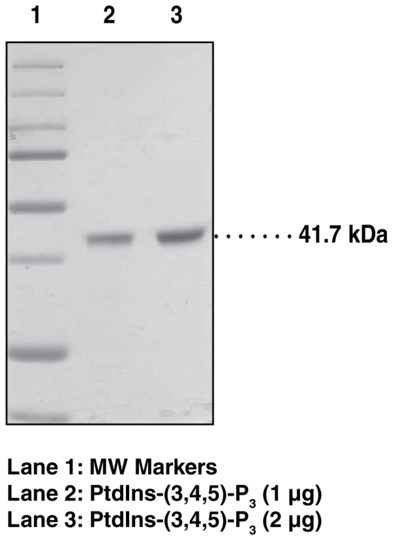
Pleckstrin homology (PH) domains all contain a seven-standard beta-sandwich that allows binding to various species of phosphatidyl inositol (PtdIns) phosphates. Most PH domains bind to PtdIns phosphates with weak affinity and low specificity. However, a small subclass binds specifically and with high-affinity for certain PtdIns phosphates. PtdIns-(3,4,5)-P3 Binding Protein contains a highly specific PH domain that recognizes and binds PtdIns-(3,4,5)-P3 (see Figure 1). PtdIns phosphates represent a small percentage of total membrane phospholipids. However, they play a critical role in the generation and transmission of cellular signals.{4096, 8344} PtdIns-(4,5)-P2 can be phosphorylated by phosphoinositide (PI)-3-kinase to make PtdIns-(3,4,5)-P3 which initiates an intricate signalling cascade that has been implicated in cancer. Due to PtdIns-(3,4,5)-P3 binding protein · s unique affinity for PtdIns-(3,4,5)-P3, this protein can be used to detect product formed by PI3-kinase in in vitro assays. Cayman's PtdIns-(3,4,5)-P3 Binding Protein is isoform 2, which differs from isoform 1 by the absence of a glycine residue at position 277.Synonyms: Cyth3, Cytohesin 3, GRP1, GRP1 PH Domain, PIP3, PIP3[3',4',5'] Binding Protein, PI(3,4,5)-P3, PI(3,4,5)P3 Binding Protein, Phosphatidylinositol-3,4,5-triphosphate. Purity: >95%. Source: Recombinant human N-terminal GST-tagged PIP3 expressed in E. coli. Amino Acids: 264-381 (PH domain). MW: ~41.7 kDa. Formulation: (Request formulation change), A solution in PBS, pH 7.4, containing 20% glycerol. UniProt Accession #: O43739.

| Keywords: | Grp1, Grp1, ARNO3, Cytohesin-3, Cytohesin-3, Protein ARNO3, Protein ARNO3, ARF nucleotide-binding site opener 3, ARF nucleotide-binding site opener 3, General receptor of phosphoinositides 1, General receptor of phosphoinositides 1, PH, SEC7 and coiled-co |
| Supplier: | Cayman Chemical |
| Supplier-Nr: | 10009817 |
Properties
| Application: | WB |
| Conjugate: | No |
| MW: | 41,7 kD |
| Purity: | >95% |
| Format: | Solution |
Database Information
| KEGG ID : | K18441 | Matching products |
| UniProt ID : | O43739 | Matching products |
| Gene ID : | GeneID 9265 | Matching products |
Handling & Safety
| Storage: | -80°C |
| Shipping: | -80°C (International: -80°C) |
Caution
Our products are for laboratory research use only: Not for administration to humans!
Information about the product reference will follow.
more
You will get a certificate here
Viewed