
Cookie preferences
This website uses cookies, which are necessary for the technical operation of the website and are always set. Other cookies, which increase the comfort when using this website, are used for direct advertising or to facilitate interaction with other websites and social networks, are only set with your consent.
Configuration
Technically required
These cookies are necessary for the basic functions of the shop.
"Allow all cookies" cookie
"Decline all cookies" cookie
CSRF token
Cookie preferences
Currency change
Customer-specific caching
FACT-Finder tracking
Individual prices
Selected shop
Session
Comfort functions
These cookies are used to make the shopping experience even more appealing, for example for the recognition of the visitor.
Note
Show the facebook fanpage in the right blod sidebar
Statistics & Tracking
Affiliate program
Conversion and usertracking via Google Tag Manager
Track device being used

If you have any questions, please use our Contact Form.
You can also order by e-mail: info@biomol.com
Larger quantity required? Request bulk
You can also order by e-mail: info@biomol.com
Larger quantity required? Request bulk
Organism: Homo sapiens (Human). Source: Yeast. Expression Region: 517-818aa. Protein Length:... more
Product information "Protein argonaute-2 (AGO2), partial, human, recombinant"
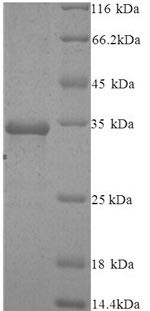
Organism: Homo sapiens (Human). Source: Yeast. Expression Region: 517-818aa. Protein Length: Partial. Tag Info: N-terminal 6xHis-tagged. Target Protein Sequence: LVVVILPGKT PVYAEVKRVG DTVLGMATQC VQMKNVQRTT PQTLSNLCLK INVKLGGVNN ILLPQGRPPV FQQPVIFLGA DVTHPPAGDG KKPSIAAVVG SMDAHPNRYC ATVRVQQHRQ EIIQDLAAMV RELLIQFYKS TRFKPTRIIF YRDGVSEGQF QQVLHHELLA IREACIKLEK DYQPGITFIV VQKRHHTRLF CTDKNERVGK SGNIPAGTTV DTKITHPTEF DFYLCSHAGI QGTSRPSHYH VLWDDNRFSS DELQILTYQL CHTYVRCTRS VSIPAPAYYA HLVAFRARYH LV. Purity: Greater than 90% as determined by SDS-PAGE. Endotoxin: Not test. Biological Activity: n/a. Form: Liquid or Lyophilized powder. Buffer: If the delivery form is liquid, the default storage buffer is Tris/PBS-based buffer, 5%-50% glycerol. If the delivery form is lyophilized powder, the buffer before lyophilization is Tris/PBS-based buffer, 6% Trehalose, pH 8.0. Reconstitution: We recommend that this vial be briefly centrifuged prior to opening to bring the contents to the bottom. Please reconstitute protein in deionized sterile water to a concentration of 0.1-1.0 mg/mL.We recommend to add 5-50% of glycerol (final concentration) and aliquot for long-term storage at -20 °C/-80 °C. Our default final concentration of glycerol is 50%. Customers could use it as reference. Storage: The shelf life is related to many factors, storage state, buffer ingredients, storage temperature and the stability of the protein itself. Generally, the shelf life of liquid form is 6 months at -20 °C/-80 °C. The shelf life of lyophilized form is 12 months at -20 °C/-80 °C. Notes: Repeated freezing and thawing is not recommended. Store working aliquots at 4 °C for up to one week. Relevance: Required for RNA-mediated gene silencing (RNAi) by the RNA-induced silencing complex (RISC). The 'minimal RISC' appears to include AGO2 bound to a short guide RNA such as a microRNA (miRNA) or short interfering RNA (siRNA). These guide RNAs direct RISC to complentary mRNAs that are targets for RISC-mediated gene silencing. The precise mechanism of gene silencing depends on the degree of complentarity between the miRNA or siRNA and its target. Binding of RISC to a perfectly complentary mRNA generally results in silencing due to endonucleolytic cleavage of the mRNA specifically by AGO2. Binding of RISC to a partially complentary mRNA results in silencing through inhibition of translation, and this is independent of endonuclease activity. May inhibit translation initiation by binding to the 7-methylguanosine cap, thereby preventing the recruitment of the translation initiation factor eIF4-E. May also inhibit translation initiation via interaction with EIF6, which itself binds to the 60S ribosomal subunit and prevents its association with the 40S ribosomal subunit. The inhibition of translational initiation leads to the accumulation of the affected mRNA in Cytoplasmic domain processing bodies (P-bodies), where mRNA degradation may subsequently occur. In some cases RISC-mediated translational repression is also observed for miRNAs that perfectly match the 3' untranslated region (3'-UTR). Can also up-regulate the translation of specific mRNAs under certain growth conditions. Binds to the AU elent of the 3'-UTR of the TNF (TNF-alpha) mRNA and up-regulates translation under conditions of serum starvation. Also required for transcriptional gene silencing (TGS), in which short RNAs known as antigene RNAs or agRNAs direct the transcriptional repression of complentary promoter regions. Reference: DNA sequence and analysis of human chromosome 8.Nusbaum C., Mikkelsen T.S., Zody M.C., Asakawa S., Taudien S., Garber M., Kodira C.D., Schueler M.G., Shimizu A., Whittaker C.A., Chang J.L., Cuomo C.A., Dewar K., FitzGerald M.G., Yang X., Allen N.R., Anderson S., Asakawa T. , Blechschmidt K., Bloom T., Borowsky M.L., Butler J., Cook A., Corum B., DeArellano K., DeCaprio D., Dooley K.T., Dorris L. III, Engels R., Gloeckner G., Hafez N., Hagopian D.S., Hall J.L., Ishikawa S.K., Jaffe D.B., Kamat A., Kudoh J., Lehmann R., Lokitsang T., Macdonald P., Major J.E., Matthews C.D., Mauceli E., Menzel U., Mihalev A.H., Minoshima S., Murayama Y., Naylor J.W., Nicol R., Nguyen C., O'Leary S.B., O'Neill K., Parker S.C.J., Polley A., Raymond C.K., Reichwald K., Rodriguez J., Sasaki T., Schilhabel M., Siddiqui R., Smith C.L., Sneddon T.P., Talamas J.A., Tenzin P., Topham K., Venkataraman V., Wen G., Yamazaki S., Young S.K., Zeng Q., Zimmer A.R., Rosenthal A., Birren B.W., Platzer M., Shimizu N., Lander E.S.Nature 439:331-335(2006). Function: Required for RNA-mediated gene silencing (RNAi) by the RNA-induced silencing complex (RISC). The 'minimal RISC' appears to include AGO2 bound to a short guide RNA such as a microRNA (miRNA) or short interfering RNA (siRNA). These guide RNAs direct RISC to complementary mRNAs that are targets for RISC-mediated gene silencing. The precise mechanism of gene silencing depends on the degree of complementarity between the miRNA or siRNA and its target. Binding of RISC to a perfectly complementary mRNA generally results in silencing due to endonucleolytic cleavage of the mRNA specifically by AGO2. Binding of RISC to a partially complementary mRNA results in silencing through inhibition of translation, and this is independent of endonuclease activity. May inhibit translation initiation by binding to the 7-methylguanosine cap, thereby preventing the recruitment of the translation initiation factor eIF4-E. May also inhibit translation initiation via interaction with EIF6, which itself binds to the 60S ribosomal subunit and prevents its association with the 40S ribosomal subunit. The inhibition of translational initiation leads to the accumulation of the affected mRNA in cytoplasmic processing bodies (P-bodies), where mRNA degradation may subsequently occur. In some cases RISC-mediated translational repression is also observed for miRNAs that perfectly match the 3' untranslated region (3'-UTR). Can also up-regulate the translation of specific mRNAs under certain growth conditions. Binds to the AU element of the 3'-UTR of the TNF (TNF-alpha) mRNA and up-regulates translation under conditions of serum starvation. Also required for transcriptional gene silencing (TGS), in which short RNAs known as antigene RNAs or agRNAs direct the transcriptional repression of complementary promoter regions.
| Keywords: | PPD, AGO2, hAgo2, EIF2C2, eIF2C 2, eIF-2C 2, Argonaute2, Protein slicer, Protein argonaute-2, PAZ Piwi domain protein, Argonaute RISC catalytic component 2, Eukaryotic translation initiation factor 2C 2, Recombinant Human Protein argonaute-2 (AGO2), parti |
| Supplier: | Cusabio |
| Supplier-Nr: | YP891731HU |
Properties
| Application: | Activity not tested |
| Conjugate: | No |
| Host: | Yeast |
| Species reactivity: | human |
| MW: | 36.1 kD |
| Purity: | >90% (SDS-PAGE) |
Database Information
| KEGG ID : | K11593 | Matching products |
| UniProt ID : | Q9UKV8 | Matching products |
| Gene ID : | GeneID 27161 | Matching products |
Handling & Safety
| Storage: | -20°C |
| Shipping: | +4°C (International: +4°C) |
Caution
Our products are for laboratory research use only: Not for administration to humans!
Our products are for laboratory research use only: Not for administration to humans!
You will get a certificate here
Viewed