
Cookie preferences
This website uses cookies, which are necessary for the technical operation of the website and are always set. Other cookies, which increase the comfort when using this website, are used for direct advertising or to facilitate interaction with other websites and social networks, are only set with your consent.
Configuration
Technically required
These cookies are necessary for the basic functions of the shop.
"Allow all cookies" cookie
"Decline all cookies" cookie
CSRF token
Cookie preferences
Currency change
Customer-specific caching
FACT-Finder tracking
Individual prices
Selected shop
Session
Comfort functions
These cookies are used to make the shopping experience even more appealing, for example for the recognition of the visitor.
Note
Show the facebook fanpage in the right blod sidebar
Statistics & Tracking
Affiliate program
Conversion and usertracking via Google Tag Manager
Track device being used

If you have any questions, please use our Contact Form.
You can also order by e-mail: info@biomol.com
Larger quantity required? Request bulk
You can also order by e-mail: info@biomol.com
Larger quantity required? Request bulk
Organism: Homo sapiens (Human). Source: E.coli. Expression Region: 1-190aa. Protein Length: Full... more
Product information "Probable DNA dC->dU-editing enzyme APOBEC-3C (APOBEC3C), human, recombinant"
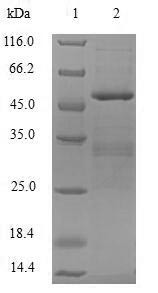
Organism: Homo sapiens (Human). Source: E.coli. Expression Region: 1-190aa. Protein Length: Full Length of BC011739. Tag Info: N-terminal GST-tagged. Target Protein Sequence: MNPQIRNPMK AMYPGTFYFQ FKNLWEANDR DETWLCFTVE GIKRRSVVSW KTGVFRNQVD SETHCHAERC FLSWFCDDIL SPNTKYQVTW YTSWSPCPDC AGEVAEFLAR HSNVNLTIFT ARLYYFQYPC YQEGLRSLSQ EGVAVEIMDY EDFKYCWENF VYNDNEPFKP WKGLKTNFRL LKRRLRESLQ. Purity: Greater than 90% as determined by SDS-PAGE. Endotoxin: Not test. Biological Activity: n/a. Form: Liquid or Lyophilized powder. Buffer: If the delivery form is liquid, the default storage buffer is Tris/PBS-based buffer, 5%-50% glycerol. If the delivery form is lyophilized powder, the buffer before lyophilization is Tris/PBS-based buffer, 6% Trehalose, pH 8.0. Reconstitution: We recommend that this vial be briefly centrifuged prior to opening to bring the contents to the bottom. Please reconstitute protein in deionized sterile water to a concentration of 0.1-1.0 mg/mL.We recommend to add 5-50% of glycerol (final concentration) and aliquot for long-term storage at -20 °C/-80 °C. Our default final concentration of glycerol is 50%. Customers could use it as reference. Storage: The shelf life is related to many factors, storage state, buffer ingredients, storage temperature and the stability of the protein itself. Generally, the shelf life of liquid form is 6 months at -20 °C/-80 °C. The shelf life of lyophilized form is 12 months at -20 °C/-80 °C. Notes: Repeated freezing and thawing is not recommended. Store working aliquots at 4 °C for up to one week. Relevance: DNA deaminase (cytidine deaminase) which acts as an inhibitor of retrovirus replication and retrotransposon mobility via deaminase-dependent and -independent mechanisms. After the penetration of retroviral nucleocapsids into target cells of infection and the initiation of reverse transcription, it can induce the conversion of cytosine to uracil in the minus-sense single-strand viral DNA, leading to G-to-A hypermutations in the subsequent plus-strand viral DNA. The resultant detrimental levels of mutations in the proviral genome, along with a deamination-independent mechanism that works prior to the proviral integration, together exert efficient antiretroviral effects in infected target cells. Selectively targets single-stranded DNA and does not deaminate double-stranded DNA or single-or double-stranded RNA. Exhibits antiviral activity against simian immunodeficiency virus (SIV), hepatitis B virus (HBV), herpes simplex virus 1 (HHV-1) and Epstein-Barr virus (EBV) and may inhibit the mobility of LTR and non-LTR retrotransposons. May also play a role in the epigenetic regulation of gene expression through the process of active DNA demethylation. Reference: "Novel genes expressed in hematopoietic stem/progenitor cells from myelodysplastic syndrome patients." Gu J., Huang Q., Yu Y., Xu S., Wang Y., Han Z., Chen Z., Zhou J., Tu Y., Gu W., Fu G., Huang C. Submitted (JUL-1999). Function: DNA deaminase (cytidine deaminase) which acts as an inhibitor of retrovirus replication and retrotransposon mobility via deaminase-dependent and -independent mechanisms. After the penetration of retroviral nucleocapsids into target cells of infection and the initiation of reverse transcription, it can induce the conversion of cytosine to uracil in the minus-sense single-strand viral DNA, leading to G-to-A hypermutations in the subsequent plus-strand viral DNA. The resultant detrimental levels of mutations in the proviral genome, along with a deamination-independent mechanism that works prior to the proviral integration, together exert efficient antiretroviral effects in infected target cells. Selectively targets single-stranded DNA and does not deaminate double-stranded DNA or single-or double-stranded RNA. Exhibits antiviral activity against simian immunodeficiency virus (SIV), hepatitis B virus (HBV), herpes simplex virus 1 (HHV-1) and Epstein-Barr virus (EBV) and may inhibit the mobility of LTR and non-LTR retrotransposons. May also play a role in the epigenetic regulation of gene expression through the process of active DNA demethylation.
| Keywords: | A3C, APOBEC1L, APOBEC3C, EC=3.5.4.38, Phorbolin I, APOBEC1-like, DNA dC->dU-editing enzyme APOBEC-3C, Recombinant Human Probable DNA dC->dU-editing enzyme APOBEC-3C (APOBEC3C) |
| Supplier: | Cusabio |
| Supplier-Nr: | EP889097HU |
Properties
| Application: | Activity not tested |
| Conjugate: | No |
| Host: | E.coli |
| Species reactivity: | human |
| MW: | 49.8 kD |
| Purity: | >90% (SDS-PAGE) |
Database Information
| KEGG ID : | K18750 | Matching products |
| UniProt ID : | Q9NRW3 | Matching products |
| Gene ID : | GeneID 27350 | Matching products |
Handling & Safety
| Storage: | -20°C |
| Shipping: | +4°C (International: +4°C) |
Caution
Our products are for laboratory research use only: Not for administration to humans!
Our products are for laboratory research use only: Not for administration to humans!
You will get a certificate here
Viewed