
Cookie preferences
This website uses cookies, which are necessary for the technical operation of the website and are always set. Other cookies, which increase the comfort when using this website, are used for direct advertising or to facilitate interaction with other websites and social networks, are only set with your consent.
Configuration
Technically required
These cookies are necessary for the basic functions of the shop.
"Allow all cookies" cookie
"Decline all cookies" cookie
CSRF token
Cookie preferences
Currency change
Customer-specific caching
FACT-Finder tracking
Individual prices
Selected shop
Session
Comfort functions
These cookies are used to make the shopping experience even more appealing, for example for the recognition of the visitor.
Note
Show the facebook fanpage in the right blod sidebar
Statistics & Tracking
Affiliate program
Conversion and usertracking via Google Tag Manager
Track device being used

If you have any questions, please use our Contact Form.
You can also order by e-mail: info@biomol.com
Larger quantity required? Request bulk
You can also order by e-mail: info@biomol.com
Larger quantity required? Request bulk
Organism: Homo sapiens (Human). Source: E.coli. Expression Region: 1-370aa. Protein Length:... more
Product information "Polyadenylate-binding protein 1 (PABPC1), partial, human, recombinant"
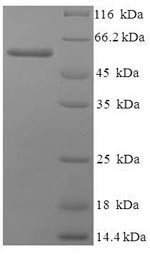
Organism: Homo sapiens (Human). Source: E.coli. Expression Region: 1-370aa. Protein Length: Partial. Tag Info: N-terminal 6xHis-SUMO-tagged. Target Protein Sequence: MNPSAPSYPM ASLYVGDLHP DVTEAMLYEK FSPAGPILSI RVCRDMITRR SLGYAYVNFQ QPADAERALD TMNFDVIKGK PVRIMWSQRD PSLRKSGVGN IFIKNLDKSI DNKALYDTFS AFGNILSCKV VCDENGSKGY GFVHFETQEA AERAIEKMNG MLLNDRKVFV GRFKSRKERE AELGARAKEF TNVYIKNFGE DMDDERLKDL FGKFGPALSV KVMTDESGKS KGFGFVSFER HEDAQKAVDE MNGKELNGKQ IYVGRAQKKV ERQTELKRKF EQMKQDRITR YQGVNLYVKN LDDGIDDERL RKEFSPFGTI TSAKVMMEGG RSKGFGFVCF SSPEEATKAV TEMNGRIVAT KPLYVALAQR. Purity: Greater than 90% as determined by SDS-PAGE. Endotoxin: Not test. Biological Activity: n/a. Form: Liquid or Lyophilized powder. Buffer: If the delivery form is liquid, the default storage buffer is Tris/PBS-based buffer, 5%-50% glycerol. If the delivery form is lyophilized powder, the buffer before lyophilization is Tris/PBS-based buffer, 6% Trehalose, pH 8.0. Reconstitution: We recommend that this vial be briefly centrifuged prior to opening to bring the contents to the bottom. Please reconstitute protein in deionized sterile water to a concentration of 0.1-1.0 mg/mL.We recommend to add 5-50% of glycerol (final concentration) and aliquot for long-term storage at -20 °C/-80 °C. Our default final concentration of glycerol is 50%. Customers could use it as reference. Storage: The shelf life is related to many factors, storage state, buffer ingredients, storage temperature and the stability of the protein itself. Generally, the shelf life of liquid form is 6 months at -20 °C/-80 °C. The shelf life of lyophilized form is 12 months at -20 °C/-80 °C. Notes: Repeated freezing and thawing is not recommended. Store working aliquots at 4 °C for up to one week. Relevance: Binds the poly(A) tail of mRNA, including that of its own transcript. May be involved in Cytoplasmic domain regulatory processes of mRNA metabolism such as pre-mRNA splicing. Its function in translational initiation regulation can either be enhanced by PAIP1 or repressed by PAIP2. Can probably bind to Cytoplasmic domain RNA sequences other than poly(A) in vivo. Involved in translationally coupled mRNA turnover. Implicated with other RNA-binding proteins in the Cytoplasmic domain deadenylation/translational and decay interplay of the FOS mRNA mediated by the major coding-region determinant of instability (mCRD) domain. Involved in regulation of nonsense-mediated decay (NMD) of mRNAs containing prature stop codons, for the recognition of prature termination codons (PTC) and initiation of NMD a competitive interaction between UPF1 and PABPC1 with the ribosome-bound release factors is proposed. Reference: Human senataxin resolves RNA/DNA hybrids formed at transcriptional pause sites to promote Xrn2-dependent termination.Skourti-Stathaki K., Proudfoot N.J., Gromak N.Mol. Cell 42:794-805(2011). Function: Binds the poly(A) tail of mRNA, including that of its own transcript. May be involved in cytoplasmic regulatory processes of mRNA metabolism such as pre-mRNA splicing. Its function in translational initiation regulation can either be enhanced by PAIP1 or repressed by PAIP2. Can probably bind to cytoplasmic RNA sequences other than poly(A) in vivo. Involved in translationally coupled mRNA turnover. Implicated with other RNA-binding proteins in the cytoplasmic deadenylation/translational and decay interplay of the FOS mRNA mediated by the major coding-region determinant of instability (mCRD) domain. Involved in regulation of nonsense-mediated decay (NMD) of mRNAs containing premature stop codons, for the recognition of premature termination codons (PTC) and initiation of NMD a competitive interaction between UPF1 and PABPC1 with the ribosome-bound release factors is proposed. By binding to long poly(A) tails, may protect them from uridylation by ZCCHC6/ZCCHC11 and hence contribute to mRNA stability
| Keywords: | PAB1, PABPC1, PABP-1, Poly(A)-binding protein 1, Polyadenylate-binding protein 1, Recombinant Human Polyadenylate-binding protein 1 (PABPC1), partial |
| Supplier: | Cusabio |
| Supplier-Nr: | EP017352HU |
Properties
| Application: | Activity not tested |
| Conjugate: | No |
| Host: | E.coli |
| Species reactivity: | human |
| MW: | 57.8 kD |
| Purity: | >90% (SDS-PAGE) |
Database Information
| KEGG ID : | K13126 | Matching products |
| UniProt ID : | P11940 | Matching products |
| Gene ID : | GeneID 26986 | Matching products |
Handling & Safety
| Storage: | -20°C |
| Shipping: | +4°C (International: +4°C) |
Caution
Our products are for laboratory research use only: Not for administration to humans!
Our products are for laboratory research use only: Not for administration to humans!
You will get a certificate here
Viewed