
Cookie preferences
This website uses cookies, which are necessary for the technical operation of the website and are always set. Other cookies, which increase the comfort when using this website, are used for direct advertising or to facilitate interaction with other websites and social networks, are only set with your consent.
Configuration
Technically required
These cookies are necessary for the basic functions of the shop.
"Allow all cookies" cookie
"Decline all cookies" cookie
CSRF token
Cookie preferences
Currency change
Customer-specific caching
FACT-Finder tracking
Individual prices
Selected shop
Session
Comfort functions
These cookies are used to make the shopping experience even more appealing, for example for the recognition of the visitor.
Note
Show the facebook fanpage in the right blod sidebar
Statistics & Tracking
Affiliate program
Conversion and usertracking via Google Tag Manager
Track device being used

If you have any questions, please use our Contact Form.
You can also order by e-mail: info@biomol.com
Larger quantity required? Request bulk
You can also order by e-mail: info@biomol.com
Larger quantity required? Request bulk
Organism: Escherichia coli (strain K12). Source: E.coli. Expression Region: 212-553aa. Protein... more
Product information "Methyl-accepting chemotaxis protein II (tar), partial, Escherichia coli, recombinant"
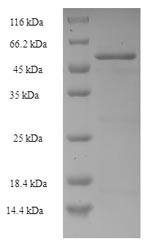
Organism: Escherichia coli (strain K12). Source: E.coli. Expression Region: 212-553aa. Protein Length: Cytoplasmic Domain. Tag Info: N-terminal 6xHis-SUMO-tagged. Target Protein Sequence: IRRMLLTPLA KIIAHIREIA GGNLANTLTI DGRSEMGDLA QSVSHMQRSL TDTVTHVREG SDAIYAGTRE IAAGNTDLSS RTEQQASALE ETAASMEQLT ATVKQNADNA RQASQLAQSA SDTAQHGGKV VDGVVKTMHE IADSSKKIAD IISVIDGIAF QTNILALNAA VEAARAGEQG RGFAVVAGEV RNLASRSAQA AKEIKALIED SVSRVDTGSV LVESAGETMN NIVNAVTRVT DIMGEIASAS DEQSRGIDQV ALAVSEMDRV TQQNASLVQE SAAAAAALEE QASRLTQAVS AFRLAASPLT NKPQTPSRPA SEQPPAQPRL RIAEQDPNWE TF. Purity: Greater than 90% as determined by SDS-PAGE. Endotoxin: Not test. Biological Activity: n/a. Form: Liquid or Lyophilized powder. Buffer: If the delivery form is liquid, the default storage buffer is Tris/PBS-based buffer, 5%-50% glycerol. If the delivery form is lyophilized powder, the buffer before lyophilization is Tris/PBS-based buffer, 6% Trehalose, pH 8.0. Reconstitution: We recommend that this vial be briefly centrifuged prior to opening to bring the contents to the bottom. Please reconstitute protein in deionized sterile water to a concentration of 0.1-1.0 mg/mL.We recommend to add 5-50% of glycerol (final concentration) and aliquot for long-term storage at -20 °C/-80 °C. Our default final concentration of glycerol is 50%. Customers could use it as reference. Storage: The shelf life is related to many factors, storage state, buffer ingredients, storage temperature and the stability of the protein itself. Generally, the shelf life of liquid form is 6 months at -20 °C/-80 °C. The shelf life of lyophilized form is 12 months at -20 °C/-80 °C. Notes: Repeated freezing and thawing is not recommended. Store working aliquots at 4 °C for up to one week. Relevance: Receptor for the attractant L-aspartate and related amino and dicarboxylic acids. Tar also mediates taxis to the attractant maltose via an interaction with the periplasmic maltose binding protein. Tar mediates taxis away from the repellents cobalt and nickel.Chotactic-signal transducers respond to changes in the concentration of attractants and repellents in the environment, transduce a signal from the outside to the inside of the cell, and facilitate sensory adaptation through the variation of the level of methylation. Attractants increase the level of methylation while repellents decrease the level of methylation, the methyl groups are added by the methyltransferase CheR and roved by the methylesterase CheB. Reference: Apo structure of the ligand-binding domain of aspartate receptor from Escherichia coli and its comparison with ligand-bound or pseudoligand-bound structures.Chi Y.-I., Yokota H., Kim S.-H.FEBS Lett. 414:327-332(1997). Function: Receptor for the attractant L-aspartate and related amino and dicarboxylic acids. Tar also mediates taxis to the attractant maltose via an interaction with the periplasmic maltose binding protein. Tar mediates taxis away from the repellents cobalt and nickel., FUNCTION
| Keywords: | tar, cheM, b1886, MCP-II, Aspartate chemoreceptor protein, Methyl-accepting chemotaxis protein II, Recombinant Escherichia coli Methyl-accepting chemotaxis protein II (tar), partial |
| Supplier: | Cusabio |
| Supplier-Nr: | EP356999ENV |
Properties
| Application: | Activity not tested |
| Conjugate: | No |
| Host: | E.coli |
| Species reactivity: | E.coli |
| MW: | 52 kD |
| Purity: | >90% (SDS-PAGE) |
Database Information
| KEGG ID : | K05875 | Matching products |
| UniProt ID : | P07017 | Matching products |
| Gene ID : | GeneID 946399 | Matching products |
Handling & Safety
| Storage: | -20°C |
| Shipping: | +4°C (International: +4°C) |
Caution
Our products are for laboratory research use only: Not for administration to humans!
Our products are for laboratory research use only: Not for administration to humans!
You will get a certificate here
Viewed