
Cookie preferences
This website uses cookies, which are necessary for the technical operation of the website and are always set. Other cookies, which increase the comfort when using this website, are used for direct advertising or to facilitate interaction with other websites and social networks, are only set with your consent.
Configuration
Technically required
These cookies are necessary for the basic functions of the shop.
"Allow all cookies" cookie
"Decline all cookies" cookie
CSRF token
Cookie preferences
Currency change
Customer-specific caching
FACT-Finder tracking
Individual prices
Selected shop
Session
Comfort functions
These cookies are used to make the shopping experience even more appealing, for example for the recognition of the visitor.
Note
Show the facebook fanpage in the right blod sidebar
Statistics & Tracking
Affiliate program
Conversion and usertracking via Google Tag Manager
Track device being used

If you have any questions, please use our Contact Form.
You can also order by e-mail: info@biomol.com
Larger quantity required? Request bulk
You can also order by e-mail: info@biomol.com
Larger quantity required? Request bulk
Organism: Murine polyomavirus (strain Kilham) (MPyV) (Murine pneumotropic virus). Source: E.coli.... more
Product information "Major capsid protein VP1, Murine polyomavirus, recombinant"
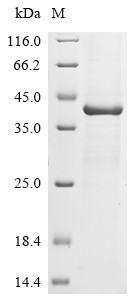
Organism: Murine polyomavirus (strain Kilham) (MPyV) (Murine pneumotropic virus). Source: E.coli. Expression Region: 2-373aa. Protein Length: Full Length of Mature Protein. Tag Info: C-terminal 6xHis-tagged. Target Protein Sequence: APTVKKRTSQ NQGLSPQKSQ NSVVVGGIQV LDVRTGPDSI TQIEAFLNPR MGKPVDSDFY GFSDNITVSA DYTQDMPRIK ELPCYSMAKI SLPMLNEDMT CDTILMWEAI SCKTEVVGVS SLTNCHSAVK RLYDNEGAGF PVQGLNFHFF SVGGEALDLQ WLWKNYRCNY PAGVAALQAA PKAAQVLDPK LKAKLTADGK FPIEAWSPDP AKNENTRYFG TYTGGLQTPP VLQITNTTTT ILLNENGVGP LCKGDGLYLA SADIVGFRTQ QNNKMHLRGL PRYFSIHLRK GCANPYPVSS LLNTFSSEMM PLNSWMLQVE EVRIYDGVER LPGDPDMIRY RIIWPGRLLS LIFPAMRHKH LYFFVMQAFI VL. Purity: Greater than 85% as determined by SDS-PAGE. Endotoxin: Not test. Biological Activity: n/a. Form: Liquid or Lyophilized powder. Buffer: If the delivery form is liquid, the default storage buffer is Tris/PBS-based buffer, 5%-50% glycerol. If the delivery form is lyophilized powder, the buffer before lyophilization is Tris/PBS-based buffer, 6% Trehalose, pH 8.0. Reconstitution: We recommend that this vial be briefly centrifuged prior to opening to bring the contents to the bottom. Please reconstitute protein in deionized sterile water to a concentration of 0.1-1.0 mg/mL.We recommend to add 5-50% of glycerol (final concentration) and aliquot for long-term storage at -20 °C/-80 °C. Our default final concentration of glycerol is 50%. Customers could use it as reference. Storage: The shelf life is related to many factors, storage state, buffer ingredients, storage temperature and the stability of the protein itself. Generally, the shelf life of liquid form is 6 months at -20 °C/-80 °C. The shelf life of lyophilized form is 12 months at -20 °C/-80 °C. Notes: Repeated freezing and thawing is not recommended. Store working aliquots at 4 °C for up to one week. Relevance: Forms an icosahedral capsid with a T=7 symmetry and a 40 nm diameter. The capsid is composed of 72 pentamers linked to each other by disulfide bonds and associated with VP2 or VP3 proteins. Interacts with terminal alpha(2,3)-linked sialic acids on the cell surface to provide virion attachment to target cell. This attachment induces virion internalization predominantly through caveolin-mediated endocytosis. Once attached, the virion is internalized by caveolin-mediated endocytosis and traffics to the endoplasmic reticulum. Inside the endoplasmic reticulum, the protein folding machinery isomerizes VP1 interpentamer disulfide bonds, thereby triggering initial uncoating. Next, the virion uses the endoplasmic reticulum-associated degradation machinery to probably translocate in the cytosol before reaching the nucleus. Nuclear entry of the viral DNA involves the selective exposure and importin recognition of VP2/Vp3 nuclear localization signal. In late phase of infection, neo-synthesized VP1 encapsulates replicated genomic DNA in the nucleus, and participates in rearranging nucleosomes around the viral DNA. Reference: "The Polyomaviridae: Contributions of virus structure to our understanding of virus receptors and infectious entry." Neu U., Stehle T., Atwood W.J. Virology 384:389-399(2009). Function: nan
| Keywords: | Major capsid protein VP1, Major structural protein VP1, Recombinant Murine polyomavirus Major capsid protein VP1 |
| Supplier: | Cusabio |
| Supplier-Nr: | EP326154MKKc7 |
Properties
| Application: | Activity not tested |
| Conjugate: | No |
| Host: | E.coli |
| Species reactivity: | Murine polyomavirus |
| MW: | 42.4 kD |
| Purity: | >85% (SDS-PAGE) |
Database Information
| UniProt ID : | P24595 | Matching products |
| Gene ID : | GeneID 29031028 | Matching products |
Handling & Safety
| Storage: | -20°C |
| Shipping: | +4°C (International: +4°C) |
Caution
Our products are for laboratory research use only: Not for administration to humans!
Our products are for laboratory research use only: Not for administration to humans!
You will get a certificate here
Viewed