
Cookie preferences
This website uses cookies, which are necessary for the technical operation of the website and are always set. Other cookies, which increase the comfort when using this website, are used for direct advertising or to facilitate interaction with other websites and social networks, are only set with your consent.
Configuration
Technically required
These cookies are necessary for the basic functions of the shop.
"Allow all cookies" cookie
"Decline all cookies" cookie
CSRF token
Cookie preferences
Currency change
Customer-specific caching
FACT-Finder tracking
Individual prices
Selected shop
Session
Comfort functions
These cookies are used to make the shopping experience even more appealing, for example for the recognition of the visitor.
Note
Show the facebook fanpage in the right blod sidebar
Statistics & Tracking
Affiliate program
Conversion and usertracking via Google Tag Manager
Track device being used

| Item number | Size | Datasheet | Manual | SDS | Delivery time | Quantity | Price |
|---|---|---|---|---|---|---|---|
| NZY-AE00031 | 4 mg | - | - |
10 - 14 business days* |
167.00€
|
If you have any questions, please use our Contact Form.
You can also order by e-mail: info@biomol.com
Larger quantity required? Request bulk
You can also order by e-mail: info@biomol.com
Larger quantity required? Request bulk
Lactaldehyde dehydrogenase (E.C. 1.2.1.22) from E. coli (aldA gene product, P25553) is a... more
Product information "Lactaldehyde dehydrogenase (EC 1.2.1.22), Escherichia coli"
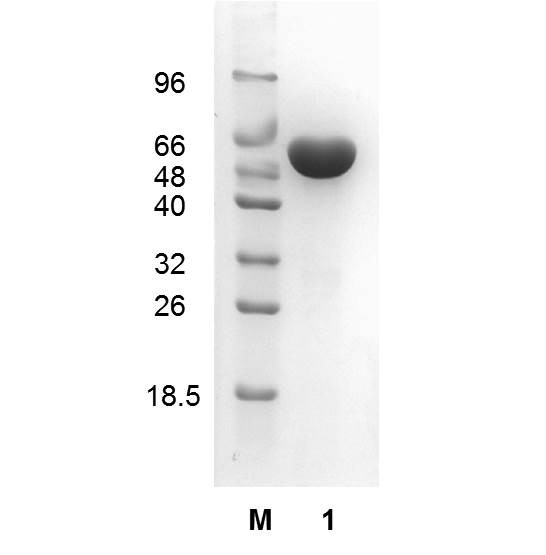
Lactaldehyde dehydrogenase (E.C. 1.2.1.22) from E. coli (aldA gene product, P25553) is a homotetrameric protein, localized in the cytoplasm, which unliganded 3D structure bas been deposited in the RCSB Protein Data Bank with accession code 2hg2 (Constanzo et al., 2007). Each monomer is composed of a catalytic domain, a cofactor NAD+ binding domain and an oligomerization domain. This enzyme, with systematic name L-lactaldehyde:NAD+ oxidoreductase, belongs to the superfamily of NAD+- or NADP+- dependent enzymes that catalyze the oxidation of aldehydes to the corresponding carboxylic acids. These enzymes are widespread in all living systems, from archea to eukaryotes, where they metabolize endogenous and exogenous aldehydes. This lactaldehyde dehydrogenase from E. coli is an NAD+-dependent enzyme implicated in the metabolism of L-fucose and L-rhamnose (Baldoma and Aguillar, 1987). L-lactaldehyde is generated as an intermediate in the metabolism of L-fucose and L-rhamnose in bacteria that utilize these carbohydrates as a carbon source. However, the enzyme may function in multiple metabolic pathways due to its ability to catalyse the oxidation of several aldehydes, with a Km in the micromolar range for alpha-hydroxyaldehydes (lactaldehyde, glyceraldehydes or glycoaldehyde), and a higher Km, in the millimolar range, for the alpha- ketoaldehyde methylglyoxal. The enzyme is provided in 3.2 M ammonium sulphate. Temperature and pH optimum/stability: The optimum pH and temperature are 9.5 and 25 °C, respectively. Shipping Conditions: Room Temperature. Storage Conditions: 2 °C to 8 °C. Features: >95% pure (SDS-PAGE). aldA, b1415, Aldehyde dehydrogenase A, Lactaldehyde dehydrogenase, Glycolaldehyde dehydrogenase
| Keywords: | aldA, b1415, Aldehyde dehydrogenase A, Lactaldehyde dehydrogenase, Glycolaldehyde dehydrogenase |
| Supplier: | NZYtech |
| Supplier-Nr: | AE00031 |
Properties
| Application: | Enzyme assays |
| Conjugate: | No |
Database Information
| KEGG ID : | K07248 | Matching products |
| UniProt ID : | P25553 | Matching products |
| Gene ID : | GeneID 945672 | Matching products |
Handling & Safety
| Storage: | +4°C |
| Shipping: | +20°C (International: °C) |
| Signal Word: | Danger |
| H Phrases: | H315, H360D, H319 |
| P Phrases: | P201, P264, P280, P302+P352, P305+P351+P338, P308+P313, P337+P313, P501 |
Caution
Our products are for laboratory research use only: Not for administration to humans!
Our products are for laboratory research use only: Not for administration to humans!
You will get a certificate here
Viewed