
Cookie preferences
This website uses cookies, which are necessary for the technical operation of the website and are always set. Other cookies, which increase the comfort when using this website, are used for direct advertising or to facilitate interaction with other websites and social networks, are only set with your consent.
Configuration
Technically required
These cookies are necessary for the basic functions of the shop.
"Allow all cookies" cookie
"Decline all cookies" cookie
CSRF token
Cookie preferences
Currency change
Customer-specific caching
FACT-Finder tracking
Individual prices
Selected shop
Session
Comfort functions
These cookies are used to make the shopping experience even more appealing, for example for the recognition of the visitor.
Note
Show the facebook fanpage in the right blod sidebar
Statistics & Tracking
Affiliate program
Conversion and usertracking via Google Tag Manager
Track device being used

If you have any questions, please use our Contact Form.
You can also order by e-mail: info@biomol.com
Larger quantity required? Request bulk
You can also order by e-mail: info@biomol.com
Larger quantity required? Request bulk
Organism: Homo sapiens (Human). Source: E.coli. Expression Region: 1-577aa. Protein Length: Full... more
Product information "Insulin-like growth factor 2 mRNA-binding protein 1 (IGF2BP1), human, recombinant"
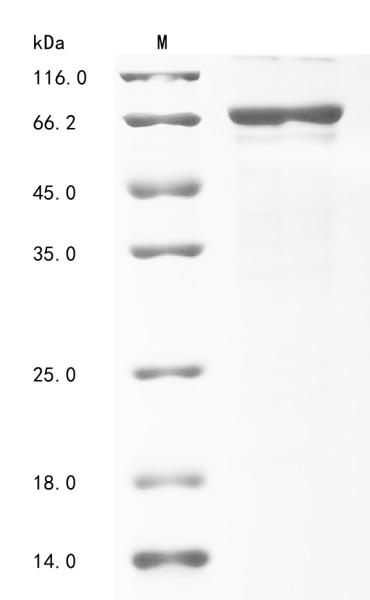
Organism: Homo sapiens (Human). Source: E.coli. Expression Region: 1-577aa. Protein Length: Full Length. Tag Info: N-terminal 10xHis-tagged and C-terminal Myc-tagged. Target Protein Sequence: MNKLYIGNLN ESVTPADLEK VFAEHKISYS GQFLVKSGYA FVDCPDEHWA MKAIETFSGK VELQGKRLEI EHSVPKKQRS RKIQIRNIPP QLRWEVLDSL LAQYGTVENC EQVNTESETA VVNVTYSNRE QTRQAIMKLN GHQLENHALK VSYIPDEQIA QGPENGRRGG FGSRGQPRQG SPVAAGAPAK QQQVDIPLRL LVPTQYVGAI IGKEGATIRN ITKQTQSKID VHRKENAGAA EKAISVHSTP EGCSSACKMI LEIMHKEAKD TKTADEVPLK ILAHNNFVGR LIGKEGRNLK KVEQDTETKI TISSLQDLTL YNPERTITVK GAIENCCRAE QEIMKKVREA YENDVAAMSL QSHLIPGLNL AAVGLFPASS SAVPPPPSSV TGAAPYSSFM QAPEQEMVQV FIPAQAVGAI IGKKGQHIKQ LSRFASASIK IAPPETPDSK VRMVIITGPP EAQFKAQGRI YGKLKEENFF GPKEEVKLET HIRVPASAAG RVIGKGGKTV NELQNLTAAE VVVPRDQTPD ENDQVIVKII GHFYASQMAQ RKIRDILAQV KQQHQKGQSN QAQARRK. Purity: Greater than 85% as determined by SDS-PAGE. Endotoxin: Not test. Biological Activity: n/a. Form: Liquid or Lyophilized powder. Buffer: If the delivery form is liquid, the default storage buffer is Tris/PBS-based buffer, 5%-50% glycerol. If the delivery form is lyophilized powder, the buffer before lyophilization is Tris/PBS-based buffer, 6% Trehalose, pH 8.0. Reconstitution: We recommend that this vial be briefly centrifuged prior to opening to bring the contents to the bottom. Please reconstitute protein in deionized sterile water to a concentration of 0.1-1.0 mg/mL.We recommend to add 5-50% of glycerol (final concentration) and aliquot for long-term storage at -20 °C/-80 °C. Our default final concentration of glycerol is 50%. Customers could use it as reference. Storage: The shelf life is related to many factors, storage state, buffer ingredients, storage temperature and the stability of the protein itself. Generally, the shelf life of liquid form is 6 months at -20 °C/-80 °C. The shelf life of lyophilized form is 12 months at -20 °C/-80 °C. Notes: Repeated freezing and thawing is not recommended. Store working aliquots at 4 °C for up to one week. Relevance: RNA-binding factor that recruits target transcripts to cytoplasmic protein-RNA complexes (mRNPs). This transcript 'caging' into mRNPs allows mRNA transport and transient storage. It also modulates the rate and location at which target transcripts encounter the translational apparatus and shields them from endonuclease attacks or microRNA-mediated degradation. Preferentially binds to N6-methyladenosine (m6A)-containing mRNAs and increases their stability. Plays a direct role in the transport and translation of transcripts required for axonal regeneration in adult sensory neurons. Regulates localized beta-actin/ACTB mRNA translation, a crucial process for cell polarity, cell migration and neurite outgrowth. Co-transcriptionally associates with the ACTB mRNA in the nucleus. This binding involves a conserved 54-nucleotide element in the ACTB mRNA 3'-UTR, known as the 'zipcode'. The RNP thus formed is exported to the cytoplasm, binds to a motor protein and is transported along the cytoskeleton to the cell periphery. During transport, prevents ACTB mRNA from being translated into protein. When the RNP complex reaches its destination near the plasma membrane, IGF2BP1 is phosphorylated. This releases the mRNA, allowing ribosomal 40S and 60S subunits to assemble and initiate ACTB protein synthesis. Monomeric ACTB then assembles into the subcortical actin cytoskeleton. During neuronal development, key regulator of neurite outgrowth, growth cone guidance and neuronal cell migration, presumably through the spatiotemporal fine tuning of protein synthesis, such as that of ACTB. May regulate mRNA transport to activated synapses. Binds to and stabilizes ABCB1/MDR-1 mRNA. During interstinal wound repair, interacts with and stabilizes PTGS2 transcript. PTGS2 mRNA stabilization may be crucial for colonic mucosal wound healing. Binds to the 3'-UTR of IGF2 mRNA by a mechanism of cooperative and sequential dimerization and regulates IGF2 mRNA subcellular localization and translation. Binds to MYC mRNA, in the coding region instability determinant (CRD) of the open reading frame (ORF), hence preventing MYC cleavage by endonucleases and possibly microRNA targeting to MYC-CRD. Binding to MYC mRNA is enhanced by m6A-modification of the CRD. Binds to the 3'-UTR of CD44 mRNA and stabilizes it, hence promotes cell adhesion and invadopodia formation in cancer cells. Binds to the oncofetal H19 transcript and to the neuron-specific TAU mRNA and regulates their localizations. Binds to and stabilizes BTRC/FBW1A mRNA. Binds to the adenine-rich autoregulatory sequence (ARS) located in PABPC1 mRNA and represses its translation. PABPC1 mRNA-binding is stimulated by PABPC1 protein. Prevents BTRC/FBW1A mRNA degradation by disrupting microRNA-dependent interaction with AGO2. Promotes the directed movement of tumor-derived cells by fine-tuning intracellular signaling networks. Binds to MAPK4 3'-UTR and inhibits its translation. Interacts with PTEN transcript open reading frame (ORF) and prevents mRNA decay. This combined action on MAPK4 (down-regulation) and PTEN (up-regulation) antagonizes HSPB1 phosphorylation, consequently it prevents G-actin sequestration by phosphorylated HSPB1, allowing F-actin polymerization. Hence enhances the velocity of cell migration and stimulates directed cell migration by PTEN-modulated polarization. Interacts with Hepatitis C virus (HCV) 5'-UTR and 3'-UTR and specifically enhances translation at the HCV IRES, but not 5'-cap-dependent translation, possibly by recruiting eIF3. Interacts with HIV-1 GAG protein and blocks the formation of infectious HIV-1 particles. Reduces HIV-1 assembly by inhibiting viral RNA packaging, as well as assembly and processing of GAG protein on cellular membranes. During cellular stress, such as oxidative stress or heat shock, stabilizes target mRNAs that are recruited to stress granules, including CD44, IGF2, MAPK4, MYC, PTEN, RAPGEF2 and RPS6KA5 transcripts. Reference: "ZBP1 recognition of beta-actin zipcode induces RNA looping." Chao J.A., Patskovsky Y., Patel V., Levy M., Almo S.C., Singer R.H. Genes Dev. 24:148-158(2010). Function: nan
| Keywords: | IMP1, ZBP-1, CRDBP, IMP-1, CRD-BP, IGF2BP1, VICKZ family member 1, Zipcode-binding protein 1, IGF2 mRNA-binding protein 1, IGF-II mRNA-binding protein 1, Coding region determinant-binding protein, Insulin-like growth factor 2 mRNA-binding protein 1, Recom |
| Supplier: | Cusabio |
| Supplier-Nr: | EP878937HUb1 |
Properties
| Application: | Activity not tested |
| Conjugate: | No |
| Host: | E.coli |
| Species reactivity: | human |
| MW: | 69.5 kD |
| Purity: | >85% (SDS-PAGE) |
Database Information
| KEGG ID : | K17391 | Matching products |
| UniProt ID : | Q9NZI8 | Matching products |
| Gene ID : | GeneID 10642 | Matching products |
Handling & Safety
| Storage: | -20°C |
| Shipping: | +4°C (International: +4°C) |
Caution
Our products are for laboratory research use only: Not for administration to humans!
Our products are for laboratory research use only: Not for administration to humans!
You will get a certificate here
Viewed