
Cookie preferences
This website uses cookies, which are necessary for the technical operation of the website and are always set. Other cookies, which increase the comfort when using this website, are used for direct advertising or to facilitate interaction with other websites and social networks, are only set with your consent.
Configuration
Technically required
These cookies are necessary for the basic functions of the shop.
"Allow all cookies" cookie
"Decline all cookies" cookie
CSRF token
Cookie preferences
Currency change
Customer-specific caching
FACT-Finder tracking
Individual prices
Selected shop
Session
Comfort functions
These cookies are used to make the shopping experience even more appealing, for example for the recognition of the visitor.
Note
Show the facebook fanpage in the right blod sidebar
Statistics & Tracking
Affiliate program
Conversion and usertracking via Google Tag Manager
Track device being used

| Item number | Size | Datasheet | Manual | SDS | Delivery time | Quantity | Price |
|---|---|---|---|---|---|---|---|
| CSB-CF872802VAQ.20 | 20 µg | - |
10 - 14 business days* |
1,458.00€
|
|||
| CSB-CF872802VAQ.100 | 100 µg | - |
10 - 14 business days* |
2,416.00€
|
If you have any questions, please use our Contact Form.
You can also order by e-mail: info@biomol.com
Larger quantity required? Request bulk
You can also order by e-mail: info@biomol.com
Larger quantity required? Request bulk
Organism: Varicella-zoster virus (strain Oka vaccine) (HHV-3) (Human herpesvirus 3). Source: in... more
Product information "Envelope glycoprotein E (gE), Varicella-zoster virus, recombinant"
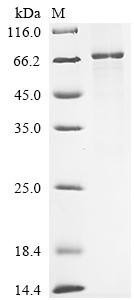
Organism: Varicella-zoster virus (strain Oka vaccine) (HHV-3) (Human herpesvirus 3). Source: in vitro E.coli expression system. Expression Region: 31-623aa. Protein Length: Full Length. Tag Info: N-terminal 10xHis-tagged. Target Protein Sequence: SVLRYDDFHI DEDKLDTNSV YEPYYHSDHA ESSWVNRGES SRKAYDHNSP YIWPRNDYDG FLENAHEHHG VYNQGRGIDS GERLMQPTQM SAQEDLGDDT GIHVIPTLNG DDRHKIVNVD QRQYGDVFKG DLNPKPQGQR LIEVSVEENH PFTLRAPIQR IYGVRYTETW SFLPSLTCTG DAAPAIQHIC LKHTTCFQDV VVDVDCAENT KEDQLAEISY RFQGKKEADQ PWIVVNTSTL FDELELDPPE IEPGVLKVLR TEKQYLGVYI WNMRGSDGTS TYATFLVTWK GDEKTRNPTP AVTPQPRGAE FHMWNYHSHV FSVGDTFSLA MHLQYKIHEA PFDLLLEWLY VPIDPTCQPM RLYSTCLYHP NAPQCLSHMN SGCTFTSPHL AQRVASTVYQ NCEHADNYTA YCLGISHMEP SFGLILHDGG TTLKFVDTPE SLSGLYVFVV YFNGHVEAVA YTVVSTVDHF VNAIEERGFP PTAGQPPATT KPKEITPVNP GTSPLLRYAA WTGGLAAVVL LCLVIFLICT AKRMRVKAYR VDKSPYNQSM YYAGLPVDDF EDSESTDTEE EFGNAIGGSH GGSSYTVYID KTR. Purity: Greater than 85% as determined by SDS-PAGE. Endotoxin: Not test. Biological Activity: n/a. Form: Liquid or Lyophilized powder. Buffer: If the delivery form is liquid, the default storage buffer is Tris/PBS-based buffer, 5%-50% glycerol. If the delivery form is lyophilized powder, the buffer before lyophilization is Tris/PBS-based buffer, 6% Trehalose, pH 8.0. Reconstitution: We recommend that this vial be briefly centrifuged prior to opening to bring the contents to the bottom. Please reconstitute protein in deionized sterile water to a concentration of 0.1-1.0 mg/mL.We recommend to add 5-50% of glycerol (final concentration) and aliquot for long-term storage at -20 °C/-80 °C. Our default final concentration of glycerol is 50%. Customers could use it as reference. Storage: The shelf life is related to many factors, storage state, buffer ingredients, storage temperature and the stability of the protein itself. Generally, the shelf life of liquid form is 6 months at -20 °C/-80 °C. The shelf life of lyophilized form is 12 months at -20 °C/-80 °C. Notes: Repeated freezing and thawing is not recommended. Store working aliquots at 4 °C for up to one week. Relevance: Envelope glycoprotein that binds to the potential host cell entry receptor IDE., In epithelial cells, the heterodimer gE/gI is required for the cell-to-cell spread of the virus, by sorting nascent virions to cell junctions. Once the virus reaches the cell junctions, virus particles can spread to adjacent cells extremely rapidly through interactions with cellular receptors that accumulate at these junctions. Implicated in basolateral spread in polarized cells. In neuronal cells, gE/gI is essential for the anterograde spread of the infection throughout the host nervous system. Together with US9, the heterodimer gE/gI is involved in the sorting and transport of viral structural components toward axon tips. , The heterodimer gE/gI serves as a receptor for the Fc part of host IgG. Dissociation of gE/gI from IgG occurs at acidic pH. May thus be involved in anti-VZV antibodies bipolar bridging, followed by intracellular endocytosis and degradation, thereby interfering with host IgG-mediated immune responses. Reference: "Deletion of the first cysteine-rich region of the varicella-zoster virus glycoprotein E ectodomain abolishes the gE and gI interaction and differentially affects cell-cell spread and viral entry." Berarducci B., Rajamani J., Reichelt M., Sommer M.H., Zerboni L., Arvin A.M. J. Virol. 83:228-240(2009). Function: nan
| Keywords: | gE, ORF68, Envelope glycoprotein E, Recombinant Varicella-zoster virus Envelope glycoprotein E (gE) |
| Supplier: | Cusabio |
| Supplier-Nr: | CF872802VAQ |
Properties
| Application: | Activity not tested |
| Conjugate: | No |
| Host: | E.coli in vitro |
| Species reactivity: | Varicella-zoster virus |
| MW: | 68.4 kD |
| Purity: | >85% (SDS-PAGE) |
Database Information
| UniProt ID : | Q9J3M8 | Matching products |
Handling & Safety
| Storage: | -20°C |
| Shipping: | +4°C (International: +4°C) |
Caution
Our products are for laboratory research use only: Not for administration to humans!
Our products are for laboratory research use only: Not for administration to humans!
You will get a certificate here
Viewed