
Cookie preferences
This website uses cookies, which are necessary for the technical operation of the website and are always set. Other cookies, which increase the comfort when using this website, are used for direct advertising or to facilitate interaction with other websites and social networks, are only set with your consent.
Configuration
Technically required
These cookies are necessary for the basic functions of the shop.
"Allow all cookies" cookie
"Decline all cookies" cookie
CSRF token
Cookie preferences
Currency change
Customer-specific caching
FACT-Finder tracking
Individual prices
Selected shop
Session
Comfort functions
These cookies are used to make the shopping experience even more appealing, for example for the recognition of the visitor.
Note
Show the facebook fanpage in the right blod sidebar
Statistics & Tracking
Affiliate program
Conversion and usertracking via Google Tag Manager
Track device being used

If you have any questions, please use our Contact Form.
You can also order by e-mail: info@biomol.com
Larger quantity required? Request bulk
You can also order by e-mail: info@biomol.com
Larger quantity required? Request bulk
Organism: Mus musculus (Mouse). Source: E.coli. Expression Region: 1-488aa. Protein Length: Full... more
Product information "Cis-aconitate decarboxylase (Acod1), mouse, recombinant"
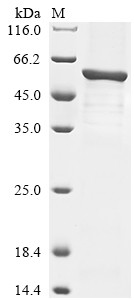
Organism: Mus musculus (Mouse). Source: E.coli. Expression Region: 1-488aa. Protein Length: Full Length. Tag Info: N-terminal 10xHis-tagged and C-terminal Myc-tagged. Target Protein Sequence: MMLKSVTESF AGMIHGLKVN HLTDGIIRRS KRMILDSLGV GFLGTGTEVF HKVTQYSKIY SSNTSSTVWG RPDFRLPPTY AAFVNGVAVH SMDFDDTWHP ATHPSGAVLP VLTALSEALP QIPKFSGLDL LLAFNVGIEV QGRLMHFSKE AKDIPKRFHP PSVVGTLGSA AAASKFLGLS LTKCREALAI AVSHAGAPIA NAATQTKPLH IGNAAKHGME ATFLAMLGLQ GNKQILDLGS GFGAFYANYS PEDLPSLDSH IWLLDQQDVA FKSFPAHLAT HWVADAAAAV RKHLVTPERA LFPADHIERI VLRIPDVQYV NRPFPDSEHE ARHSFQYVAC ASLLDGSITV PSFHSQQVNR PQVRELLKKV KLEHPPDNPP SFDTLYCEIS ITLKDGTTFT ERSDTFYGHW RKPLSQEDLR NKFRANASKM LCRDTVESLI TVVEKLEDLE DCSVLTRLLK GPSVQDEASK LSSMSSFDHT TLPRFTNI. Purity: Greater than 90% as determined by SDS-PAGE. Endotoxin: Not test. Biological Activity: n/a. Form: Liquid or Lyophilized powder. Buffer: If the delivery form is liquid, the default storage buffer is Tris/PBS-based buffer, 5%-50% glycerol. If the delivery form is lyophilized powder, the buffer before lyophilization is Tris/PBS-based buffer, 6% Trehalose, pH 8.0. Reconstitution: We recommend that this vial be briefly centrifuged prior to opening to bring the contents to the bottom. Please reconstitute protein in deionized sterile water to a concentration of 0.1-1.0 mg/mL.We recommend to add 5-50% of glycerol (final concentration) and aliquot for long-term storage at -20 °C/-80 °C. Our default final concentration of glycerol is 50%. Customers could use it as reference. Storage: The shelf life is related to many factors, storage state, buffer ingredients, storage temperature and the stability of the protein itself. Generally, the shelf life of liquid form is 6 months at -20 °C/-80 °C. The shelf life of lyophilized form is 12 months at -20 °C/-80 °C. Notes: Repeated freezing and thawing is not recommended. Store working aliquots at 4 °C for up to one week. Relevance: Polymerase responsible for protein-primed viral DNA replication by strand displacement with high processivity and fidelity. To start replication, the DNA polymerase forms a heterodimer with a free primer terminal protein (TP), recognizes the replication origins at both 5' ends of the linear chromosome, and initiates replication using as primer the OH-group of Ser-232 of the TP. This polymerase possesses three enzymatic activities: DNA synthesis (polymerase), primer terminal protein (TP) deoxynucleotidylation, which is the formation of a covalent linkage (phosphoester) between the hydroxyl group of a specific serine residue in TP and 5'-dAMP, a reaction directed by the second T at the 3' end, and 3' to 5' exonuclease activity. Exonuclease activity has a proofreading purpose. DNA polymerase edits the polymerization errors using an intramolecular pathway as the primer terminus travels from one active site to the other without dissociation from the DNA. DNA polymerization catalyzed by the DNA polymerase is a highly accurate process, but the protein-primed initiation is a quite inaccurate reaction. Since the polymerase initiates the replication on the second thymine, the TP-dAMP initiation product translocates backwards to recover the template information of the first nucleotide (sliding back-mechanism). Reference: "phi29 DNA polymerase residue Ser122, a single-stranded DNA ligand for 3'-5' exonucleolysis, is required to interact with the terminal protein." de Vega M., Blanco L., Salas M. J. Biol. Chem. 273:28966-28977(1998). Function: nan
| Keywords: | CAD, Irg1, Aconitate decarboxylase, Aconitate decarboxylase 1, Cis-aconitate decarboxylase, Cis-aconitic acid decarboxylase, Immune-responsive gene 1 protein, Recombinant Mouse Cis-aconitate decarboxylase (Acod1) |
| Supplier: | Cusabio |
| Supplier-Nr: | EP011825MO |
Properties
| Application: | Activity not tested |
| Conjugate: | No |
| Host: | E.coli |
| Species reactivity: | mouse |
| MW: | 61.3 kD |
| Purity: | >90% (SDS-PAGE) |
Database Information
| KEGG ID : | K17724 | Matching products |
| UniProt ID : | P54987 | Matching products |
| Gene ID : | GeneID 16365 | Matching products |
Handling & Safety
| Storage: | -20°C |
| Shipping: | +4°C (International: +4°C) |
Caution
Our products are for laboratory research use only: Not for administration to humans!
Our products are for laboratory research use only: Not for administration to humans!
You will get a certificate here
Viewed