
Cookie preferences
This website uses cookies, which are necessary for the technical operation of the website and are always set. Other cookies, which increase the comfort when using this website, are used for direct advertising or to facilitate interaction with other websites and social networks, are only set with your consent.
Configuration
Technically required
These cookies are necessary for the basic functions of the shop.
"Allow all cookies" cookie
"Decline all cookies" cookie
CSRF token
Cookie preferences
Currency change
Customer-specific caching
FACT-Finder tracking
Individual prices
Selected shop
Session
Comfort functions
These cookies are used to make the shopping experience even more appealing, for example for the recognition of the visitor.
Note
Show the facebook fanpage in the right blod sidebar
Statistics & Tracking
Affiliate program
Conversion and usertracking via Google Tag Manager
Track device being used

| Item number | Size | Datasheet | Manual | SDS | Delivery time | Quantity | Price |
|---|---|---|---|---|---|---|---|
| Cay44180-100 | 100 µg | - |
6 - 10 business days* |
402.00€
|
If you have any questions, please use our Contact Form.
You can also order by e-mail: info@biomol.com
Larger quantity required? Request bulk
You can also order by e-mail: info@biomol.com
Larger quantity required? Request bulk
L1 cell adhesion molecule (L1CAM), also known as CD171, is a transmembrane glycoprotein and... more
Product information "CD171 Extracellular Domain (human, recombinant)"
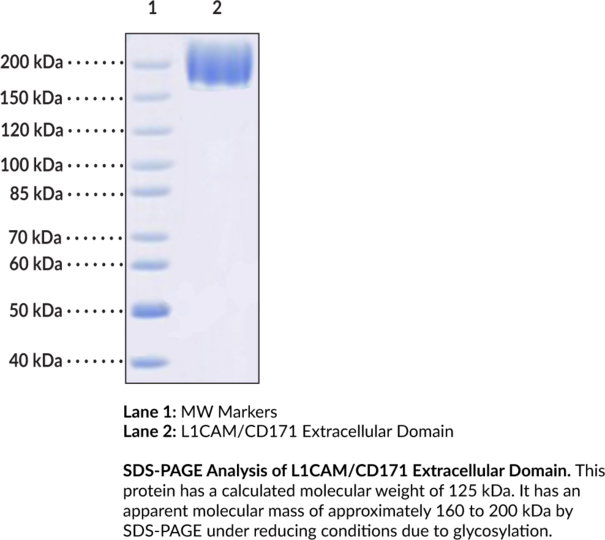
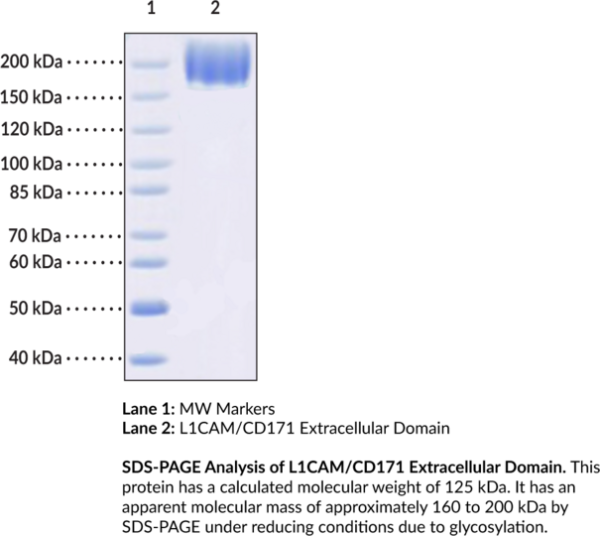
L1 cell adhesion molecule (L1CAM), also known as CD171, is a transmembrane glycoprotein and member of the L1 family of neural adhesion proteins. It is composed of six immunoglobulin (Ig) domains, five fibronectin type III-like domains, a transmembrane domain, and a short C-terminal domain. L1CAM is found in central and peripheral neurons, oligodendrocytes, immune cells, and cancer cells. It can interact with other L1CAM receptors in a cis confirmation and bind receptors, such as reelin or integrins, on other cells in a trans confirmation. L1CAM is generally involved in cell-cell binding, neural signaling, and signal transduction through C-terminal interactions with ezrin and focal adhesion kinase (FAK). The extracellular domain of L1CAM can be cleaved by serine proteases and promotes angiogenesis, invasion and metastasis, and cell survival and proliferation in tumors. The residual intracellular C-terminal fragment can be translocated to the nucleus where it promotes formation of neurite outgrowth and induces neuron migration. Truncating or missense mutations in L1CAM are found in patients with L1 syndrome, a group of neonatal conditions characterized by intellectual disability, hydrocephaly, involuntary spasms, and adducted thumbs. Cayman's L1CAM/CD171 Extracellular Domain (human, recombinant) protein consists of 1,112 amino acids, has a calculated molecular weight of 125 kDa, and a predicted N-terminus of Ile20 after signal peptide cleavage. By SDS-PAGE, under reducing conditions, the apparent molecular mass of the protein is 160-200 kDa due to glycosylation.
| Keywords: | CAML1, CD171, L1 Cell Adhesion Molecule, L1CAM, NCAML1, Neural Cell Adhesion Molecule L1 |
| Supplier: | Cayman Chemical |
| Supplier-Nr: | 44180 |
Properties
| Conjugate: | No |
| Host: | Human cells |
| Species reactivity: | human |
| Purity: | >85% (SDS-PAGE) |
| Format: | Lyophilized |
Database Information
| KEGG ID : | K06550 | Matching products |
| UniProt ID : | P32004 | Matching products |
| Gene ID : | GeneID 3897 | Matching products |
Handling & Safety
| Storage: | -80°C |
| Shipping: | -80°C (International: -80°C) |
Caution
Our products are for laboratory research use only: Not for administration to humans!
Our products are for laboratory research use only: Not for administration to humans!
Information about the product reference will follow.
more
You will get a certificate here
Viewed