
Cookie preferences
This website uses cookies, which are necessary for the technical operation of the website and are always set. Other cookies, which increase the comfort when using this website, are used for direct advertising or to facilitate interaction with other websites and social networks, are only set with your consent.
Configuration
Technically required
These cookies are necessary for the basic functions of the shop.
"Allow all cookies" cookie
"Decline all cookies" cookie
CSRF token
Cookie preferences
Currency change
Customer-specific caching
FACT-Finder tracking
Individual prices
Selected shop
Session
Comfort functions
These cookies are used to make the shopping experience even more appealing, for example for the recognition of the visitor.
Note
Show the facebook fanpage in the right blod sidebar
Statistics & Tracking
Affiliate program
Conversion and usertracking via Google Tag Manager
Track device being used

| Item number | Size | Datasheet | Manual | SDS | Delivery time | Quantity | Price |
|---|---|---|---|---|---|---|---|
| CSB-EP001936MOW.20 | 20 µg | - | - | - |
10 - 14 business days* |
219.00€
|
|
| CSB-EP001936MOW.100 | 100 µg | - | - | - |
10 - 14 business days* |
392.00€
|
|
| CSB-EP001936MOW.1 | 1 mg | - | - | - |
10 - 14 business days* |
1,628.00€
|
If you have any questions, please use our Contact Form.
You can also order by e-mail: info@biomol.com
Larger quantity required? Request bulk
You can also order by e-mail: info@biomol.com
Larger quantity required? Request bulk
Organism: Macaca mulatta (Rhesus macaque). Source: E.coli. Expression Region: 19-295aa. Protein... more
Product information "Apolipoprotein E (APOE), recombinant Macaca mulatta"
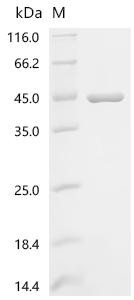
Organism: Macaca mulatta (Rhesus macaque). Source: E.coli. Expression Region: 19-295aa. Protein Length: Full Length of Mature Protein. Tag Info: C-terminal 6xHis-tagged. Target Protein Sequence: KVEQPVEPET EPELRQQAEG QSGQPWELAL GRFWDYLRWV QTLSEQVQEE LLSPQVTQEL TTLMDETMKE LKAYKSELEE QLSPVAEETR ARLSKELQAA QARLGADMED VRSRLVQYRS EVQAMLGQST EELRARLASH LRKLRKRLLR DADDLQKRLA RLGPLVEQGR VRAATVGSLA SQPLQERAQA KLRARMEEMG SRTRDRLDEV KEQVAEVRAK LEEQAQQISL QAEAFQARLK SWFEPLVEDM QRQWAGLVEK VQAAVGASTA PVPSDNH. Purity: Greater than 95% as determined by SDS-PAGE. Endotoxin: Not test. Biological Activity: Not Test. Form: Liquid or Lyophilized powder. Buffer: If the delivery form is liquid, the default storage buffer is Tris/PBS-based buffer, 5%-50% glycerol. If the delivery form is lyophilized powder, the buffer before lyophilization is Tris/PBS-based buffer, 6% Trehalose, pH 8.0. Reconstitution: We recommend that this vial be briefly centrifuged prior to opening to bring the contents to the bottom. Please reconstitute protein in deionized sterile water to a concentration of 0.1-1.0 mg/mL.We recommend to add 5-50% of glycerol (final concentration) and aliquot for long-term storage at -20°C/-80°C. Our default final concentration of glycerol is 50%. Customers could use it as reference. Storage: The shelf life is related to many factors, storage state, buffer ingredients, storage temperature and the stability of the protein itself. Generally, the shelf life of liquid form is 6 months at -20°C/-80°C. The shelf life of lyophilized form is 12 months at -20°C/-80°C. Notes: Repeated freezing and thawing is not recommended. Store working aliquots at 4°C for up to one week. Relevance: APOE is an apolipoprotein, a protein associating with lipid particles, that mainly functions in lipoprotein-mediated lipid transport between organs via the plasma and interstitial fluids. APOE is a core component of plasma lipoproteins and is involved in their production, conversion and clearance. Apolipoproteins are amphipathic molecules that interact both with lipids of the lipoprotein particle core and the aqueous environment of the plasma. As such, APOE associates with chylomicrons, chylomicron remnants, very low density lipoproteins (VLDL) and intermediate density lipoproteins (IDL) but shows a preferential binding to high-density lipoproteins (HDL). It also binds a wide range of cellular receptors including the LDL receptor/LDLR, the LDL receptor-related proteins LRP1, LRP2 and LRP8 and the very low-density lipoprotein receptor/VLDLR that mediate the cellular uptake of the APOE-containing lipoprotein particles. Finally, APOE has also a heparin-binding activity and binds heparan-sulfate proteoglycans on the surface of cells, a property that supports the capture and the receptor-mediated uptake of APOE-containing lipoproteins by cells. A main function of APOE is to mediate lipoprotein clearance through the uptake of chylomicrons, VLDLs, and HDLs by hepatocytes. APOE is also involved in the biosynthesis by the liver of VLDLs as well as their uptake by peripheral tissues ensuring the delivery of triglycerides and energy storage in muscle, heart and adipose tissues. By participating in the lipoprotein-mediated distribution of lipids among tissues, APOE plays a critical role in plasma and tissues lipid homeostasis. APOE is also involved in two steps of reverse cholesterol transport, the HDLs-mediated transport of cholesterol from peripheral tissues to the liver, and thereby plays an important role in cholesterol homeostasis. First, it is functionally associated with ABCA1 in the biogenesis of HDLs in tissues. Second, it is enriched in circulating HDLs and mediates their uptake by hepatocytes. APOE also plays an important role in lipid transport in the central nervous system, regulating neuron survival and sprouting. Reference: n/a. Function: nan
| Keywords: | APOE, Apo-E, Apolipoprotein E |
| Supplier: | Cusabio |
| Supplier-Nr: | EP001936MOW |
Properties
| Application: | Activity not tested |
| Conjugate: | No |
| Host: | E.coli |
| Species reactivity: | Rhesus macaque |
| MW: | 38.6 kD |
| Purity: | >95% (SDS-PAGE) |
Database Information
| KEGG ID : | K05768 | Matching products |
| UniProt ID : | Q28502 | Matching products |
Handling & Safety
| Storage: | -20°C |
| Shipping: | +4°C (International: +4°C) |
Caution
Our products are for laboratory research use only: Not for administration to humans!
Our products are for laboratory research use only: Not for administration to humans!
You will get a certificate here
Viewed