
Cookie preferences
This website uses cookies, which are necessary for the technical operation of the website and are always set. Other cookies, which increase the comfort when using this website, are used for direct advertising or to facilitate interaction with other websites and social networks, are only set with your consent.
Configuration
Technically required
These cookies are necessary for the basic functions of the shop.
"Allow all cookies" cookie
"Decline all cookies" cookie
CSRF token
Cookie preferences
Currency change
Customer-specific caching
FACT-Finder tracking
Individual prices
Selected shop
Session
Comfort functions
These cookies are used to make the shopping experience even more appealing, for example for the recognition of the visitor.
Note
Show the facebook fanpage in the right blod sidebar
Statistics & Tracking
Affiliate program
Conversion and usertracking via Google Tag Manager
Track device being used

If you have any questions, please use our Contact Form.
You can also order by e-mail: info@biomol.com
Larger quantity required? Request bulk
You can also order by e-mail: info@biomol.com
Larger quantity required? Request bulk
Organism: Mus musculus (Mouse). Source: E.coli. Expression Region: 2-243aa. Protein Length: Full... more
Product information "40S ribosomal protein S3 (RPS3), mouse, recombinant"
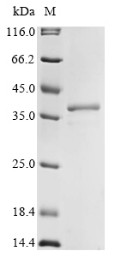
Organism: Mus musculus (Mouse). Source: E.coli. Expression Region: 2-243aa. Protein Length: Full Length of Mature Protein. Tag Info: N-terminal 10xHis-tagged and C-terminal Myc-tagged. Target Protein Sequence: AVQISKKRKF VADGIFKAEL NEFLTRELAE DGYSGVEVRV TPTRTEIIIL ATRTQNVLGE KGRRIRELTA VVQKRFGFPE GSVELYAEKV ATRGLCAIAQ AESLRYKLLG GLAVRRACYG VLRFIMESGA KGCEVVVSGK LRGQRAKSMK FVDGLMIHSG DPVNYYVDTA VRHVLLRQGV LGIKVKIMLP WDPSGKIGPK KPLPDHVSIV EPKDEILPTT PISEQKGGKP EPPAMPQPVP TA. Purity: Greater than 85% as determined by SDS-PAGE. Endotoxin: Not test. Biological Activity: n/a. Form: Liquid or Lyophilized powder. Buffer: If the delivery form is liquid, the default storage buffer is Tris/PBS-based buffer, 5%-50% glycerol. If the delivery form is lyophilized powder, the buffer before lyophilization is Tris/PBS-based buffer, 6% Trehalose, pH 8.0. Reconstitution: We recommend that this vial be briefly centrifuged prior to opening to bring the contents to the bottom. Please reconstitute protein in deionized sterile water to a concentration of 0.1-1.0 mg/mL.We recommend to add 5-50% of glycerol (final concentration) and aliquot for long-term storage at -20 °C/-80 °C. Our default final concentration of glycerol is 50%. Customers could use it as reference. Storage: The shelf life is related to many factors, storage state, buffer ingredients, storage temperature and the stability of the protein itself. Generally, the shelf life of liquid form is 6 months at -20 °C/-80 °C. The shelf life of lyophilized form is 12 months at -20 °C/-80 °C. Notes: Repeated freezing and thawing is not recommended. Store working aliquots at 4 °C for up to one week. Relevance: Involved in translation as a component of the 40S small ribosomal subunit (By similarity). Has endonuclease activity and plays a role in repair of damaged DNA (PubMed:7775413). Cleaves phosphodiester bonds of DNAs containing altered bases with broad specificity and cleaves supercoiled DNA more efficiently than relaxed DNA (By similarity). Displays high binding affinity for 7,8-dihydro-8-oxoguanine (8-oxoG), a common DNA lesion caused by reactive oxygen species (ROS) (By similarity). Has also been shown to bind with similar affinity to intact and damaged DNA (By similarity). Stimulates the N-glycosylase activity of the base excision protein OGG1 (By similarity). Enhances the uracil excision activity of UNG1 (By similarity). Also stimulates the cleavage of the phosphodiester backbone by APEX1 (By similarity). When located in the mitochondrion, reduces cellular ROS levels and mitochondrial DNA damage (By similarity). Has also been shown to negatively regulate DNA repair in cells exposed to hydrogen peroxide (By similarity). Plays a role in regulating transcription as part of the NF-kappa-B p65-p50 complex where it binds to the RELA/p65 subunit, enhances binding of the complex to DNA and promotes transcription of target genes (By similarity). Represses its own translation by binding to its cognate mRNA (By similarity). Binds to and protects TP53/p53 from MDM2-mediated ubiquitination (By similarity). Involved in spindle formation and chromosome movement during mitosis by regulating microtubule polymerization (By similarity). Involved in induction of apoptosis through its role in activation of CASP8 (PubMed:14988002). Induces neuronal apoptosis by interacting with the E2F1 transcription factor and acting synergistically with it to up-regulate pro-apoptotic proteins BCL2L11/BIM and HRK/Dp5 (By similarity). Interacts with TRADD following exposure to UV radiation and induces apoptosis by caspase-dependent JNK activation (By similarity). Reference: "RpS3, a DNA repair endonuclease and ribosomal protein, is involved in apoptosis." Jang C.Y., Lee J.Y., Kim J. FEBS Lett. 560:81-85(2004). Function: nan
| Keywords: | Rps3, 40S ribosomal protein S3, Recombinant Mouse 40S ribosomal protein S3 (RPS3) |
| Supplier: | Cusabio |
| Supplier-Nr: | EP020443MO |
Properties
| Application: | Activity not tested |
| Conjugate: | No |
| Host: | E.coli |
| Species reactivity: | mouse |
| MW: | 34.0 kD |
| Purity: | >85% (SDS-PAGE) |
Database Information
| KEGG ID : | K02985 | Matching products |
| UniProt ID : | P62908 | Matching products |
| Gene ID : | GeneID 27050 | Matching products |
Handling & Safety
| Storage: | -20°C |
| Shipping: | +4°C (International: +4°C) |
Caution
Our products are for laboratory research use only: Not for administration to humans!
Our products are for laboratory research use only: Not for administration to humans!
You will get a certificate here
Viewed