
No results were found for the filter!
 5-CR110 (5-Carboxyrhodamine 110) *Single isomer*
Item number: ABD-322

Compared to fluorescein labeling reagents such as FITC and FAM, CR110 reagents give more photostable and pH-independent bioconjugates that have the absorption maximum around the preferred 488 nm excitation wavelength. They are photostable alternative
| Application: | Labeling |
434.00€
*
![CF-MU [6-Chloro-8-fluoro-umbelliferone] (Fluorescence reference standard)](https://www.biomol.com/media/image/cf/2c/54/ABD-42_200x200.gif "CF-MU [6-Chloro-8-fluoro-umbelliferone] (Fluorescence reference standard)") CF-MU [6-Chloro-8-fluoro-umbelliferone] (Fluorescence...
CF-MU [6-Chloro-8-fluoro-umbelliferone] (Fluorescence...
Item number: ABD-42
This compound is used as a calibration standard for CF-MU-based enzyme substrates. It has pH-dependent fluorescence. Compared to umbelliferone, this dye has much lower pKa, making it more fluorescent than umbelliferone under physiological conditions.
| Application: | Calibration standard |
145.00€
*
 AMCA, succinimidyl ester
Item number: ABD-502
AMCA is one of the brightest blue fluorescent labeling dyes. It can be well excited at 365 nm. It is quite photostable, and its fluorescence is pH-independent from pH 4 to 10.
| Application: | Labeling |
145.00€
*
 Sulforhodamine B *Fluorescence reference standard*
Item number: ABD-72
Sulforhodamine B, also known as Kiton Red, is primarily used as a polar tracer. It does not exhibit pH-dependent absorption or fluorescence over the range of 3 to 10.
| Application: | Labeling |
| CAS | 3520-42-1 |
114.00€
*
![Cyanine 5 monoacid [equivalent to Cy5(R) acid]](https://www.biomol.com/media/image/81/f6/da/ABD-150_200x200.gif "Cyanine 5 monoacid [equivalent to Cy5(R) acid]") Cyanine 5 monoacid [equivalent to Cy5(R) acid]
Cyanine 5 monoacid [equivalent to Cy5(R) acid]
Item number: ABD-150
Ex: 649 nm. Em: 665 nm. Soluble in: DMSO. A variety of cyanine 5 ( Cy5®) dyes has been used to label biological molecules for fluorescence imaging and other fluorescence-based biochemical analysis. They are widely used for labeling peptides, proteins and oligos etc. Cy5® dyes are one type of the most common red...
| Application: | Labeling probe, classic labeling dye, cyanine |
| MW: | 770,83 D |
291.00€
*
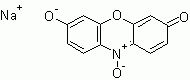 Resazurin, sodium salt *UltraPure grade*
Item number: ABD-15700
Resazurin is a non-toxic, water-soluble and redox-sensitive dye that changes from its blue/non-fluorescent state to pink/highly-fluorescent upon reduction to resorufin by many biological processes.
| Application: | Cell viability assays |
| CAS | 62758-13-8 |
114.00€
*
![Cyanine 5.5 maleimide [equivalent to Cy5.5(R) maleimide]](https://www.biomol.com/media/image/1c/27/3c/ABD-175_200x200.gif "Cyanine 5.5 maleimide [equivalent to Cy5.5(R) maleimide]") Cyanine 5.5 maleimide [equivalent to Cy5.5(R) maleimide]
Cyanine 5.5 maleimide [equivalent to Cy5.5(R) maleimide]
Item number: ABD-175
Ex: 678 nm. Em: 701 nm. Soluble in: DMSO. A variety of cyanine 5.5 (Cy5.5®) dyes has been used to label biological molecules for fluorescence imaging and other fluorescence-based biochemical analysis. They are widely used for labeling peptides, proteins and oligos etc. Cy5.5® dyes are one type of the most common red...
| Application: | Labeling probe, classic labeling dye, cyanine |
| MW: | 1153,20 D |
157.00€
*
 5-DTAF (5-(4,6-Dichlorotriazinyl)aminofluorescein)
Item number: ABD-200
The 5-isomer of fluorescein dichlorotriazine (5-DTAF) is highly reactive with proteins. Unlike other reactive fluoresceins, 5-DTAF not only reacts with amino groups, but also reacts with thiol groups and with hydroxy groups.
| Application: | Labeling |
| CAS | 51306-35-5 |
145.00€
*

 BCECF, AM *Custom packaging*
Item number: ABD-21203
Fluorescent pH indicators. BCECF is the most popular pH probe since it can be used to monitor cellular pH ratiometrically. BCECF AM is the cell-permeable version of BCECF.
| Application: | Fluorescent pH indicator |
363.00€
*
 DiIC12(3) perchlorate...
Item number: ABD-22035
Lipophilic fluorescent stain. DiO (green fluorescence), DiD (red fluorescence) and DiR (deep red fluorescent) provide a convenient tool for multicolor imaging and flow cytometric analysis of live cells.
| Application: | Lipophilic fluorescent stain |
114.00€
*
 DiOC3(3) iodide (3,3-Dipropyloxacarbocyanine iodide)
Item number: ABD-22039
Lipophilic fluorescent stain. DiO (green fluorescence), DiD (red fluorescence) and DiR (deep red fluorescent) provide a convenient tool for multicolor imaging and flow cytometric analysis of live cells.
| Application: | Lipophilic fluorescent stain |
114.00€
*