
Cookie preferences
This website uses cookies, which are necessary for the technical operation of the website and are always set. Other cookies, which increase the comfort when using this website, are used for direct advertising or to facilitate interaction with other websites and social networks, are only set with your consent.
Configuration
Technically required
These cookies are necessary for the basic functions of the shop.
"Allow all cookies" cookie
"Decline all cookies" cookie
CSRF token
Cookie preferences
Currency change
Customer-specific caching
FACT-Finder tracking
Individual prices
Selected shop
Session
Comfort functions
These cookies are used to make the shopping experience even more appealing, for example for the recognition of the visitor.
Note
Show the facebook fanpage in the right blod sidebar
Statistics & Tracking
Affiliate program
Conversion and usertracking via Google Tag Manager
Track device being used

| Item number | Size | Datasheet | Manual | SDS | Delivery time | Quantity | Price |
|---|---|---|---|---|---|---|---|
| CDX-D0180-G001 | 1 g | - | - |
3 - 6 business days* |
91.00€
|
If you have any questions, please use our Contact Form.
You can also order by e-mail: info@biomol.com
Larger quantity required? Request bulk
You can also order by e-mail: info@biomol.com
Larger quantity required? Request bulk
3,3'-Diethyloxacarbocyanine iodide is a cyanine based dye that has been used for measuring... more
Product information "3,3'-Diethyloxacarbocyanine iodide"
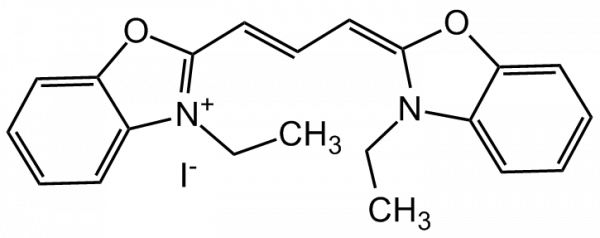
3,3'-Diethyloxacarbocyanine iodide is a cyanine based dye that has been used for measuring membrane potentials in bacteria. The green fluorescent dye forms red fluorescent aggregates with increasing membrane potential. The spectral shifting phenomenon has been exploited to measure membrane potential and analyze bacterial viability by flow cytometry ratiometrically. Spectral data: lambdamax 483nm (methanol), lambdaem 498nm (methanol). The dye has also been used as laser dye and in photosensitization of mitochondria and endoplastic recticulum in animals and plant cells. It may be used as a conjugate for labelling cells for cytofluorometry studies and in the imaging of carbon nanotubes(CNTs) using fluorescence microscopy. References: (1) D.N. Dempster, et al., J. Chem. Soc. Faraday II 68, 1479 (1972) , (2) D. Magde & M.W. Windsor, Chem. Phys. Lett. 27, 31 (1974) , (3) M. Zalokar & C. Sardet, Dev. Biol. 102, 195 (1984) , (4) M. Castedo, et al., J. Immunol. Meth. 265, 39 (2002) , (5) H.J. Broxterman, et al., Leukemia 11, 1110 (1997) , (6) D.J. Novo, et al., Cytometry 35, 55 (1999) , (7) D.J. Novo, et al., Antimicrob. Agents Chemother. 44, 827 (2000) , (8) D.R. Gentry, et al., J. Microbiol. Methods 83, 254 (2010) , (9) R.W. Sabnis, Handbook of biological dyes and stains (2010) , (10) M.A. Hudson, et al., Antimicrob. Agents Chemother. 64, e00910 (2020) Appearance: Dark red crystals or powder. Solubility: Soluble in DMSO or methanol. Identity: Determined by 1H-NMR. Declaration: Manufactured by Chemodex. Inchi Key: FIZZUEJIOKEFFZ-UHFFFAOYSA-M Smiles: CCN1/C(OC2=CC=CC=C12)=C\C=C\C3=[N+](CC)C4=CC=CC=C4O3.[I-]
| Keywords: | DiOC2(3), 3-Ethyl-2-[3-(3-ethyl-2(3H)-benzoxazolylidene)-1-propenyl]benzoxazolium iodide, DOC iodide |
| Supplier: | Chemodex |
| Supplier-Nr: | D0180 |
Properties
| Application: | Bacterial membrane potential measurement |
| MW: | 460.31 D |
| Formula: | C21H19IN2S |
| Purity: | >98% (Titration) |
| Format: | Powder |
Database Information
| CAS : | 905-96-4| Matching products |
Handling & Safety
| Storage: | -20°C (protect from light & moisture) |
| Shipping: | +20°C (International: +20°C) |
Caution
Our products are for laboratory research use only: Not for administration to humans!
Our products are for laboratory research use only: Not for administration to humans!
Information about the product reference will follow.
more
You will get a certificate here
Viewed