
Cookie preferences
This website uses cookies, which are necessary for the technical operation of the website and are always set. Other cookies, which increase the comfort when using this website, are used for direct advertising or to facilitate interaction with other websites and social networks, are only set with your consent.
Configuration
Technically required
These cookies are necessary for the basic functions of the shop.
"Allow all cookies" cookie
"Decline all cookies" cookie
CSRF token
Cookie preferences
Currency change
Customer-specific caching
FACT-Finder tracking
Individual prices
Selected shop
Session
Comfort functions
These cookies are used to make the shopping experience even more appealing, for example for the recognition of the visitor.
Note
Show the facebook fanpage in the right blod sidebar
Statistics & Tracking
Affiliate program
Conversion and usertracking via Google Tag Manager
Track device being used
Please request pricing for this article.
Request Pricing
Request Pricing
| Item number | Size | Datasheet | Manual | SDS | Delivery time | Quantity | Price |
|---|---|---|---|---|---|---|---|
| TGM-TMIJ-0052-1mg | 1 mg |
7 - 10 business days* |
-
|
||||
| TGM-TMIJ-0052-5mg | 5 mg |
7 - 10 business days* |
-
|
If you have any questions, please use our Contact Form.
You can also order by e-mail: info@biomol.com
Larger quantity required? Request bulk
You can also order by e-mail: info@biomol.com
Larger quantity required? Request bulk
Description: Propionicacid-d5 is a deuterated compound of Propionicacid. Propionicacid has a CAS... more
Product information "Propionicacid-d5"
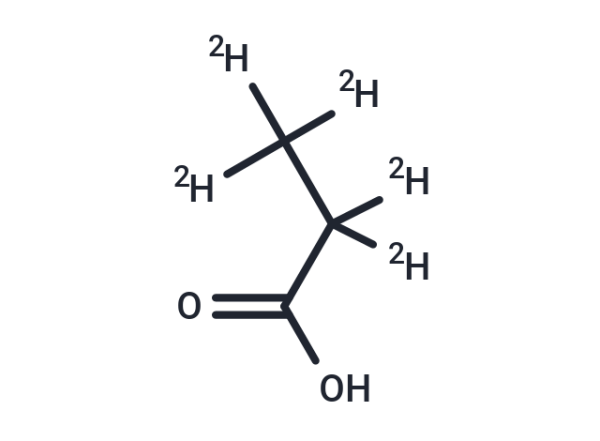
Description: Propionicacid-d5 is a deuterated compound of Propionicacid. Propionicacid has a CAS number of 79-09-4. Propionic acid (PA) is widely used as an antifungal agent in food. It is present naturally at low levels in dairy products and occurs ubiquitously, together with other short-chain fatty acids (SCFA), in the gastro-intestinal tract of humans and other mammals as an end-product of the microbial digestion of carbohydrates. It has significant physiological activity in animals. PA is irritant but produces no acute systemic effects and has no demonstrable genotoxic potential.Propionic aciduria is one of the most frequent organic acidurias, a disease that comprise many various disorders. The outcome of patients born with Propionic aciduria (genetic disorder) is poor intellectual development patterns, with 60% having an IQ less than 75 and requiring special education. Successful liver and/or renal transplantations, in a few patients, have resulted in better quality of life but have not necessarily prevented neurological and various visceral complications. These results emphasize the need for permanent metabolic follow-up whatever the therapeutic strategy. Decreased early mortality, less severe symptoms at diagnosis, and more favorable short-term neurodevelopmental outcome were recorded in patients identified through expanded newborn screening. Smiles: C(C(C([2H])([2H])[2H])([2H])[2H])(O)=O
| Supplier: | TargetMol |
| Supplier-Nr: | TMIJ-0052 |
Properties
| Application: | GC-MS, LC-MS, internal standard, quantification, FFAR2/FFAR3 agonist |
| MW: | 79.11 D |
| Formula: | C3D5H1O2 |
Database Information
| CAS : | 60153-92-6| Matching products |
| KEGG ID : | K04328 | Matching products |
Handling & Safety
| Storage: | -20°C |
| Shipping: | +20°C (International: +4°C) |
Caution
Our products are for laboratory research use only: Not for administration to humans!
You will get a certificate here
Viewed