
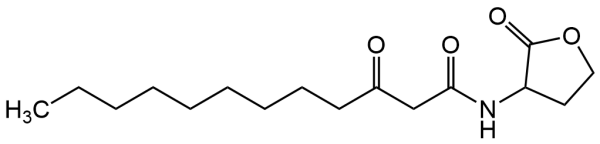
N-(3-Oxododecanoyl)-DL-homoserine lactone

If you have any questions, please use our Contact Form.
You can also order by e-mail: info@biomol.com
Larger quantity required? Request bulk
You can also order by e-mail: info@biomol.com
Larger quantity required? Request bulk
Quorum sensing agent. N-(3-Oxododecanoyl)-L-homoserine lactone (3-oxo-C12-HSL) is a small... more
Product information "N-(3-Oxododecanoyl)-DL-homoserine lactone"
Quorum sensing agent. N-(3-Oxododecanoyl)-L-homoserine lactone (3-oxo-C12-HSL) is a small diffusible signaling molecule, also identified as P. aeruginosa autoinducer (PAI), and is a member of N-acyl-homoserine lactone family. N-acylhomoserine lactones (AHL) are involved in quorum sensing, controlling gene expression, and cellular metabolism. The diverse applications of this kind of molecule include regulation of virulence in general, infection prevention and formation of biofilms. 3-oxo-C12-HSL is one of the AHLs frequently identified in extracts of respiratory secretions from cystic fibrosis patients infected with P. aeruginosa. 3-oxo-C12-HSL activates the transcription factors NF-kappaB and AP-2 to induce interleukin-8, cyclooxygenase 2, and prostaglandin E2 production in human lung fibroblasts and epithelial cells, possibly contributing to the neutrophil infiltration and inflammation found in P. aeruginosa infections. 3-oxo-C12-HSL also suppresses human and murine leucocyte proliferation and inhibits LPS-induced secretion of TNF-R and IL-12. 3-oxo-C12-HSL accelerated apoptosis in mammalian macrophages and neutrophils and shown to inhibit the growth of human colorectal, breast and prostate cancer cells.
| Keywords: | OdDHL, 3O-C12-DL-HSL, 3-oxo-C12-HSL, 3OC12HSL, n-(3-Oxododecanoyl) DL-homoserine lactone, 3-Oxo-N-(tetrahydro-2-oxo-3-furanyl)dodecanamide, 3-Oxo-N-(2-oxooxolan-3-yl)dodecanamide |
| Supplier: | Chemodex |
| Supplier-Nr: | O0032 |
Properties
| Application: | Quorum sensing agent |
| MW: | 297,39 D |
| Formula: | C16H27NO4 |
| Format: | Solid |
Database Information
| CAS : | 152833-54-0| Matching products |
Handling & Safety
| Storage: | -20°C |
| Shipping: | +20°C (International: +20°C) |
| Signal Word: | Warning |
| GHS Hazard Pictograms: |

|
| H Phrases: | H302 |
Caution
Our products are for laboratory research use only: Not for administration to humans!
Our products are for laboratory research use only: Not for administration to humans!
Information about the product reference will follow.
more
You will get a certificate here
Viewed