
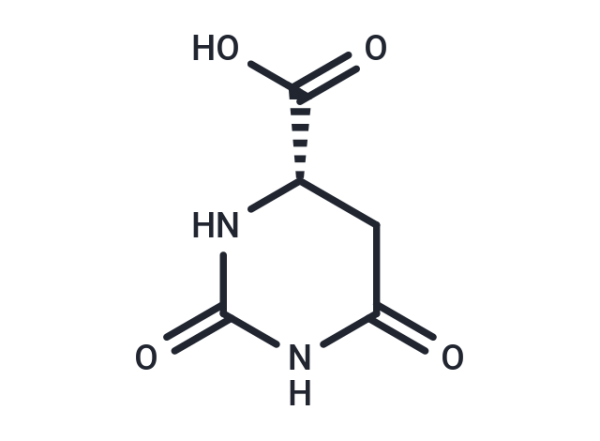
L-Dihydroorotic acid

If you have any questions, please use our Contact Form.
You can also order by e-mail: info@biomol.com
Larger quantity required? Request bulk
You can also order by e-mail: info@biomol.com
Larger quantity required? Request bulk
Description: L-Dihydroorotic acid, also known as (S)-4,5-dihydroorotate or dihydro-L-orotate,... more
Product information "L-Dihydroorotic acid"
Description: L-Dihydroorotic acid, also known as (S)-4,5-dihydroorotate or dihydro-L-orotate, belongs to the class of organic compounds known as alpha amino acids and derivatives. Within the cell, L-dihydroorotic acid is primarily located in the cytoplasm and mitochondria. L-Dihydroorotic acid exists in all eukaryotes, ranging from yeast to humans. L-Dihydroorotic acid participates in a number of enzymatic reactions. In particular, L-Dihydroorotic acid can be biosynthesized from ureidosuccinic acid, which is catalyzed by the enzyme cad protein. In addition, L-Dihydroorotic acid and quinone can be converted into orotic acid, which is mediated by the enzyme dihydroorotate dehydrogenase (quinone), mitochondrial. In humans, L-dihydroorotic acid is involved in the pyrimidine metabolism pathway. L-Dihydroorotic acid is also involved in several metabolic disorders, some of which include UMP synthase deficiency (orotic aciduria), the mngie (mitochondrial neurogastrointestinal encephalopathy) pathway, Beta ureidopropionase deficiency, and dihydropyrimidinase deficiency. Target: Endogenous Metabolite. Smiles: OC(=O)[C@@H]1CC(=O)NC(=O)N1. References: Jiang, G., et al.: J. Med. Chem., 44, 453 (2001)
| Keywords: | L-Hydroorotic acid |
| Supplier: | TargetMol |
| Supplier-Nr: | T4880 |
Properties
| MW: | 158.11 D |
| Formula: | C5H6N2O4 |
Database Information
| CAS : | 5988-19-2| Matching products |
Handling & Safety
| Storage: | -20°C |
| Shipping: | +20°C (International: +4°C) |
| Signal Word: | Warning |
| GHS Hazard Pictograms: |

|
| H Phrases: | H315, H319, H335 |
| P Phrases: | P261, P264, P271, P280, P302+352, P304+340, P305+351+338, P312, P321, P332+313, P337+313, P362+364, P403+233, P405, P501 |
Caution
Our products are for laboratory research use only: Not for administration to humans!
Our products are for laboratory research use only: Not for administration to humans!
You will get a certificate here
Viewed