
Cookie preferences
This website uses cookies, which are necessary for the technical operation of the website and are always set. Other cookies, which increase the comfort when using this website, are used for direct advertising or to facilitate interaction with other websites and social networks, are only set with your consent.
Configuration
Technically required
These cookies are necessary for the basic functions of the shop.
"Allow all cookies" cookie
"Decline all cookies" cookie
CSRF token
Cookie preferences
Currency change
Customer-specific caching
FACT-Finder tracking
Individual prices
Selected shop
Session
Comfort functions
These cookies are used to make the shopping experience even more appealing, for example for the recognition of the visitor.
Note
Show the facebook fanpage in the right blod sidebar
Statistics & Tracking
Affiliate program
Conversion and usertracking via Google Tag Manager
Track device being used

| Item number | Size | Datasheet | Manual | SDS | Delivery time | Quantity | Price |
|---|---|---|---|---|---|---|---|
| CDX-L0054-G100 | 100 g | - | - |
3 - 6 business days* |
79.00€
|
||
| CDX-L0054-G500 | 500 g | - | - |
3 - 6 business days* |
314.00€
|
If you have any questions, please use our Contact Form.
You can also order by e-mail: info@biomol.com
Larger quantity required? Request bulk
You can also order by e-mail: info@biomol.com
Larger quantity required? Request bulk
L-Ascorbic acid (better known as Vitamin C) is a naturally occurring electron donor and therefore... more
Product information "L-Ascorbic acid"
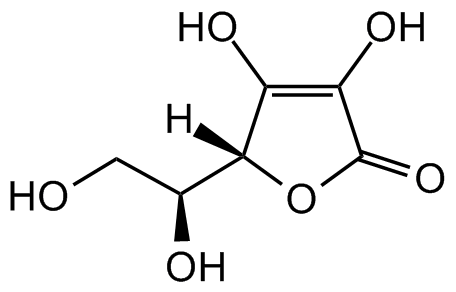
L-Ascorbic acid (better known as Vitamin C) is a naturally occurring electron donor and therefore serves as a reducing agent. It is synthesized from glucose in the liver of most mammalian species, excluding humans, non-human primates, or guinea pigs who must obtain it through dietary consumption. In humans, L-Ascorbic acid acts as an electron donor for eight different enzymes, including those related to collagen hydroxylation, carnitine synthesis (which aids in the generation of adenosine triphosphate), norepinephrine synthesis, tyrosine metabolism and amidating peptides. L-Ascorbic acid demonstrates antioxidant activity that may be of some benefit for reducing the risk of developing chronic diseases such as cancer, cardiovascular disease, and cataracts. L-Ascorbic acid is an inhibitor of Cav3.2 channels, but displays no effect on Cav3.1 or Cav3.3 channels heterologously expressed in HEK 293 cells. L-Ascorbic acid enhances the generation of induced pluripotent stem cells (iPSCs) from mouse and human somatic cells by increasing reprogramming efficiency. It is also a commonly used antifade reagent in live cell microscopy. Ascorbate has critical roles in the central nervous system (CNS), it is a neuromodulator of glutamatergic, cholinergic, dopaminergic and gamma-aminobutyric acid (GABA)-ergic neurotransmission, provides support and structure to neurons, and participates in processes such as differentiation, maturation and survival of neurons. L-Ascorbic acid is essential to stimulate the immune system. Its immunostimulant, anti-inflammatory, antiviral and antibacterial properties are well known. Due to its effects and diversity of regulated pathways, L-Ascorbic acid is suitable for use in various fields of medicine including immunology, toxicology, radiobiology and is co-applied as an adjuvant to regulate immunity, gene expression and other important physiological processes. Product References: (1) S. Englard & S. Seifter, Ann. Rev. Nutr. 6, 365 (1986) (Review) , (2) B. Peterkofsky, Am. J. Clin. Nutr. 54, 1135S (1991) , (3) C.J. Rebouche, Am. J. Clin. Nutr. 54, 1147S (1991) , (4) E.J. Diliberto, et al., Am. J. Clin. Nutr. 54, 1163S (1991) , (5) S.J. Padayatty, et al., J. Am. Coll. Nutr. 22, 18 (2003) , (6) S.S. Gropper, et al., Adv. Nutr. Human Metab. 4, 259 (2005) , (7) M.T. Nelson, et al., J. Neurosci. 27, 12577 (2007) , (8) M.A. Esteban, et al., Cell Stem Cell 6, 71 (2010) , (9) T. Cordes, et al., Phys. Chem. Chem. Phys. 13, 6699 (2011) , (10) A. Sorice, et al., Mini Rev. Med. Chem. 14, 444 (2014) (Review) , (11) M. Moretti, et al., CNS Drugs 31, 571 (2017) (Review) , (12) R. Bakalova, et al., Oxid. Med. Cell Longev. 2020, 1504048 (2020) (Review) , (13) D. Njus, et al., Free Radic. Biol. Med. 159, 37 (2020) (Review) Appearance: White to off-white powder. Solubility: Soluble in water (50mg/ml) or DMSO (10mg/ml) . Identity: Determined by 1H-NMR. InChi Key: CIWBSHSKHKDKBQ-JLAZNSOCSA-N Smiles: OC1=C(O)[C@]([C@@H](O)CO)([H])OC1=O
| Keywords: | L-Threoascorbic acid, Antiscorbutic factor, Vitamin C, Ascorbate, NSC 33832, NSC 218455 |
| Supplier: | Chemodex |
| Supplier-Nr: | L0054 |
Properties
| Application: | Reducing agent, Antioxidant, Ntifade reagent (live cell microscopy) |
| MW: | 176.12 D |
| Formula: | C6H8O6 |
| Purity: | >99% (Assay) |
| Format: | Solid |
Database Information
| CAS : | 50-81-7| Matching products |
Handling & Safety
| Storage: | -20°C |
| Shipping: | +20°C (International: +20°C) |
Caution
Our products are for laboratory research use only: Not for administration to humans!
Our products are for laboratory research use only: Not for administration to humans!
Information about the product reference will follow.
more
You will get a certificate here
Viewed