
This website uses cookies, which are necessary for the technical operation of the website and are always set. Other cookies, which increase the comfort when using this website, are used for direct advertising or to facilitate interaction with other websites and social networks, are only set with your consent.
Configuration
Technically required
These cookies are necessary for the basic functions of the shop.
"Allow all cookies" cookie
"Decline all cookies" cookie
CSRF token
Cookie preferences
Currency change
Customer-specific caching
FACT-Finder tracking
Individual prices
Selected shop
Session
Comfort functions
These cookies are used to make the shopping experience even more appealing, for example for the recognition of the visitor.
Note
Show the facebook fanpage in the right blod sidebar
Statistics & Tracking
Affiliate program
Conversion and usertracking via Google Tag Manager
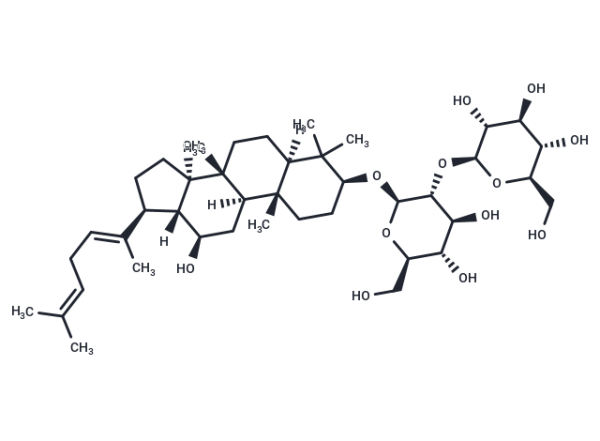
Description: 1. Ginsenoside Rg5 could be a beneficial agent for the treatment of Alzheimer's disease. 2. Ginsenoside Rg5 suppresses LPS-induced nitric oxide (NO) production and proinflammatory TNF-alpha secretion. 3. Ginsenoside Rg5 can ameliorate lung inflammation possibly by inhibiting the binding of LPS to toll-like receptor (TLR)-4 on macrophages. 4. Ginsenoside Rg5 plays a novel role as an IGF-1R agonist, promoting therapeutic angiogenesis and improving hypertension without adverse effects in the vasculature. 5. Ginsenoside Rg5 blocks cell cycle of SK-HEP-1 cells at the Gl/S transition phase by down-regulating cyclin E-dependent kinase activity and that the down-regulation of cyclin E-dependent kinase activity is caused mainly by induced CDK2 inhibitor, p21Cip/WAF1 and decreased levels of cyclin E. Target: NF-kappaB, COX, IGF-1R. Smiles: CC(C)=CC\C=C(/C)[C@H]1CC[C@]2(C)[C@@H]1[C@H](O)C[C@@H]1[C@@]3(C)CC[C@H](O[C@@H]4O[C@H](CO)[C@@H](O)[C@H](O)[C@H]4O[C@@H]4O[C@H](CO)[C@@H](O)[C@H](O)[C@H]4O)C(C)(C)[C@@H]3CC[C@@]21C. References: Ginsenoside Rg5 improves cognitive dysfunction and beta-amyloid deposition in STZ-induced memory impaired rats via attenuating neuroinflammatory responses[J]. International Immunopharmacology, 2014, 19(2):317-326.
This website uses cookies, which are necessary for the technical operation of the website and are always set. Other cookies, which increase the usability of this website, serve for direct advertising or simplify interaction with other websites and social networks, will only be used with your consent.
More information