
This website uses cookies, which are necessary for the technical operation of the website and are always set. Other cookies, which increase the comfort when using this website, are used for direct advertising or to facilitate interaction with other websites and social networks, are only set with your consent.
Configuration
Technically required
These cookies are necessary for the basic functions of the shop.
"Allow all cookies" cookie
"Decline all cookies" cookie
CSRF token
Cookie preferences
Currency change
Customer-specific caching
FACT-Finder tracking
Individual prices
Selected shop
Session
Comfort functions
These cookies are used to make the shopping experience even more appealing, for example for the recognition of the visitor.
Note
Show the facebook fanpage in the right blod sidebar
Statistics & Tracking
Affiliate program
Conversion and usertracking via Google Tag Manager
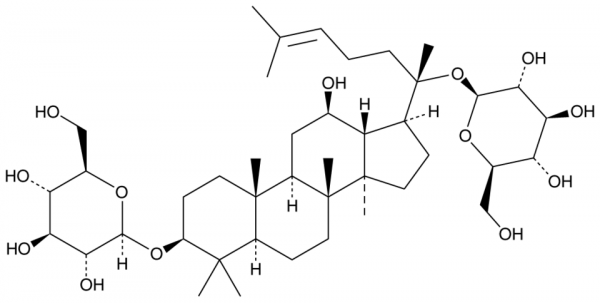
Ginsenoside F2 is a ginsenoside that has been found in P. ginseng and has diverse biological activities. It increases the proliferation of human hair dermal papilla cells (HHDPCs) and HaCaT human keratinocytes when used at concentrations of 0.01, 0.1, and 1 µM. Ginsenoside F2 (0.5 and 2.5 mg/kg) induces hair growth and increases hair density following depilation in mice. It is cytotoxic to U373MG glioblastoma cells in vitro (IC50 = 50 µg/ml) and reduces tumor growth in a U373MG mouse xenograft model when administered at a dose of 35 mg/kg every other day. Ginsenoside F2 (1 mg/ear) reduces ear edema induced by phorbol 12-myristate 13-acetate (TPA, Cay-10008014) in mice. It is a human intestinal bacterial metabolite of ginsenoside Rb1 (Cay-15319) via the intermediate ginsenoside Rd (Cay-15329).Formal Name: (3beta,12beta)-12-hydroxydammar-24-ene-3,20-diyl bis-beta-D-glucopyranoside. CAS Number: 62025-49-4. Molecular Formula: C42H72O13. Formula Weight: 785.0. Purity: >95%. Formulation: (Request formulation change), A crystalline solid. Solubility: DMF: 10 mg/ml, DMSO: 10 mg/ml, DMSO:PBS (pH 7.2) (1:1): 0.5 mg/ml. SMILES: O[C@H]1[C@@]2([H])[C@](CC[C@]2([H])[C@@](CC/C=C(C)/C)(C)O[C@@H]3O[C@H](CO)[C@@H](O)[C@H](O)[C@H]3O)(C)[C@]4(C)CC[C@]5([H])[C@@](CC[C@H](O[C@]6([H])O[C@H](CO)[C@@H](O)[C@H](O)[C@H]6O)C5(C)C)(C)[C@@]4([H])C1. InChi Code: InChI=1S/C42H72O13/c1-21(2)10-9-14-42(8,55-37-35(51)33(49)31(47)25(20-44)53-37)22-11-16-41(7)29(22)23(45)18-27-39(5)15-13-28(38(3,4)26(39)12-17-40(27,41)6)54-36-34(50)32(48)30(46)24(19-43)52-36/h10,22-37,43-51H,9,11-20H2,1-8H3/t22-,23+,24+,25+,26-,27+,28-,29-,30+,31+,32-,33-,34+,35+,36-,37-,39-,40+,41+,42-/m0/s1. InChi Key: SWIROVJVGRGSPO-JBVRGBGGSA-N. Origin: Plant/Ginseng Radix Et Rhizoma.
This website uses cookies, which are necessary for the technical operation of the website and are always set. Other cookies, which increase the usability of this website, serve for direct advertising or simplify interaction with other websites and social networks, will only be used with your consent.
More information