

No results were found for the filter!
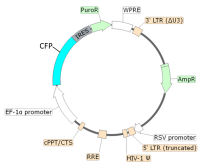 CFP (mTurquoise2) Lentivirus
Item number: BPS-83024

CFP (mTurquoise2) Lentivirus are replication incompetent, HIV based, VSV-G pseudotyped lentiviral particles that are ready to transduce almost all types of mammalian cells, including primary and non-dividing cells. These particles contain a CFP (cyan fluorescent protein) under the control of an EF1a promoter. The...
| Keywords: | GFP, Green fluorescent protein |
| Application: | Cellular labeling, cell pool/stable cell line (puromycin selection) generation |
1,307.00€
*
 CFP (mCerulean3) Lentivirus
Item number: BPS-83025
CFP (mCerulean3) Lentivirus are replication incompetent, HIV based, VSV-G pseudotyped lentiviral particles that are ready to transduce almost all types of mammalian cells, including primary and non-dividing cells. These particles contain a CFP (cyan fluorescent protein) under the control of an EF1a promoter. The...
| Keywords: | GFP, Green fluorescent protein |
| Application: | Cellular labeling, cell pool/stable cell line (puromycin selection) generation |
1,307.00€
*
 YFP (mVenus) Lentivirus
Item number: BPS-83026
YFP (mVenus) Lentivirus are replication incompetent, HIV based, VSV-G pseudotyped lentiviral particles that are ready to transduce almost all types of mammalian cells, including primary and non-dividing cells. These particles contain a YFP (yellow fluorescent protein) under the control of an EF1a promoter. The...
| Keywords: | GFP, Green fluorescent protein |
| Application: | Cellular labeling, cell pool/stable cell line (puromycin selection) generation |
1,307.00€
*
 Anti-CD19 CAR Lentivirus (CD19 ScFv-CD8-4-1BB-CD3zeta)
Item number: BPS-78600
The anti-CD19 CAR lentiviruses are replication incompetent, HIV-based, VSV-G pseudotyped lentiviral particles that are ready to be transduced into almost all types of mammalian cells, including primary and non-dividing cells. These viruses constitutively express the ScFv portion of anti-CD19 (clone FMC63) linked to...
| Keywords: | Anti-CD19 Lentivirus, CAR Lentivirus, Anti-CD19 Lenti, Lenti, Lentivirus, CD19, CD8, 4-1BB, CD3zeta, Anti-CD19, 78600-1,... |
| Application: | CAR-T studies |
| Species reactivity: | human |
2,019.00€
*
 Anti-CD20 CAR Lentivirus (Clone Leu-16...
Item number: BPS-78606
The anti-CD20 CAR lentiviruses are replication incompetent, HIV-based, VSV-G-pseudotyped lentiviral particles that are ready to infect almost all types of mammalian cells, including primary and non-dividing cells. These viruses transduce the ScFv (single-chain variable fragment) of anti-CD20 (clone Leu-16) linked to...
| Keywords: | B-lymphocyte antigen CD20, B-lymphocyte surface antigen B1, Bp35, Leukocyte surface antigen Leu-16, Membrane-spanning... |
| Application: | Positive control for anti-CD20 CAR evaluation in T cells, transduction optimization |
| Species reactivity: | human |
1,708.00€
*
 Anti-CD19 CAR Lentivirus (CD19 ScFv-CD8-4-1BB-CD3zeta,...
Item number: BPS-78601
The anti-CD19 CAR lentiviruses are replication incompetent, HIV-based, VSV-G pseudotyped lentiviral particles that are ready to infect almost all types of mammalian cells, including primary and non-dividing cells. These viruses transduce the ScFv portion of anti-CD19 (clone FMC63) linked to 2nd generation CAR...
| Keywords: | CD19, B-lymphocyte antigen CD19, Differentiation antigen CD19, T-cell surface antigen Leu-12, B-lymphocyte surface antigen... |
| Application: | Anti-CD19 CAR evaluation positive control, transduction optimization, anti-CD19 CAR-T cell generation |
| Species reactivity: | human |
2,019.00€
*
 Spike (B.1.617.2 Delta Variant) Pseudotyped Lentivirus...
Item number: BPS-78215-1
The pandemic coronavirus disease 2019 (COVID-19) is caused by Severe Acute Respiratory Syndrome Coronavirus 2 (SARS-CoV-2). As the first step of the viral replication, the virus attaches to the host cell surface before entering the cell. The viral Spike protein recognizes and attaches to the Angiotensin-Converting...
| Keywords: | 2, |
| Application: | Coronavirus studies |
| Species reactivity: | SARS-CoV-2 |
From 1,343.00€
*
 ARE Luciferase Reporter Lentivirus
Item number: BPS-79869
The Nrf2 antioxidant response pathway plays an important role in the cellular antioxidant defense. Nrf2, a basic leucine zipper transcription factor, induces the expression of antioxidant and phase II enzymes by binding to the ARE (antioxidant response element) region of the gene promoter. Under basal conditions,...
| Keywords: | ARE cell line, Nrf2 reporter, Nrf, Hepg2, ARE, HIV-based, VSV-G, |
| Application: | Nrf2 antioxidant response pathway activator / inhibitor screening, stable cell line generation |
| Species reactivity: | human |
1,373.00€
*
 TCF/LEF Luciferase Reporter Lentivirus (Wnt/beta-catenin...
Item number: BPS-79787
The TCF/LEF Luciferase Reporter Lentivirus are replication incompetent, HIV-based, VSV-G pseudotyped lentiviral particles that are ready to be transduced into almost all types of mammalian cells, including primary and non-dividing cells. The particles contain a firefly luciferase gene under the control of...
| Keywords: | TCF reporter. LEF reporter, lentivirus reporter, Wnt reporter, beta-catenin pathway, |
| Application: | Activator / inhibitor screening, TCF/LEF luciferase reporter stable cell line generation |
| Species reactivity: | human |
1,373.00€
*
COVID-19 Research
 Spike (SARS-CoV-2) Pseudotyped Lentivirus (Luciferase...
Item number: BPS-79942-1
The pandemic coronavirus disease 2019 (COVID-19) is caused by Severe Acute Respiratory Syndrome Coronavirus 2 (SARS-CoV-2). As the first step of the viral replication, the virus attaches to the host cell surface before entering the cell. The viral Spike protein recognizes and attaches to the Angiotensin-Converting...
| Keywords: | 2, |
| Application: | Viral transduction studies, neutralizing SARS-CoV-2 Spike antibodies screening |
| Species reactivity: | SARS-CoV-2 |
From 1,307.00€
*
COVID-19 Research
 Bald Lentiviral Pseudovirion (Luciferase Reporter)
Item number: BPS-79943
The bald lentiviral pseudovirion was produced without envelope glycoproteins such as VSV-G or SARS-CoV-2 spike. It contains the firefly luciferase gene driven by a CMV promoter as the reporter. The bald lentiviral pseudovirion can serve as a negative control when studying virus entry initiated by specific...
| Keywords: | coronavirus, Luciferase reporter SARS-Cov-2, glycoprotein reporter, viral entry reporter, covid, covid-19, covid19,... |
| Application: | Negative control pseudovirion, viral transduction mechanism studios |
1,307.00€
*
COVID-19 Research
 Spike (SARS-CoV-2) Pseudotyped Lentivirus (eGFP Reporter)
Item number: BPS-79981-1
The pandemic coronavirus disease 2019 (COVID-19) is caused by Severe Acute Respiratory Syndrome Coronavirus 2 (SARS-CoV-2). As the first step of the viral replication, the virus attaches to the host cell surface before entering the cell. The viral Spike protein recognizes and attaches to the Angiotensin-Converting...
| Keywords: | 2, |
| Application: | Viral transduction studies, SARS-CoV-2 Spike / ACE2 neutralizing antibody screening |
| Species reactivity: | SARS-CoV-2 |
From 1,307.00€
*