
Cookie preferences
This website uses cookies, which are necessary for the technical operation of the website and are always set. Other cookies, which increase the comfort when using this website, are used for direct advertising or to facilitate interaction with other websites and social networks, are only set with your consent.
Configuration
Technically required
These cookies are necessary for the basic functions of the shop.
"Allow all cookies" cookie
"Decline all cookies" cookie
CSRF token
Cookie preferences
Currency change
Customer-specific caching
FACT-Finder tracking
Individual prices
Selected shop
Session
Comfort functions
These cookies are used to make the shopping experience even more appealing, for example for the recognition of the visitor.
Note
Show the facebook fanpage in the right blod sidebar
Statistics & Tracking
Affiliate program
Conversion and usertracking via Google Tag Manager
Track device being used

| Item number | Size | Datasheet | Manual | SDS | Delivery time | Quantity | Price |
|---|---|---|---|---|---|---|---|
| GSC-M00463 | 2 vials | - |
Request delivery time estimate |
11,424.00€
|
If you have any questions, please use our Contact Form.
You can also order by e-mail: info@biomol.com
Larger quantity required? Request bulk
You can also order by e-mail: info@biomol.com
Larger quantity required? Request bulk
Lysophosphatidic acid (LPA), a bioactive lipid produced by several cell types including... more
Product information "RH7777/EDG4 Stable Cell Line"
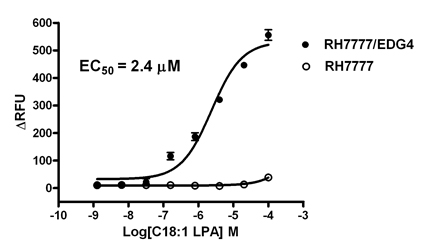
Lysophosphatidic acid (LPA), a bioactive lipid produced by several cell types including postmitotic neurons and activated platelets, is thought to be involved in various biological processes, including brain development. Three cognate G-protein coupled receptors encoded by lpa(1)/lp(A1)/Edg-2/Gpcr26, lpa(2)/lp(A2)/Edg-4, and lpa(3)/lp(A3)/Edg-7 mediate the cellular effects of LPA. However, many LPA-induced responses, including phospholipase C activation, Ca2+ mobilization, adenylyl cyclase activation, proliferation, JNK activation, AKT activation, and stress fiber formation, were absent or severely reduced in embryonic fibroblasts derived from lpa(1)(-/-) lpa(2)(-/-) mice. The lysophosphatidic acid receptor LPA2 or endothelial differentiation, G-protein coupled receptor 4(EDG-4) is expressed most abundantly in testes and peripheral blood leukocytes. It is reported to be a distinctive functional marker for ovarian carcinoma.
| Keywords: | LPAR2, Lysophosphatidic acid receptor 2, Lysophosphatidic acid receptor Edg-4 |
| Supplier: | GenScript |
| Supplier-Nr: | M00463 |
Properties
Database Information
| UniProt ID : | Q9HBW0 | Matching products |
| Gene ID : | GeneID 9170 | Matching products |
Handling & Safety
| Storage: | -80°C |
| Shipping: | -80°C (International: °C) |
Caution
Our products are for laboratory research use only: Not for administration to humans!
Our products are for laboratory research use only: Not for administration to humans!
You will get a certificate here
Viewed