
Cookie preferences
This website uses cookies, which are necessary for the technical operation of the website and are always set. Other cookies, which increase the comfort when using this website, are used for direct advertising or to facilitate interaction with other websites and social networks, are only set with your consent.
Configuration
Technically required
These cookies are necessary for the basic functions of the shop.
"Allow all cookies" cookie
"Decline all cookies" cookie
CSRF token
Cookie preferences
Currency change
Customer-specific caching
FACT-Finder tracking
Individual prices
Selected shop
Session
Comfort functions
These cookies are used to make the shopping experience even more appealing, for example for the recognition of the visitor.
Note
Show the facebook fanpage in the right blod sidebar
Statistics & Tracking
Affiliate program
Conversion and usertracking via Google Tag Manager
Track device being used



| Item number | Size | Datasheet | Manual | SDS | Delivery time | Quantity | Price |
|---|---|---|---|---|---|---|---|
| BPS-83031 | 2 vials | - | - |
3 - 15 business days* |
9,897.00€
|
If you have any questions, please use our Contact Form.
You can also order by e-mail: info@biomol.com
Larger quantity required? Request bulk
You can also order by e-mail: info@biomol.com
Larger quantity required? Request bulk
The Membrane BAFF CHO Cell Line is a clonal CHO cell line stably expressing an engineered,... more
Product information "Membrane BAFF CHO Cell Line"
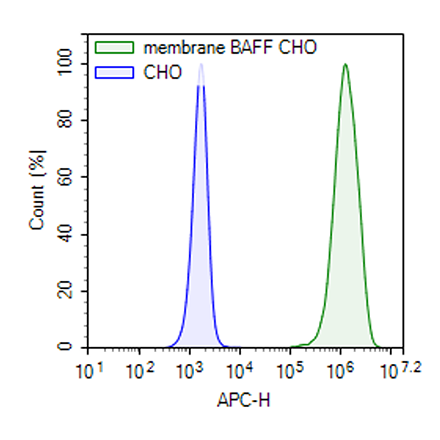
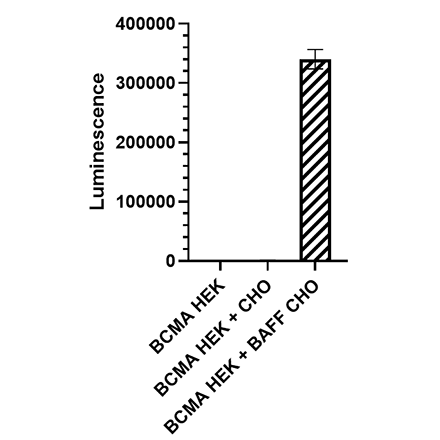
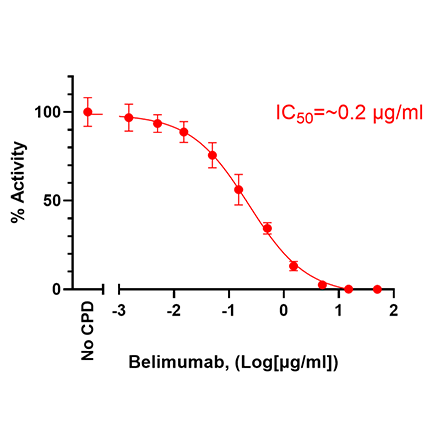
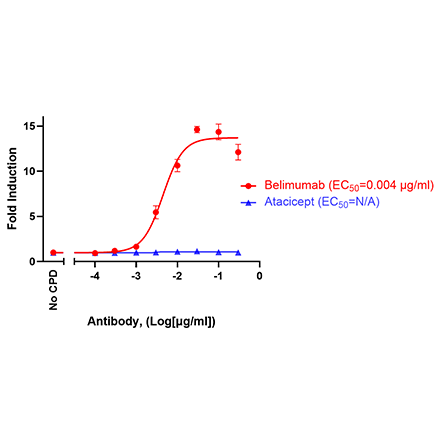
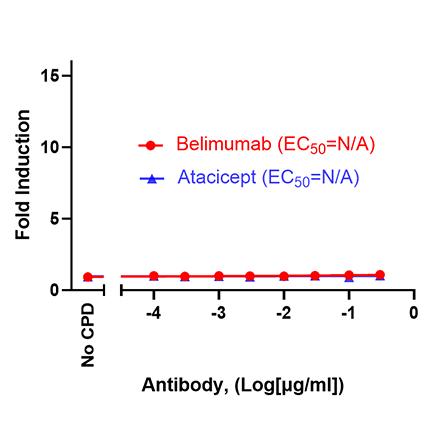
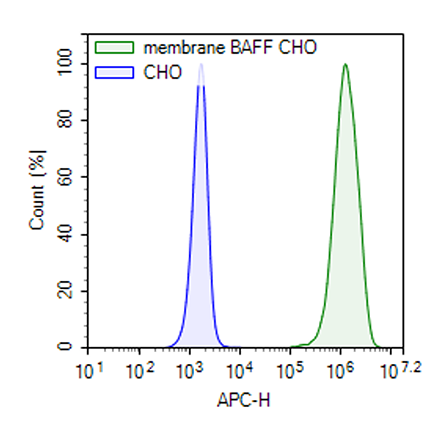
The Membrane BAFF CHO Cell Line is a clonal CHO cell line stably expressing an engineered, cleavage-resistant form of BAFF (TNF family ligand B-cell Activating Factor), that enforces its cell surface localization. This cell line has been validated by flow cytometry and in a co-culture assay with BAFF/APRIL Responsive BCMA-NF-kappaB Luciferase Reporter HEK293 Cell Line (#79755) in the presence of the anti-BAFF antibody Belimumab. The cell line has also been validated by ADCC (antibody dependent cellular cytotoxicity) in a co-culture assay with ADCC Bioassay Effector Cell V Variant (High Affinity)/NFAT Luciferase Reporter Jurkat Cell Line (#60541) in response to Belimumab. The BAFF (tumor necrosis factor family ligand B-cell Activating Factor), also known as BLyS, TALL-1 or CD257, is encoded by the TNFSF13B gene and is a Type II membrane-bound protein, which can be released as a soluble ligand upon proteolytic processing at the furin consensus sequence. This cytokine is a ligand for the receptors Transmembrane Activator and CAML Interactor (TACI or TNFRSF13B), BAFF Receptor (BAFFR, or TNFRSF13C) and B-cell Maturation Antigen (BCMA, TNFRSF17). These interactions promote cell survival and play a crucial role in B cell development. In particular, BAFFR signaling is important in the later stages of B cell differentiation, including the survival of long-lived bone marrow plasma cells and likely for the survival of plasma blasts. BAFF signaling is also required for CCL (chronic lymphocytic leukemia) cell survival. Binding of BAFF to BAFFR results in the degradation of TRAF3 (TNF receptor associated factor 3), which stops the inhibition of SYK and results in activation of pathways necessary for B cells. It also activates the non-canonical slow NF-kappaB2-dependent pathway, which relies on the activation of NIK (NF-kappaB-inducing kinase). Targeting the membrane bound form of BAFF, which is required for the survival of B and plasma cells, has been used as a therapeutic strategy. Belimumab, an antibody that inhibits membrane bound BAFF, has been approved for the treatment of SLE (systemic lupus erythematosus) and lupus nephritis. Further studies around this form of BAFF will open new opportunities for treatment of auto-immune disorders.
| Keywords: | TNFSF13B, Tumor necrosis factor ligand superfamily member 13B, B lymphocyte stimulator, B-cell-activating factor, BAFF, Dendritic cell-derived TNF-like molecule, TNF- and APOL-related leukocyte expressed ligand 1 |
| Supplier: | BPS Bioscience |
| Supplier-Nr: | 83031 |
Properties
| Application: | ADCC (antibody dependent cellular cytotoxicity) studies |
| Host: | Hamster cells |
| Species reactivity: | human |
Database Information
| KEGG ID : | K05476 | Matching products |
| UniProt ID : | Q9Y275 | Matching products |
| Gene ID : | GeneID 10673 | Matching products |
Handling & Safety
| Storage: | -80°C |
| Shipping: | -80°C (International: -80°C) |
Caution
Our products are for laboratory research use only: Not for administration to humans!
Our products are for laboratory research use only: Not for administration to humans!
You will get a certificate here
Viewed