
Cookie preferences
This website uses cookies, which are necessary for the technical operation of the website and are always set. Other cookies, which increase the comfort when using this website, are used for direct advertising or to facilitate interaction with other websites and social networks, are only set with your consent.
Configuration
Technically required
These cookies are necessary for the basic functions of the shop.
"Allow all cookies" cookie
"Decline all cookies" cookie
CSRF token
Cookie preferences
Currency change
Customer-specific caching
FACT-Finder tracking
Individual prices
Selected shop
Session
Comfort functions
These cookies are used to make the shopping experience even more appealing, for example for the recognition of the visitor.
Note
Show the facebook fanpage in the right blod sidebar
Statistics & Tracking
Affiliate program
Conversion and usertracking via Google Tag Manager
Track device being used

| Item number | Size | Datasheet | Manual | SDS | Delivery time | Quantity | Price |
|---|---|---|---|---|---|---|---|
| BPS-83716 | 2 vials | - | - |
3 - 15 business days* |
4,968.00€
|
If you have any questions, please use our Contact Form.
You can also order by e-mail: info@biomol.com
Larger quantity required? Request bulk
You can also order by e-mail: info@biomol.com
Larger quantity required? Request bulk
Cadherin3 (CDH3) HEK293 Cell Line is a HEK293 cell line expressing human CDH3 (Cadherin3,... more
Product information "Cadherin3 (CDH3) HEK293 Cell Line"
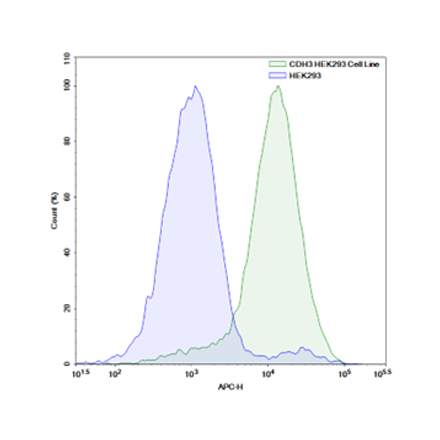
Cadherin3 (CDH3) HEK293 Cell Line is a HEK293 cell line expressing human CDH3 (Cadherin3, NM_001793.6) under the control of a cytomegalovirus (CMV) promoter. This cell line was generated by transfection with CDH3 followed by Hygromycin B selection and limited dilution. Individual clones were screened for CDH3 expression levels by flow cytometry, and a clone was selected to generate this cell line. This cell line has been validated by flow cytometry The CDH3 gene, encoding P-cadherin, is a classical cadherin family member involved in calcium-dependent cell-cell adhesion and maintenance of epithelial tissue architecture. Aberrant overexpression of CDH3 has been reported in several cancers, including breast, gastric, pancreatic, colorectal, and lung cancers, where it is often associated with poor prognosis, enhanced tumor cell proliferation, invasion, and metastasis. Mechanistically, CDH3 can disrupt normal adhesion signaling, promote epithelial-mesenchymal transition (EMT), and activate oncogenic pathways such as Wnt/beta-catenin. Because CDH3 is frequently upregulated in tumors but largely restricted in normal adult tissues, it has emerged as a promising therapeutic target. Recent advances in cancer immunotherapy have explored P-cadherin as an antigen for monoclonal antibodies, antibody-drug conjugates (ADCs), bispecific antibodies, and CAR (chimeric antigen receptor)-T/CAR-NK cell therapies, aiming to selectively eliminate CDH3-expressing tumor cells while sparing normal tissues. This dual role as both a cancer driver and an immunogenic surface protein makes CDH3 a valuable focus for developing targeted therapies in solid tumors.
| Keywords: | CDH3, Cadherin-3, Placental cadherin |
| Supplier: | BPS Bioscience |
| Supplier-Nr: | 83716 |
Properties
| Application: | Therapeutic antibody screening, Co-culture assays |
| Host: | Human cells |
| Species reactivity: | human |
Database Information
| KEGG ID : | K06796 | Matching products |
| UniProt ID : | P22223 | Matching products |
| Gene ID : | GeneID 1001 | Matching products |
Handling & Safety
| Storage: | -80°C |
| Shipping: | -80°C (International: -80°C) |
Caution
Our products are for laboratory research use only: Not for administration to humans!
Our products are for laboratory research use only: Not for administration to humans!
You will get a certificate here
Viewed