
Cookie preferences
This website uses cookies, which are necessary for the technical operation of the website and are always set. Other cookies, which increase the comfort when using this website, are used for direct advertising or to facilitate interaction with other websites and social networks, are only set with your consent.
Configuration
Technically required
These cookies are necessary for the basic functions of the shop.
"Allow all cookies" cookie
"Decline all cookies" cookie
CSRF token
Cookie preferences
Currency change
Customer-specific caching
FACT-Finder tracking
Individual prices
Selected shop
Session
Comfort functions
These cookies are used to make the shopping experience even more appealing, for example for the recognition of the visitor.
Note
Show the facebook fanpage in the right blod sidebar
Statistics & Tracking
Affiliate program
Conversion and usertracking via Google Tag Manager
Track device being used

NEW
If you have any questions, please use our Contact Form.
You can also order by e-mail: info@biomol.com
Larger quantity required? Request bulk
You can also order by e-mail: info@biomol.com
Larger quantity required? Request bulk
The test principle applied in this kit is Sandwich enzyme immunoassay. The microtiter plate... more
Product information "Mouse NPAS4 (Neuronal PAS Domain Protein 4) Microsample ELISA Kit"
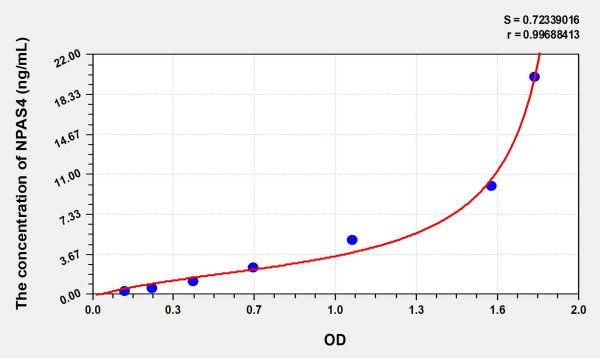
The test principle applied in this kit is Sandwich enzyme immunoassay. The microtiter plate provided in this kit has been pre-coated with an antibody specific to Mouse NPAS4. Standards or samples are added to the appropriate microtiter plate wells then with a biotin-conjugated antibody specific to Mouse NPAS4. Next, Avidin conjugated to Horseradish Peroxidase (HRP) is added to each microplate well and incubated. After TMB substrate solution is added, only those wells that contain Mouse NPAS4, biotin-conjugated antibody and enzyme-conjugated Avidin will exhibit a change in color. The enzyme-substrate reaction is terminated by the addition of sulphuric acid solution and the color change is measured spectrophotometrically at a wavelength of 450nm ± 10nm. The concentration of Mouse NPAS4 in the samples is then determined by comparing the OD of the samples to the standard curve.Detection Range: 0.32-20 ng/mL. Sensitivity: 0.127 ng/mL. Assay Type: Sandwich. Standard: 20 ng/mL. Sample Type: sTissue homogenates, cell lysates and other biological fluids.. Assay duration: 3.5h. Protein Function: Transcription factor expressed in neurons of the brain that regulates the excitatory-inhibitory balance within neural circuits and is required for contextual memory in the hippocampus (PubMed:18815592, PubMed:22194569, PubMed:23029555, PubMed:24201284, PubMed:24855953). Plays a key role in the structural and functional plasticity of neurons (PubMed:23172225). Acts as an early-response transcription factor in both excitatory and inhibitory neurons, where it induces distinct but overlapping sets of late-response genes in these two types of neurons, allowing the synapses that form on inhibitory and excitatory neurons to be modified by neuronal activity in a manner specific to their function within a circuit, thereby facilitating appropriate circuit responses to sensory experience (PubMed:24201284, PubMed:24855953). In excitatory neurons, activates transcription of BDNF, which in turn controls the number of GABA-releasing synapses that form on excitatory neurons, thereby promoting an increased number of inhibitory synapses on excitatory neurons (PubMed:18815592, PubMed:22194569, PubMed:24201284). In inhibitory neurons, regulates a distinct set of target genes that serve to increase excitatory input onto somatostatin neurons, probably resulting in enhanced feedback inhibition within cortical circuits (PubMed:24855953). The excitatory and inhibitory balance in neurons affects a number of processes, such as short-term and long-term memory, acquisition of experience, fear memory, response to stress and social behavior (PubMed:18815592, PubMed:22194569, PubMed:23029555, PubMed:24201284, PubMed:27238022). Acts as a regulator of dendritic spine development in olfactory bulb granule cells in a sensory-experience-dependent manner by regulating expression of MDM2 (PubMed:25088421). Efficient DNA binding requires dimerization with another bHLH protein, such as ARNT, ARNT2 or BMAL1 (PubMed:14701734, PubMed:15363889, PubMed:19284974). Can activate the CME (CNS midline enhancer) element (PubMed:14701734, PubMed:15363889) [The Uniprot Consortium]
| Keywords: | Npas4, Limbic-enhanced PAS protein, HLH-PAS transcription factor NXF, Neuronal PAS domain-containing protein 4 |
| Supplier: | ELK Biotechnology |
| Supplier-Nr: | ELK7294MS |
Properties
| Application: | ELISA |
| Species reactivity: | mouse |
| Format: | Solid Phase |
Database Information
| KEGG ID : | K26457 | Matching products |
| UniProt ID : | Q8BGD7 | Matching products |
| Gene ID : | GeneID 225872 | Matching products |
Handling & Safety
| Storage: | vT |
| Shipping: | +4°C (International: +4°C) |
Caution
Our products are for laboratory research use only: Not for administration to humans!
Our products are for laboratory research use only: Not for administration to humans!
You will get a certificate here
Viewed