
Cookie preferences
This website uses cookies, which are necessary for the technical operation of the website and are always set. Other cookies, which increase the comfort when using this website, are used for direct advertising or to facilitate interaction with other websites and social networks, are only set with your consent.
Configuration
Technically required
These cookies are necessary for the basic functions of the shop.
"Allow all cookies" cookie
"Decline all cookies" cookie
CSRF token
Cookie preferences
Currency change
Customer-specific caching
FACT-Finder tracking
Individual prices
Selected shop
Session
Comfort functions
These cookies are used to make the shopping experience even more appealing, for example for the recognition of the visitor.
Note
Show the facebook fanpage in the right blod sidebar
Statistics & Tracking
Affiliate program
Conversion and usertracking via Google Tag Manager
Track device being used

NEW
If you have any questions, please use our Contact Form.
You can also order by e-mail: info@biomol.com
Larger quantity required? Request bulk
You can also order by e-mail: info@biomol.com
Larger quantity required? Request bulk
The test principle applied in this kit is Sandwich enzyme immunoassay. The microtiter plate... more
Product information "Mouse AIRE (Autoimmune Regulator) Microsample ELISA Kit"
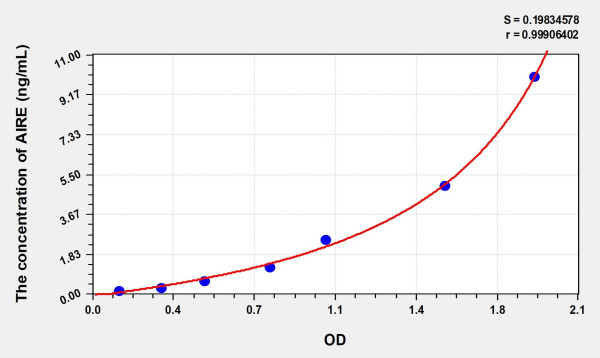
The test principle applied in this kit is Sandwich enzyme immunoassay. The microtiter plate provided in this kit has been pre-coated with an antibody specific to Mouse AIRE. Standards or samples are added to the appropriate microtiter plate wells then with a biotin-conjugated antibody specific to Mouse AIRE. Next, Avidin conjugated to Horseradish Peroxidase (HRP) is added to each microplate well and incubated. After TMB substrate solution is added, only those wells that contain Mouse AIRE, biotin-conjugated antibody and enzyme-conjugated Avidin will exhibit a change in color. The enzyme-substrate reaction is terminated by the addition of sulphuric acid solution and the color change is measured spectrophotometrically at a wavelength of 450nm ± 10nm. The concentration of Mouse AIRE in the samples is then determined by comparing the OD of the samples to the standard curve.Detection Range: 0.16-10 ng/mL. Sensitivity: 0.06 ng/mL. Assay Type: Sandwich. Standard: 10 ng/mL. Sample Type: sTissue homogenates and other biological fluids.. Assay duration: 3.5h. Protein Function: Transcription factor playing an essential role to promote self-tolerance in the thymus by regulating the expression of a wide array of self-antigens that have the commonality of being tissue-restricted in their expression pattern in the periphery, called tissue restricted antigens (TRA) (Probable). Binds to G-doublets in an A/T-rich environment, the preferred motif is a tandem repeat of 5'-. ATTGGTTA-3' combined with a 5'-TTATTA-3' box. Binds to nucleosomes (By similarity). Binds to chromatin and interacts selectively with histone H3 that is not methylated at 'Lys-4', not phosphorylated at 'Thr-3' and not methylated at 'Arg-2'. Functions as a sensor of histone H3 modifications that are important for the epigenetic regulation of gene expression. Mainly expressed by medullary thymic epithelial cells (mTECs), induces the expression of thousands of tissue-restricted proteins, which are presented on major histocompatibility complex class I (MHC-I) and MHC-II molecules to developing T-cells percolating through the thymic medulla (By similarity). Also induces self-tolerance through other mechanisms such as the regulation of the mTEC differentiation program (PubMed:19015306). Controls the medullary accumulation of thymic dendritic cells and the development of regulatory T-cell through the regulation of XCL1 expression (PubMed:21300913). Regulates the production of CCR4 and CCR7 ligands in medullary thymic epithelial cells and alters the coordinated maturation and migration of thymocytes (PubMed:19923453). In thimic B-cells, allows the presentation of licensing-dependent endogenous self-anitgen for negative selection (PubMed:26070482). In secondary lymphoid organs, induces functional inactivation of CD4(+) T-cells. Expressed by a distinct bone marrow-derived population, induces self-tolerance through a mechanism that does not require regulatory T-cells and is resitant to innate inflammatory stimuli (PubMed:23993652) [The Uniprot Consortium]
| Keywords: | Aire, Autoimmune regulator, Autoimmune polyendocrinopathy candidiasis ectodermal dystrophy protein homolog |
| Supplier: | ELK Biotechnology |
| Supplier-Nr: | ELK6262MS |
Properties
| Application: | ELISA |
| Species reactivity: | mouse |
| Format: | Solid Phase |
Database Information
| KEGG ID : | K10603 | Matching products |
| UniProt ID : | Q9Z0E3 | Matching products |
| Gene ID : | GeneID 11634 | Matching products |
Handling & Safety
| Storage: | vT |
| Shipping: | +4°C (International: +4°C) |
Caution
Our products are for laboratory research use only: Not for administration to humans!
Our products are for laboratory research use only: Not for administration to humans!
You will get a certificate here
Viewed