
Cookie preferences
This website uses cookies, which are necessary for the technical operation of the website and are always set. Other cookies, which increase the comfort when using this website, are used for direct advertising or to facilitate interaction with other websites and social networks, are only set with your consent.
Configuration
Technically required
These cookies are necessary for the basic functions of the shop.
"Allow all cookies" cookie
"Decline all cookies" cookie
CSRF token
Cookie preferences
Currency change
Customer-specific caching
FACT-Finder tracking
Individual prices
Selected shop
Session
Comfort functions
These cookies are used to make the shopping experience even more appealing, for example for the recognition of the visitor.
Note
Show the facebook fanpage in the right blod sidebar
Statistics & Tracking
Affiliate program
Conversion and usertracking via Google Tag Manager
Track device being used

If you have any questions, please use our Contact Form.
You can also order by e-mail: info@biomol.com
Larger quantity required? Request bulk
You can also order by e-mail: info@biomol.com
Larger quantity required? Request bulk
The test principle applied in this kit is Sandwich enzyme immunoassay. The microtiter plate... more
Product information "Human IgE (Immunoglobulin E) Microsample ELISA Kit"
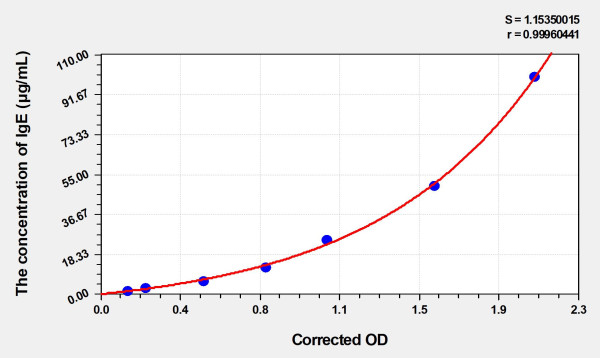
The test principle applied in this kit is Sandwich enzyme immunoassay. The microtiter plate provided in this kit has been pre-coated with an antibody specific to Human IgE. Standards or samples are added to the appropriate microtiter plate wells then with a biotin-conjugated antibody specific to Human IgE. Next, Avidin conjugated to Horseradish Peroxidase (HRP) is added to each microplate well and incubated. After TMB substrate solution is added, only those wells that contain Human IgE, biotin-conjugated antibody and enzyme-conjugated Avidin will exhibit a change in color. The enzyme-substrate reaction is terminated by the addition of sulphuric acid solution and the color change is measured spectrophotometrically at a wavelength of 450nm ± 10nm. The concentration of Human IgE in the samples is then determined by comparing the OD of the samples to the standard curve.Detection Range: 1.57-100 µg/mL. Sensitivity: 0.65 µg/mL. Assay Type: Sandwich. Standard: 100 µg/mL. Sample Type: sserum, plasma, tissue homogenates, cell lysates, cell culture supernates and other biological fluids. Assay duration: 3.5h. Protein Function: Constant region of immunoglobulin heavy chains. Immunoglobulins, also known as antibodies, are membrane-bound or secreted glycoproteins produced by B lymphocytes. In the recognition phase of humoral immunity, the membrane-bound immunoglobulins serve as receptors which, upon binding of a specific antigen, trigger the clonal expansion and differentiation of B lymphocytes into immunoglobulins-secreting plasma cells. Secreted immunoglobulins mediate the effector phase of humoral immunity, which results in the elimination of bound antigens (PubMed:20176268, PubMed:22158414). The antigen binding site is formed by the variable domain of one heavy chain, together with that of its associated light chain. Thus, each immunoglobulin has two antigen binding sites with remarkable affinity for a particular antigen. The variable domains are assembled by a process called V-(D)-J rearrangement and can then be subjected to somatic hypermutations which, after exposure to antigen and selection, allow affinity maturation for a particular antigen (PubMed:17576170, PubMed:20176268) , Constant region of secreted IgE, also known as the Fc region of IgE antibody. Mediates IgE effector functions on myeloid and lymphoid cells primarily via two Fc receptors, the high-affinity IgE Fc receptor complex/FCER1A:MS4A2:FCGR1A and the low-affinity FCER2 receptor, which upon antigen/allergen cross-linking initiate signaling pathways that lead to immune cell activation and differentiation (PubMed:2167225, PubMed:25629393, PubMed:33840121, PubMed:7544003, PubMed:8114916, PubMed:8551243). Triggers the immediate hypersensitivity response to allergens as a host defense mechanism against helminth parasites, pathogenic bacteria and venom toxicity. When dysregulated, it can elicit harmful life-threatening allergic and anaphylactic reactions (PubMed:25629393, PubMed:33840121, PubMed:7544003, PubMed:8114916, PubMed:8551243). Stimulates the high-affinity IgE Fc receptor complex/FCER1A:MS4A2:FCGR1A on mast cells, basophils and eosinophils leading to secretion of vasoactive amines, lipid mediators and cytokines that contribute to inflammatory response, tissue remodeling and cytotoxicity against microbes (PubMed:25629393, PubMed:8114916, PubMed:8551243). On macrophages, cross-linking of FCER2 by IgE immune complexes induces intracellular killing of parasites through activation of L-Arginine-nitric oxide pathway (PubMed:7544003). Activates macrophages to kill tumor cells via antigen-specific antibody-dependent cytotoxicity (ADCC). Triggers differentiation of quiescent M0 macrophages toward M1 state and reprograms M2 macrophages toward a proinflammatory state with antitumor functions (PubMed:30956175). Stimulates FCER2 on B cells and initiates IgE-dependent antigen uptake and presentation to T cells (PubMed:2167225) , Constant region of membrane-bound IgE (long mIgE), part of the B cell receptor complex (BCR). Upon antigen cross-linking triggers quick BCR signaling, ensuring survival of IgE-switched B cells and differentiation into plasma cells, thus regulating both primary and memory IgE responses , Constant region of membrane-bound IgE (short mIgE), part of the B cell receptor complex (BCR). Upon antigen cross-linking initiates slower but sustained BCR signaling that negatively regulates mature B cell proliferation [The Uniprot Consortium]
| Keywords: | IGHE, Ig epsilon chain C region, Ig epsilon chain C region ND, Immunoglobulin heavy constant epsilon |
| Supplier: | ELK Biotechnology |
| Supplier-Nr: | ELK2352MS |
Properties
| Application: | ELISA |
| Species reactivity: | human |
| Format: | Solid Phase |
Database Information
| UniProt ID : | P01854 | Matching products |
Handling & Safety
| Storage: | vT |
| Shipping: | +4°C (International: +4°C) |
Caution
Our products are for laboratory research use only: Not for administration to humans!
Our products are for laboratory research use only: Not for administration to humans!
You will get a certificate here
Viewed