
Cookie preferences
This website uses cookies, which are necessary for the technical operation of the website and are always set. Other cookies, which increase the comfort when using this website, are used for direct advertising or to facilitate interaction with other websites and social networks, are only set with your consent.
Configuration
Technically required
These cookies are necessary for the basic functions of the shop.
"Allow all cookies" cookie
"Decline all cookies" cookie
CSRF token
Cookie preferences
Currency change
Customer-specific caching
FACT-Finder tracking
Individual prices
Selected shop
Session
Comfort functions
These cookies are used to make the shopping experience even more appealing, for example for the recognition of the visitor.
Note
Show the facebook fanpage in the right blod sidebar
Statistics & Tracking
Affiliate program
Conversion and usertracking via Google Tag Manager
Track device being used

NEW
If you have any questions, please use our Contact Form.
You can also order by e-mail: info@biomol.com
Larger quantity required? Request bulk
You can also order by e-mail: info@biomol.com
Larger quantity required? Request bulk
The test principle applied in this kit is Sandwich enzyme immunoassay. The microtiter plate... more
Product information "Human FADS3 (Fatty Acid Desaturase 3) Microsample ELISA Kit"
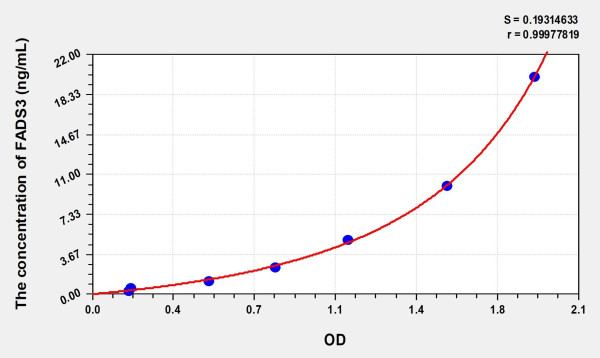
The test principle applied in this kit is Sandwich enzyme immunoassay. The microtiter plate provided in this kit has been pre-coated with an antibody specific to Human FADS3. Standards or samples are added to the appropriate microtiter plate wells then with a biotin-conjugated antibody specific to Human FADS3. Next, Avidin conjugated to Horseradish Peroxidase (HRP) is added to each microplate well and incubated. After TMB substrate solution is added, only those wells that contain Human FADS3, biotin-conjugated antibody and enzyme-conjugated Avidin will exhibit a change in color. The enzyme-substrate reaction is terminated by the addition of sulphuric acid solution and the color change is measured spectrophotometrically at a wavelength of 450nm ± 10nm. The concentration of Human FADS3 in the samples is then determined by comparing the OD of the samples to the standard curve.Detection Range: 0.32-20 ng/mL. Sensitivity: 0.124 ng/mL. Assay Type: Sandwich. Standard: 20 ng/mL. Sample Type: sTissue homogenates and other biological fluids.. Assay duration: 3.5h. Protein Function: Mammals have different sphingoid bases that differ in their length and/or pattern of desaturation and hydroxyl groups. The predominant sphingoid base that comprises mammalian ceramides is sphing-4-enine (sphingosine or SPH) which has a trans (E) desaturation at carbon 4 (PubMed:31862735, PubMed:31916624). FADS3 is a desaturase that introduces a cis (Z) double bond between carbon 14 and carbon 15 of the sphingoid base (also known as long chain base, LCB), producing LCBs such as sphinga-4,14-dienine (SPD, d18:2(4E,14Z)) from SPH (PubMed:31862735, PubMed:31916624, PubMed:37209771). Prefers SPH-containing ceramides (N-acylsphing-4-enines) as substrates (PubMed:31862735, PubMed:31916624, PubMed:37209771). Capable of metabolizing also the SPH in its free form (PubMed:31862735). SPD ceramides occur widely in mammalian tissues and cells (PubMed:31916624). Due to their unusual structure containing a cis double bond, SPD ceramides may have an opposite, negative role in lipid microdomain formation relative to conventional ceramides (PubMed:31916624). Could be involved in the detoxification of 1-deoxy sphingolipids, by desaturating the cytotoxic 1-deoxysphinganine (1-deoxySA, m18:0), produced under pathological conditions, to 1-deoxysphingenine (1-deoxysphingosine, 1-deoxySO, m18:1) (Probable). Although prefers SPH-containing ceramides (N-acylsphing-4-enines) as substrates, it also exhibits activity toward dihydrosphingosine-containing CERs (N-acylsphinganines) and produces 14Z-SPH-containing sphingolipids,which can be found in patients with DEGS1 mutations (PubMed:37209771). Its desaturase mechanism involves an electron transfer facilitated by cytochrome b5 (PubMed:37209771). FADS3 also acts as a methyl-end fatty acyl coenzyme A (CoA) desaturase that introduces a cis double bond between the preexisting double bond and the terminal methyl group of the fatty acyl chain (By similarity). Desaturates (11E)-octadecenoate (trans-vaccenoate, the predominant trans fatty acid in human milk) at carbon 13 to generate (11E,13Z)-octadecadienoate (also known as conjugated linoleic acid 11E,13Z-CLA) (By similarity) [The Uniprot Consortium]
| Keywords: | FADS3, Fatty acid desaturase 3, Delta(13) fatty acid desaturase |
| Supplier: | ELK Biotechnology |
| Supplier-Nr: | ELK3383MS |
Properties
| Application: | ELISA |
| Species reactivity: | human |
| Format: | Solid Phase |
Database Information
| KEGG ID : | K10225 | Matching products |
| UniProt ID : | Q9Y5Q0 | Matching products |
| Gene ID : | GeneID 3995 | Matching products |
Handling & Safety
| Storage: | vT |
| Shipping: | +4°C (International: +4°C) |
Caution
Our products are for laboratory research use only: Not for administration to humans!
Our products are for laboratory research use only: Not for administration to humans!
You will get a certificate here
Viewed