
Cookie preferences
This website uses cookies, which are necessary for the technical operation of the website and are always set. Other cookies, which increase the comfort when using this website, are used for direct advertising or to facilitate interaction with other websites and social networks, are only set with your consent.
Configuration
Technically required
These cookies are necessary for the basic functions of the shop.
"Allow all cookies" cookie
"Decline all cookies" cookie
CSRF token
Cookie preferences
Currency change
Customer-specific caching
FACT-Finder tracking
Individual prices
Selected shop
Session
Comfort functions
These cookies are used to make the shopping experience even more appealing, for example for the recognition of the visitor.
Note
Show the facebook fanpage in the right blod sidebar
Statistics & Tracking
Affiliate program
Conversion and usertracking via Google Tag Manager
Track device being used

If you have any questions, please use our Contact Form.
You can also order by e-mail: info@biomol.com
Larger quantity required? Request bulk
You can also order by e-mail: info@biomol.com
Larger quantity required? Request bulk
The test principle applied in this kit is Sandwich enzyme immunoassay. The microtiter plate... more
Product information "Human CADM1 (Cell Adhesion Molecule 1) Microsample ELISA Kit"
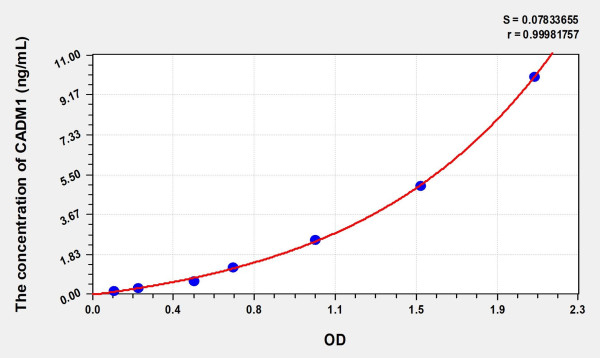
The test principle applied in this kit is Sandwich enzyme immunoassay. The microtiter plate provided in this kit has been pre-coated with an antibody specific to Human CADM1. Standards or samples are added to the appropriate microtiter plate wells then with a biotin-conjugated antibody specific to Human CADM1. Next, Avidin conjugated to Horseradish Peroxidase (HRP) is added to each microplate well and incubated. After TMB substrate solution is added, only those wells that contain Human CADM1, biotin-conjugated antibody and enzyme-conjugated Avidin will exhibit a change in color. The enzyme-substrate reaction is terminated by the addition of sulphuric acid solution and the color change is measured spectrophotometrically at a wavelength of 450nm ± 10nm. The concentration of Human CADM1 in the samples is then determined by comparing the OD of the samples to the standard curve.Detection Range: 0.16-10 ng/mL. Sensitivity: 0.071 ng/mL. Assay Type: Sandwich. Standard: 10 ng/mL. Sample Type: sSerum, plasma, tissue homogenates, cell lysates and other biological fluids.. Assay duration: 3.5h. Protein Function: Mediates homophilic cell-cell adhesion in a Ca(2+)-independent manner (PubMed:12050160, PubMed:22438059). Also mediates heterophilic cell-cell adhesion with CADM3 and NECTIN3 in a Ca(2+)-independent manner (By similarity). Interaction with CRTAM promotes natural killer (NK) cell cytotoxicity and interferon-gamma (IFN-gamma) secretion by CD8+ cells in vitro as well as NK cell-mediated rejection of tumors expressing CADM1 in vivo (PubMed:15811952). In mast cells, may mediate attachment to and promote communication with nerves (PubMed:15905536). CADM1, together with MITF, is essential for development and survival of mast cells in vivo (PubMed:22438059). By interacting with CRTAM and thus promoting the adhesion between CD8+ T-cells and CD8+ dendritic cells, regulates the retention of activated CD8+ T-cell within the draining lymph node (By similarity). Required for the intestinal retention of intraepithelial CD4+ CD8+ T-cells and, to a lesser extent, intraepithelial and lamina propria CD8+ T-cells and CD4+ T-cells (By similarity). Interaction with CRTAM promotes the adhesion to gut-associated CD103+ dendritic cells, which may facilitate the expression of gut-homing and adhesion molecules on T-cells and the conversion of CD4+ T-cells into CD4+ CD8+ T-cells (By similarity). Acts as a synaptic cell adhesion molecule and plays a role in the formation of dendritic spines and in synapse assembly (By similarity). May be involved in neuronal migration, axon growth, pathfinding, and fasciculation on the axons of differentiating neurons (By similarity). May play diverse roles in the spermatogenesis including in the adhesion of spermatocytes and spermatids to Sertoli cells and for their normal differentiation into mature spermatozoa (By similarity). Acts as a tumor suppressor in non-small-cell lung cancer (NSCLC) cells (PubMed:11279526, PubMed:12234973). May contribute to the less invasive phenotypes of lepidic growth tumor cells (PubMed:12920246) , (Microbial infection) Induces cell fusion in neuron infected by a neuropathogenic strain of measles. Interacts with measles hemagglutinin to trigger hyperfusogenic F-mediated membrane fusion and presumably transsynaptic cell-to-cell transmission of the virus [The Uniprot Consortium]
| Keywords: | CADM1, Nectin-like protein 2, Cell adhesion molecule 1, Synaptic cell adhesion molecule, Tumor suppressor in lung cancer 1, Immunoglobulin superfamily member 4, Spermatogenic immunoglobulin superfamily |
| Supplier: | ELK Biotechnology |
| Supplier-Nr: | ELK3689MS |
Properties
| Application: | ELISA |
| Species reactivity: | human |
| Format: | Solid Phase |
Database Information
| KEGG ID : | K06781 | Matching products |
| UniProt ID : | Q9BY67 | Matching products |
| Gene ID : | GeneID 23705 | Matching products |
Handling & Safety
| Storage: | vT |
| Shipping: | +4°C (International: +4°C) |
Caution
Our products are for laboratory research use only: Not for administration to humans!
Our products are for laboratory research use only: Not for administration to humans!
You will get a certificate here
Viewed