
Alternative Complement Pathway, Mouse, Assay

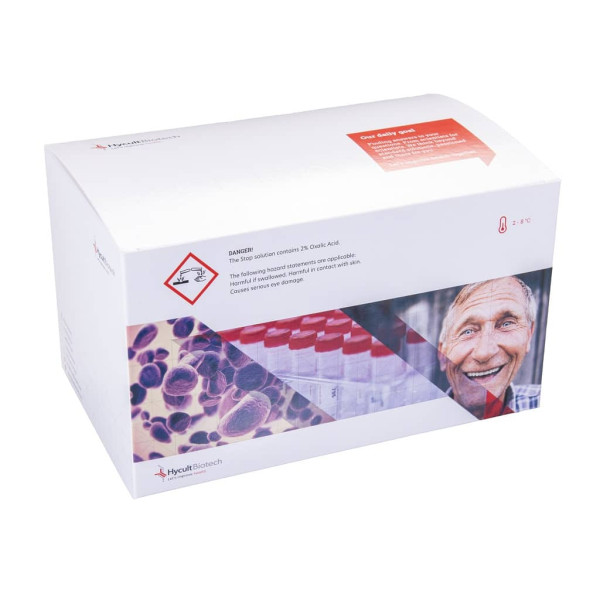
| Item number | Size | Datasheet | Manual | SDS | Delivery time | Quantity | Price |
|---|---|---|---|---|---|---|---|
| HYC-HIT422 | 96 tests (1 x 96 det.) | - |
Request delivery time estimate |
929.00€
|
If you have any questions, please use our Contact Form.
You can also order by e-mail: info@biomol.com
Larger quantity required? Request bulk
You can also order by e-mail: info@biomol.com
Larger quantity required? Request bulk
The HIT422 measures the alternative pathway activity mediated via LPS. Complement deficiencies or... more
Product information "Alternative Complement Pathway, Mouse, Assay"
The HIT422 measures the alternative pathway activity mediated via LPS. Complement deficiencies or other defects in the complement system can easily be screened by running an assay for each pathway in parallel or separately. The ELISA contains a positive control which can be used as control to ensure that the alternative complement cascade has run completely. This positive control cannot be used to determine the level of activation between batches. We advise to include in your study your own reference sample for 100% complement activity and negative control (e.g. non-preserved activated serum) to determine the level of activation of your samples. Beware that complement activity levels are mouse strain dependent and might be affected by the way the samples are collected and processed. The innate immune system is important in the first defense against foreign pathogens. A major component of this response is the complement system. The complement system consist of a complex family of proteins and receptors which are found in the circulation, in tissues and other body-fluids. Nowadays, also several links to the adaptive immunity are described. The system consist of three defined pathways which are activated by a pathway specific panel of molecules. Complement activation proceeds in a sequential fashion through the proteolytic cleavage of a series of proteins leading to the generation of activated products that mediate various biological activities through their interaction with specific cellular receptors and other serum proteins. The three pathways, designated classical, lectin and alternative pathway, converge at a central component into a final common pathway. That is activation of C3 leading to formation of C3a and C3b. This cleavage activates the terminal complement pathway leading to eventually the formation of the terminal C5b-9 complement complex (TCC). The classical pathway is initiated by binding of C1q to antibody complexes, whereas the alternative and lectin pathway are activated in an antibody-independent fashion through the interaction of complement components with respectively specific carbohydrate groups and lipopolysaccharides (LPS) on the surface of foreign pathogens. The alternative pathway also acts as an amplification loop of the other pathways. Under certain conditions, the complement system can be unfavorable to the host leading to e.g. autoimmune diseases and infections. Deficiency of C3 is e.g. associated with SLE. Alterations in the alternative pathway, like properdin or ficolin deficiency, increase the susceptibility to infection. Mannose binding lectin (MBL), a major component of the lectin pathway, is associated with bacterial, fungal and viral infection. A common way to measure the activity of the classical or alternative pathway is the hemolysis of erythrocytes. Furthermore some assays have been described to measure the activity of the MBL pathway. These assays are strenuous and not straightforward when it comes to the assay procedure. The mouse pathway ELISAs are easy to use and specific per pathway by making use of a combination of specialized coatings and buffers. Complement deficiencies or other defects in the complement system can easily be screened by running an assay for each pathway in parallel or separately.
| Keywords: | AP, alternative pathway |
| Supplier: | Hycult Biotech |
| Supplier-Nr: | HIT422 |
Properties
| Application: | ELISA |
| Species reactivity: | mouse |
| Format: | Solid Phase |
Database Information
Handling & Safety
| Storage: | +4°C |
| Shipping: | +20°C (International: °C) |
| Signal Word: | Danger |
| GHS Hazard Pictograms: |

|
| H Phrases: | H302, H314, H318 |
| P Phrases: | P305+P351+P338 |
Caution
Our products are for laboratory research use only: Not for administration to humans!
Our products are for laboratory research use only: Not for administration to humans!
You will get a certificate here
Viewed