This website uses cookies, which are necessary for the technical operation of the website and are always set. Other cookies, which increase the comfort when using this website, are used for direct advertising or to facilitate interaction with other websites and social networks, are only set with your consent.
Configuration
Technically required
These cookies are necessary for the basic functions of the shop.
"Allow all cookies" cookie
"Decline all cookies" cookie
CSRF token
Cookie preferences
Currency change
Customer-specific caching
FACT-Finder tracking
Individual prices
Selected shop
Session
Comfort functions
These cookies are used to make the shopping experience even more appealing, for example for the recognition of the visitor.
Note
Show the facebook fanpage in the right blod sidebar
Statistics & Tracking
Affiliate program
Conversion and usertracking via Google Tag Manager
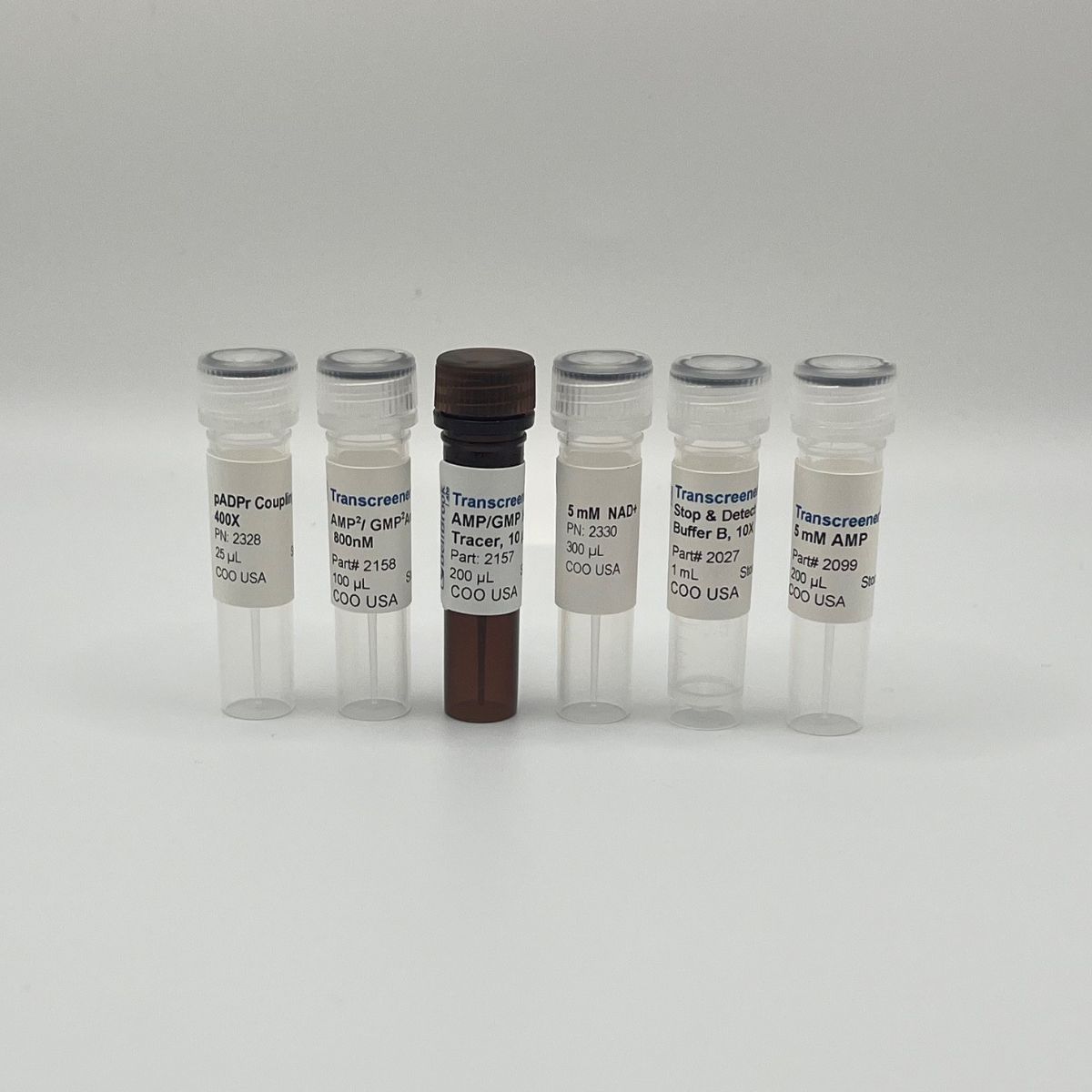
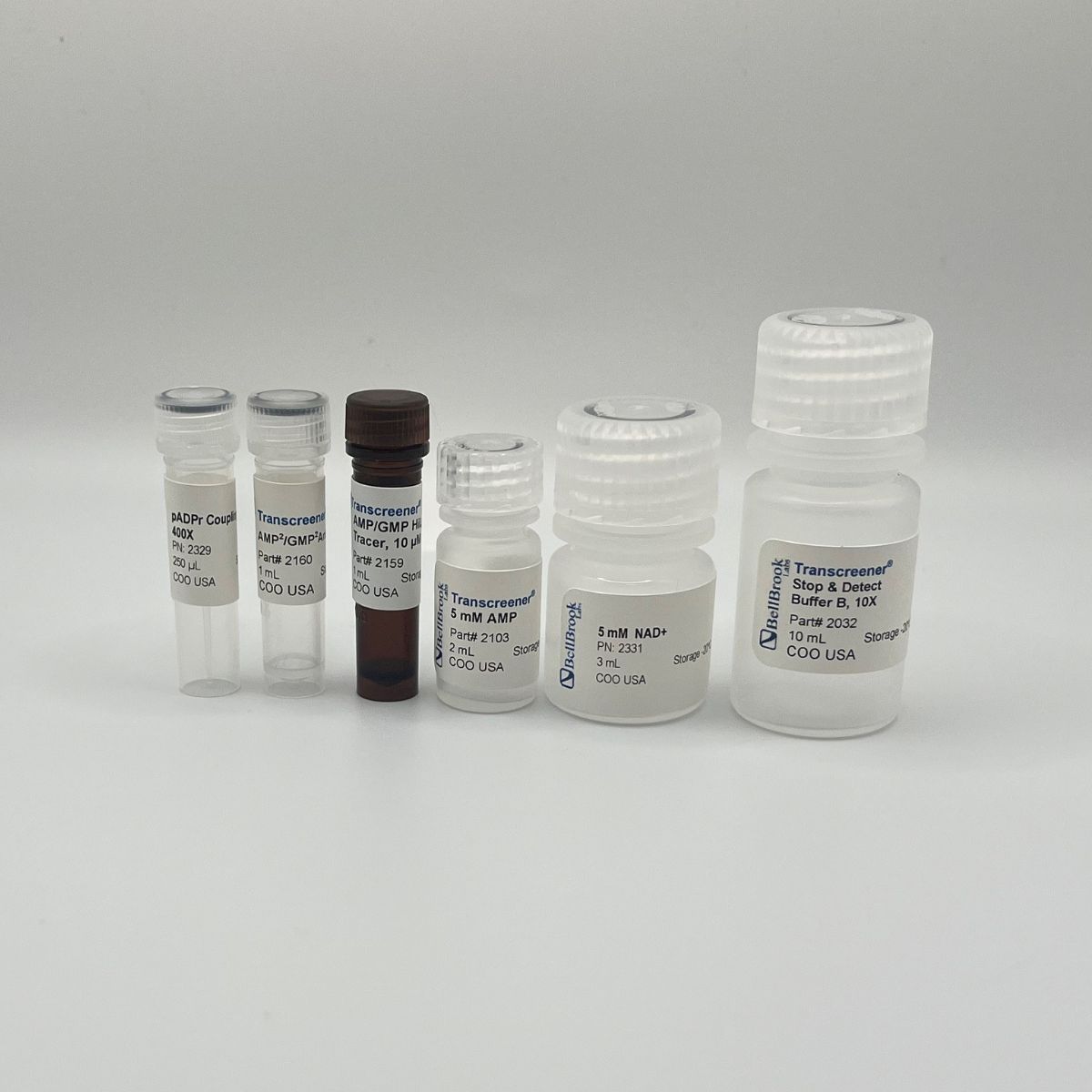
Product information "Transcreener(R) pADPr PARP TR-FRET Assay"
The Transcreener(R) pADPr PARP TR-FRET Assay is a biochemical HTS assay for measuring the production of poly(ADP-ribose) (pADPr) in poly(ADP-ribose) polymerase (PARP) reactions. The assay relies on pADPr Coupling Enzymes (CE) to convert pADPr into AMP, which is then detected using a far-red, timeresolved Förster-resonance-energy-transfer (TR-FRET) readout. As an example, the Transcreener pADPr PARP TR-FRET assay can be used to detect the activity of human PARP1, which uses NAD+ to form pADPr on itself, histones, and DNA repair proteins. The Transcreener pADPr PARP TR-FRET assay is designed specifically for high throughput screening (HTS), with a single-addition, mix-and-read format. It is easy to integrate into automated HTS workflows, with outstanding reagent stability (deck stability > 16 hours, signal stability > 24 hours), robust detection of ADPR monomers released from pADPr over a range of down to 10 nM and as high as 100 µM, and compatibility with commonly used multimode plate readers. Data quality is excellent (Z' > 0.7), and the assay uses a far-red tracer to minimize interference from fluorescent compounds and light scattering.

This website uses cookies, which are necessary for the technical operation of the website and are always set. Other cookies, which increase the usability of this website, serve for direct advertising or simplify interaction with other websites and social networks, will only be used with your consent.
More information