
Cookie preferences
This website uses cookies, which are necessary for the technical operation of the website and are always set. Other cookies, which increase the comfort when using this website, are used for direct advertising or to facilitate interaction with other websites and social networks, are only set with your consent.
Configuration
Technically required
These cookies are necessary for the basic functions of the shop.
"Allow all cookies" cookie
"Decline all cookies" cookie
CSRF token
Cookie preferences
Currency change
Customer-specific caching
FACT-Finder tracking
Individual prices
Selected shop
Session
Comfort functions
These cookies are used to make the shopping experience even more appealing, for example for the recognition of the visitor.
Note
Show the facebook fanpage in the right blod sidebar
Statistics & Tracking
Affiliate program
Conversion and usertracking via Google Tag Manager
Track device being used

NEW
| Item number | Size | Datasheet | Manual | SDS | Delivery time | Quantity | Price |
|---|---|---|---|---|---|---|---|
| ABS-ES-021.1 | 1 pair (100 µg/100 µg) | - | - |
10 - 14 business days* |
1,080.00€
|
If you have any questions, please use our Contact Form.
You can also order by e-mail: info@biomol.com
Larger quantity required? Request bulk
You can also order by e-mail: info@biomol.com
Larger quantity required? Request bulk
Product Description: The UCHL1 gene provides instructions for making an enzyme called ubiquitin... more
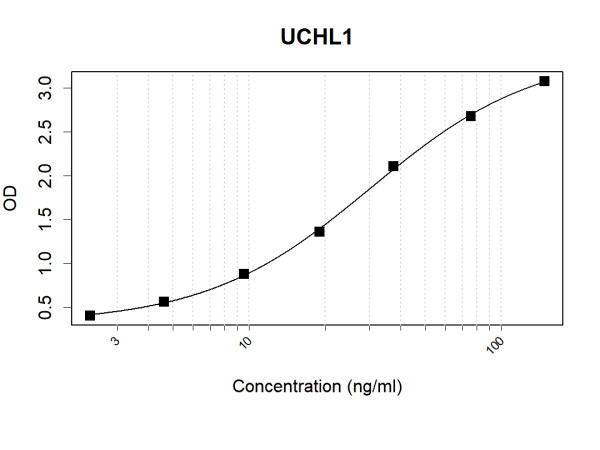
Product information "Anti-Human PGP9.5 Antibody Pair"
Product Description: The UCHL1 gene provides instructions for making an enzyme called ubiquitin carboxyl-terminal esterase L1 (UCH-L1). This enzyme is found in nerve cells throughout the brain and is involved in the cell machinery that breaks down (degrades) unneeded proteins. Several functions of UCH-L1 have been proposed, including ubiquitin hydrolase activity, ubiquitin ligase activity, and stabilization of the mono-ubiquitin pool. Dysfunction of UCH-L1 has been reported in various neurodegenerative diseases. Specific mutations in the UCHL1 gene, such as I93M and E7A, have been linked to early-onset Parkinson's disease and other neurological disorders, likely due to disruption of the ubiquitin-proteasome system and accumulation of toxic protein aggregates. Overexpression of UCH-L1 has also been shown to affect Alzheimer's disease pathology by regulating amyloid-beta production. Overall, the proper function of UCH-L1 appears crucial for maintaining neuronal health and preventing the development of neurodegenerative diseases. Protein Function: Deubiquitinase that plays a role in the regulation of several processes such as maintenance of synaptic function, cardiac function, inflammatory response or osteoclastogenesis (PubMed:22212137, PubMed:23359680). Abrogates the ubiquitination of multiple proteins including WWTR1/TAZ, EGFR, HIF1A and beta-site amyloid precursor protein cleaving enzyme 1/BACE1 (PubMed:22212137, PubMed:25615526). In addition, recognizes and hydrolyzes a peptide bond at the C-terminal glycine of ubiquitin to maintain a stable pool of monoubiquitin that is a key requirement for the ubiquitin-proteasome and the autophagy-lysosome pathways (PubMed:12408865, PubMed:8639624, PubMed:9774100). Regulates amyloid precursor protein/APP processing by promoting BACE1 degradation resulting in decreased amyloid beta production (PubMed:22212137). Plays a role in the immune response by regulating the ability of MHC I molecules to reach cross-presentation compartments competent for generating Ag-MHC I complexes (By similarity). Mediates the 'Lys-48'-linked deubiquitination of the transcriptional coactivator WWTR1/TAZ leading to its stabilization and inhibition of osteoclastogenesis (By similarity). Deubiquitinates and stabilizes epidermal growth factor receptor EGFR to prevent its degradation and to activate its downstream mediators (By similarity). Modulates oxidative activity in skeletal muscle by regulating key mitochondrial oxidative proteins (By similarity). Enhances the activity of hypoxia-inducible factor 1-alpha/HIF1A by abrogateing its VHL E3 ligase-mediated ubiquitination and consequently inhibiting its degradation (PubMed:25615526) [The Uniprot Consortium]
| Keywords: | Anti-UCHL1, Anti-PGP 9.5, Anti-Ubiquitin thioesterase L1, Anti-Neuron cytoplasmic protein 9.5, Anti-Ubiquitin carboxyl-terminal hydrolase isozyme L1, Human PGP9.5 Antibody Pair |
| Supplier: | Absea |
| Supplier-Nr: | ES-021 |
Properties
| Application: | ELISA |
| Antibody Type: | Monoclonal |
| Clone: | K52010_14C5/K49007_4E11 |
| Conjugate: | No |
| Host: | Mouse/Mouse |
| Species reactivity: | human |
| Purity: | >85% |
| Format: | Solution |
Database Information
| KEGG ID : | K05611 | Matching products |
| UniProt ID : | P09936 | Matching products |
| Gene ID : | GeneID 7345 | Matching products |
Handling & Safety
| Storage: | -20°C (avoid repeat freezing and thawing cycles) |
| Shipping: | -20°C (International: +4°C) |
Caution
Our products are for laboratory research use only: Not for administration to humans!
Our products are for laboratory research use only: Not for administration to humans!
You will get a certificate here
Viewed