
Cookie preferences
This website uses cookies, which are necessary for the technical operation of the website and are always set. Other cookies, which increase the comfort when using this website, are used for direct advertising or to facilitate interaction with other websites and social networks, are only set with your consent.
Configuration
Technically required
These cookies are necessary for the basic functions of the shop.
"Allow all cookies" cookie
"Decline all cookies" cookie
CSRF token
Cookie preferences
Currency change
Customer-specific caching
FACT-Finder tracking
Individual prices
Selected shop
Session
Comfort functions
These cookies are used to make the shopping experience even more appealing, for example for the recognition of the visitor.
Note
Show the facebook fanpage in the right blod sidebar
Statistics & Tracking
Affiliate program
Conversion and usertracking via Google Tag Manager
Track device being used

NEW
| Item number | Size | Datasheet | Manual | SDS | Delivery time | Quantity | Price |
|---|---|---|---|---|---|---|---|
| ABS-ES-1690.1 | 1 pair (100 µg/100 µg) | - | - |
10 - 14 business days* |
1,080.00€
|
If you have any questions, please use our Contact Form.
You can also order by e-mail: info@biomol.com
Larger quantity required? Request bulk
You can also order by e-mail: info@biomol.com
Larger quantity required? Request bulk
Product Description: Macrophage erythroblast attacher, E3 ubiquitin ligase (MAEA) is a... more
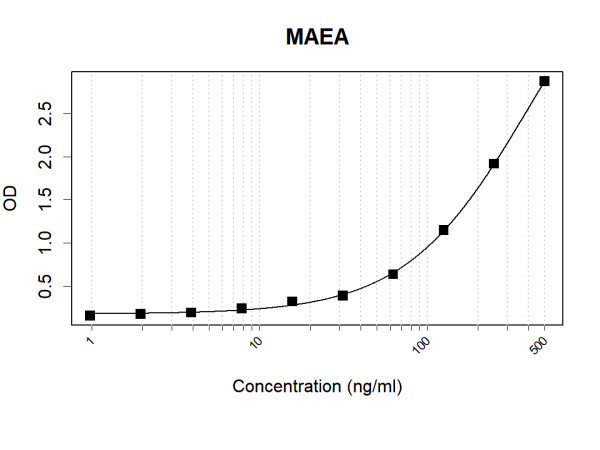
Product information "Anti-Human MAEA Antibody Pair"
Product Description: Macrophage erythroblast attacher, E3 ubiquitin ligase (MAEA) is a multifunctional protein that serves as a core component of the CTLH E3 ubiquitin-protein ligase complex, selectively accepting ubiquitin from UBE2H to mediate ubiquitination and subsequent proteasomal degradation of transcription factor HBP1. MAEA plays a crucial role in erythropoiesis by mediating the attachment of erythroblasts to macrophages, promoting terminal maturation and enucleation of erythrocytes while inhibiting erythroid cell apoptosis. It participates in erythroblastic island formation, the functional unit of definitive erythropoiesis, and associates with F-actin to regulate actin distribution in erythroblasts and macrophages. Recent studies have shown MAEA is essential for hematopoietic stem cell (HSC) maintenance and lymphoid potential, with its deletion in mice severely impairing HSC quiescence and leading to a lethal myeloproliferative syndrome. MAEA has been associated with several diseases including type 2 diabetes mellitus, various hemoglobinopathies (hemoglobin D and E diseases), hereditary elliptocytosis, myelofibrosis, and cancer. Protein Function: Core component of the CTLH E3 ubiquitin-protein ligase complex that selectively accepts ubiquitin from UBE2H and mediates ubiquitination and subsequent proteasomal degradation of the transcription factor HBP1. MAEA and RMND5A are both required for catalytic activity of the CTLH E3 ubiquitin-protein ligase complex (PubMed:29911972). MAEA is required for normal cell proliferation (PubMed:29911972). The CTLH E3 ubiquitin-protein ligase complex is not required for the degradation of enzymes involved in gluconeogenesis, such as FBP1 (PubMed:29911972). Plays a role in erythroblast enucleation during erythrocyte maturation and in the development of mature macrophages (By similarity). Mediates the attachment of erythroid cell to mature macrophages, this MAEA-mediated contact inhibits erythroid cell apoptosis (PubMed:9763581). Participates in erythroblastic island formation, which is the functional unit of definitive erythropoiesis. Associates with F-actin to regulate actin distribution in erythroblasts and macrophages (By similarity). May contribute to nuclear architecture and cells division events (Probable) [The Uniprot Consortium]
| Keywords: | Anti-MAEA, Anti-P44EMLP, Anti-Erythroblast macrophage protein, Anti-Macrophage erythroblast attacher, Anti-Human lung cancer oncogene 10 protein, Anti-E3 ubiquitin-protein transferase MAEA, Anti-Cell proliferation-inducing gene 5 protein, Human MAEA Antib |
| Supplier: | Absea |
| Supplier-Nr: | ES-1690 |
Properties
| Application: | ELISA |
| Antibody Type: | Monoclonal |
| Clone: | K1H023_12C6/K1H023_9B10 |
| Conjugate: | No |
| Host: | Mouse/Mouse |
| Species reactivity: | human |
| Purity: | >85% |
| Format: | Solution |
Database Information
| KEGG ID : | K18624 | Matching products |
| UniProt ID : | Q7L5Y9 | Matching products |
| Gene ID : | GeneID 10296 | Matching products |
Handling & Safety
| Storage: | -20°C (avoid repeat freezing and thawing cycles) |
| Shipping: | -20°C (International: +4°C) |
Caution
Our products are for laboratory research use only: Not for administration to humans!
Our products are for laboratory research use only: Not for administration to humans!
You will get a certificate here
Viewed