
Cookie preferences
This website uses cookies, which are necessary for the technical operation of the website and are always set. Other cookies, which increase the comfort when using this website, are used for direct advertising or to facilitate interaction with other websites and social networks, are only set with your consent.
Configuration
Technically required
These cookies are necessary for the basic functions of the shop.
"Allow all cookies" cookie
"Decline all cookies" cookie
CSRF token
Cookie preferences
Currency change
Customer-specific caching
FACT-Finder tracking
Individual prices
Selected shop
Session
Comfort functions
These cookies are used to make the shopping experience even more appealing, for example for the recognition of the visitor.
Note
Show the facebook fanpage in the right blod sidebar
Statistics & Tracking
Affiliate program
Conversion and usertracking via Google Tag Manager
Track device being used

NEW
| Item number | Size | Datasheet | Manual | SDS | Delivery time | Quantity | Price |
|---|---|---|---|---|---|---|---|
| ABS-ES-064.1 | 1 pair (100 µg/100 µg) | - | - |
10 - 14 business days* |
1,080.00€
|
If you have any questions, please use our Contact Form.
You can also order by e-mail: info@biomol.com
Larger quantity required? Request bulk
You can also order by e-mail: info@biomol.com
Larger quantity required? Request bulk
Product Description: INHBA, or Inhibin Subunit Beta A, is a gene that encodes a member of the... more
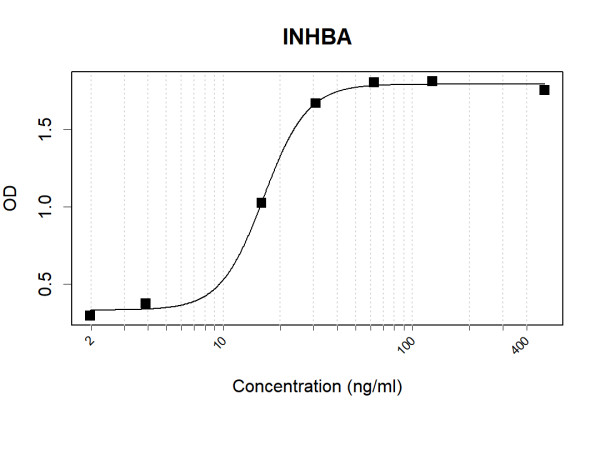
Product information "Anti-Human Inhibin beta A Antibody Pair"
Product Description: INHBA, or Inhibin Subunit Beta A, is a gene that encodes a member of the transforming growth factor-beta (TGF-beta) superfamily of proteins. The INHBA protein plays a key role in regulating follicle-stimulating hormone secretion from the pituitary gland, and is also involved in eye, tooth, and testis development. Elevated expression of INHBA has been associated with various types of cancer, including colorectal cancer, gastric cancer, and head and neck squamous cell carcinoma. Studies have shown that INHBA promotes the proliferation, migration, and invasion of cancer cells, and its overexpression is correlated with poor prognosis and reduced overall survival in cancer patients. The high expression of INHBA in cancer is also linked to increased immune cell infiltration, particularly of macrophages, mast cells, natural killer cells, neutrophils, Th2 cells, and eosinophils. These findings suggest that INHBA plays a critical role in cancer progression and may serve as a potential biomarker and therapeutic target for various types of cancer. Protein Function: Inhibins/activins are involved in regulating a number of diverse functions such as hypothalamic and pituitary hormone secretion, gonadal hormone secretion, germ cell development and maturation, erythroid differentiation, insulin secretion, nerve cell survival, embryonic axial development or bone growth, depending on their subunit composition , Activin A is a homodimer of INHBA that plays a role in several essential biological processes including embryonic development, stem cell maintenance and differentiation, haematopoiesis, cell proliferation and tissue fibrosis (PubMed:3194407, PubMed:16440334). Signals through type I (such as ACVR1B or ACVR1C) and type II receptors (such as ACVR2A, ACVR2B or BMPR2) which, upon ligand binding, phosphorylate SMAD2 and SMAD3 intracellular signaling mediators that form a complex with SMAD4, translocate to the nucleus and modulate gene expression (PubMed:10652306, PubMed:24018044). Can also activate alternative non-canonical intracellular signaling pathways including the p38 MAPK, extracellular signal-regulated kinases 1/2 (ERK1/2) and c-Jun N-terminal kinases (JNKs) to modulate cell migration and differentiation (PubMed:16440334). Alternatively, promotes osteoblastic differentiation via ACVRL1-SMAD1/5/9 pathway (PubMed:34948289). In addition, can engage the type I receptor ACVR1 to form an ACVR1-activin A-type II receptor non-signaling complex (NSC) that renders receptors unavailable for engagement with BMPs, hence resulting in an apparent inhibition of ACVR1-mediated BMP signaling (PubMed:26333933) , Inhibin A is a dimer of alpha/INHA and beta-A/INHBA that functions as a feedback regulator in the hypothalamic-pituitary-gonadal (HPG) axis. Inhibits the secretion of FSH from the anterior pituitary gland by acting on pituitary gonadotrope cells. Antagonizes activin A by binding to the proteoglycan, betaglycan, and forming a stable complex with and, thereby, sequestering type II activin receptors while excluding type I receptor [The Uniprot Consortium]
| Keywords: | Anti-INHBA, Anti-Inhibin beta A chain, Anti-Activin beta-A chain, Anti-Erythroid differentiation protein, Human Inhibin beta A Antibody Pair |
| Supplier: | Absea |
| Supplier-Nr: | ES-064 |
Properties
| Application: | ELISA |
| Antibody Type: | Monoclonal |
| Clone: | KAA378_7F6/KAA378_14E10 |
| Conjugate: | No |
| Host: | Mouse/Mouse |
| Species reactivity: | human |
| Purity: | >85% |
| Format: | Solution |
Database Information
| KEGG ID : | K04667 | Matching products |
| UniProt ID : | P08476 | Matching products |
| Gene ID : | GeneID 3624 | Matching products |
Handling & Safety
| Storage: | -20°C (avoid repeat freezing and thawing cycles) |
| Shipping: | -20°C (International: +4°C) |
Caution
Our products are for laboratory research use only: Not for administration to humans!
Our products are for laboratory research use only: Not for administration to humans!
You will get a certificate here
Viewed