
Cookie preferences
This website uses cookies, which are necessary for the technical operation of the website and are always set. Other cookies, which increase the comfort when using this website, are used for direct advertising or to facilitate interaction with other websites and social networks, are only set with your consent.
Configuration
Technically required
These cookies are necessary for the basic functions of the shop.
"Allow all cookies" cookie
"Decline all cookies" cookie
CSRF token
Cookie preferences
Currency change
Customer-specific caching
FACT-Finder tracking
Individual prices
Selected shop
Session
Comfort functions
These cookies are used to make the shopping experience even more appealing, for example for the recognition of the visitor.
Note
Show the facebook fanpage in the right blod sidebar
Statistics & Tracking
Affiliate program
Conversion and usertracking via Google Tag Manager
Track device being used

NEW
| Item number | Size | Datasheet | Manual | SDS | Delivery time | Quantity | Price |
|---|---|---|---|---|---|---|---|
| ABS-ES-2162.1 | 1 pair (100 µg/100 µg) | - | - |
10 - 14 business days* |
1,080.00€
|
If you have any questions, please use our Contact Form.
You can also order by e-mail: info@biomol.com
Larger quantity required? Request bulk
You can also order by e-mail: info@biomol.com
Larger quantity required? Request bulk
Product Description: TSC complex subunit 1 (TSC1), also known as hamartin, is a tumor suppressor... more
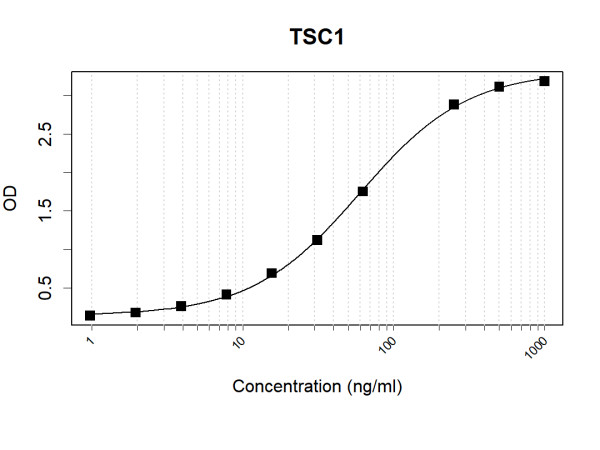
Product information "Anti-Human Hamartin Antibody Pair"
Product Description: TSC complex subunit 1 (TSC1), also known as hamartin, is a tumor suppressor protein that plays a crucial role in regulating cell growth and proliferation. TSC1 forms a multi-protein complex with TSC2 (tuberin) and TBC1D7, creating an elongated, scorpion-like structure where TSC1's coiled-coil backbone runs along the TSC2 dimer, breaking its symmetry and facilitating complex assembly. This complex acts as a GTPase-activating protein (GAP) for the small GTPase Rheb, thereby negatively regulating the mammalian target of rapamycin complex 1 (mTORC1), a central controller of anabolic cell growth. TSC1 also functions as a co-chaperone for Hsp90, inhibiting its ATPase activity and stabilizing client proteins, including TSC2, by preventing their ubiquitination and proteasomal degradation. Mutations in TSC1 disrupt these regulatory functions, leading to diseases such as tuberous sclerosis complex-a genetic disorder characterized by benign tumor growth in multiple organs-and lymphangioleiomyomatosis. Protein Function: Non-catalytic component of the TSC-TBC complex, a multiprotein complex that acts as a negative regulator of the canonical mTORC1 complex, an evolutionarily conserved central nutrient sensor that stimulates anabolic reactions and macromolecule biosynthesis to promote cellular biomass generation and growth (PubMed:12172553, PubMed:12271141, PubMed:12906785, PubMed:15340059, PubMed:24529379, PubMed:28215400). The TSC-TBC complex acts as a GTPase-activating protein (GAP) for the small GTPase RHEB, a direct activator of the protein kinase activity of mTORC1 (PubMed:12906785, PubMed:15340059, PubMed:24529379). In absence of nutrients, the TSC-TBC complex inhibits mTORC1, thereby preventing phosphorylation of ribosomal protein S6 kinase (RPS6KB1 and RPS6KB2) and EIF4EBP1 (4E-BP1) by the mTORC1 signaling (PubMed:12271141, PubMed:24529379, PubMed:28215400, PubMed:33215753). The TSC-TBC complex is inactivated in response to nutrients, relieving inhibition of mTORC1 (PubMed:12172553, PubMed:24529379). Within the TSC-TBC complex, TSC1 stabilizes TSC2 and prevents TSC2 self-aggregation (PubMed:10585443, PubMed:28215400). Acts as a tumor suppressor (PubMed:9242607). Involved in microtubule-mediated protein transport via its ability to regulate mTORC1 signaling (By similarity). Also acts as a co-chaperone for HSP90AA1 facilitating HSP90AA1 chaperoning of protein clients such as kinases, TSC2 and glucocorticoid receptor NR3C1 (PubMed:29127155). Increases ATP binding to HSP90AA1 and inhibits HSP90AA1 ATPase activity (PubMed:29127155). Competes with the activating co-chaperone AHSA1 for binding to HSP90AA1, thereby providing a reciprocal regulatory mechanism for chaperoning of client proteins (PubMed:29127155). Recruits TSC2 to HSP90AA1 and stabilizes TSC2 by preventing the interaction between TSC2 and ubiquitin ligase HERC1 (PubMed:16464865, PubMed:29127155) [The Uniprot Consortium]
| Keywords: | Anti-TSC1, Anti-Hamartin, Anti-Tuberous sclerosis 1 protein, Human Hamartin Antibody Pair |
| Supplier: | Absea |
| Supplier-Nr: | ES-2162 |
Properties
| Application: | ELISA |
| Antibody Type: | Monoclonal |
| Clone: | K56019_1B7/K56019_3H5 |
| Conjugate: | No |
| Host: | Mouse/Mouse |
| Species reactivity: | human |
| Purity: | >85% |
| Format: | Solution |
Database Information
| KEGG ID : | K07206 | Matching products |
| UniProt ID : | Q92574 | Matching products |
| Gene ID : | GeneID 7248 | Matching products |
Handling & Safety
| Storage: | -20°C (avoid repeat freezing and thawing cycles) |
| Shipping: | -20°C (International: +4°C) |
Caution
Our products are for laboratory research use only: Not for administration to humans!
Our products are for laboratory research use only: Not for administration to humans!
You will get a certificate here
Viewed