
Cookie preferences
This website uses cookies, which are necessary for the technical operation of the website and are always set. Other cookies, which increase the comfort when using this website, are used for direct advertising or to facilitate interaction with other websites and social networks, are only set with your consent.
Configuration
Technically required
These cookies are necessary for the basic functions of the shop.
"Allow all cookies" cookie
"Decline all cookies" cookie
CSRF token
Cookie preferences
Currency change
Customer-specific caching
FACT-Finder tracking
Individual prices
Selected shop
Session
Comfort functions
These cookies are used to make the shopping experience even more appealing, for example for the recognition of the visitor.
Note
Show the facebook fanpage in the right blod sidebar
Statistics & Tracking
Affiliate program
Conversion and usertracking via Google Tag Manager
Track device being used

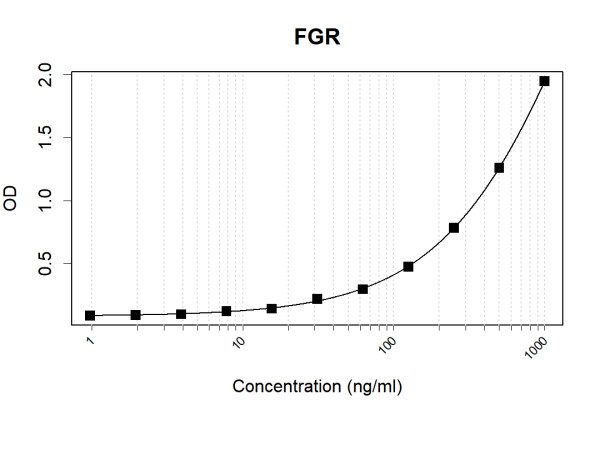
| Item number | Size | Datasheet | Manual | SDS | Delivery time | Quantity | Price |
|---|---|---|---|---|---|---|---|
| ABS-ES-1616.1 | 1 pair (100 µg/100 µg) | - | - |
10 - 14 business days* |
1,080.00€
|
If you have any questions, please use our Contact Form.
You can also order by e-mail: info@biomol.com
Larger quantity required? Request bulk
You can also order by e-mail: info@biomol.com
Larger quantity required? Request bulk
Product Description: FGR proto-oncogene, Src family tyrosine kinase (FGR) is a member of the Src... more
Product information "Anti-Human FGR Antibody Pair"
Product Description: FGR proto-oncogene, Src family tyrosine kinase (FGR) is a member of the Src family of protein tyrosine kinases. The protein contains N-terminal sites for myristoylation and palmitoylation, a PTK domain, and SH2 and SH3 domains involved in protein-protein interactions. FGR functions as a non-receptor tyrosine kinase that transmits signals from cell surface receptors and regulates immune responses, including neutrophil, monocyte, macrophage, and mast cell functions. It plays a role in cytoskeleton remodeling, phagocytosis, cell adhesion, and migration. FGR is involved in mast cell degranulation and the release of inflammatory cytokines. Diseases associated with FGR include placental insufficiency and endometriosis of pelvic peritoneum. The protein localizes to plasma membrane ruffles and negatively regulates cell migration and adhesion triggered by the beta-2 integrin signal transduction pathway. Protein Function: Non-receptor tyrosine-protein kinase that transmits signals from cell surface receptors devoid of kinase activity and contributes to the regulation of immune responses, including neutrophil, monocyte, macrophage and mast cell functions, cytoskeleton remodeling in response to extracellular stimuli, phagocytosis, cell adhesion and migration. Promotes mast cell degranulation, release of inflammatory cytokines and IgE-mediated anaphylaxis. Acts downstream of receptors that bind the Fc region of immunoglobulins, such as MS4A2/FCER1B, FCGR2A and/or FCGR2B. Acts downstream of ITGB1 and ITGB2, and regulates actin cytoskeleton reorganization, cell spreading and adhesion. Depending on the context, activates or inhibits cellular responses. Functions as a negative regulator of ITGB2 signaling, phagocytosis and SYK activity in monocytes. Required for normal ITGB1 and ITGB2 signaling, normal cell spreading and adhesion in neutrophils and macrophages. Functions as a positive regulator of cell migration and regulates cytoskeleton reorganization via RAC1 activation. Phosphorylates SYK (in vitro) and promotes SYK-dependent activation of AKT1 and MAP kinase signaling. Phosphorylates PLD2 in antigen-stimulated mast cells, leading to PLD2 activation and the production of the signaling molecules lysophosphatidic acid and diacylglycerol. Promotes activation of PIK3R1. Phosphorylates FASLG, and thereby regulates its ubiquitination and subsequent internalization. Phosphorylates ABL1. Promotes phosphorylation of CBL, CTTN, PIK3R1, PTK2/FAK1, PTK2B/PYK2 and VAV2. Phosphorylates HCLS1 that has already been phosphorylated by SYK, but not unphosphorylated HCLS1. Together with CLNK, it acts as a negative regulator of natural killer cell-activating receptors and inhibits interferon-gamma production (By similarity) [The Uniprot Consortium]
| Keywords: | Anti-FGR, Anti-p58-Fgr, Anti-p55-Fgr, Anti-p58c-Fgr, Anti-Proto-oncogene c-Fgr, Anti-Tyrosine-protein kinase Fgr, Anti-Gardner-Rasheed feline sarcoma viral (v-fgr) oncogene homolog, Human FGR Antibody Pair |
| Supplier: | Absea |
| Supplier-Nr: | ES-1616 |
Properties
| Application: | ELISA |
| Antibody Type: | Monoclonal |
| Clone: | K06346_4D4/K94033_19B12 |
| Conjugate: | No |
| Host: | Mouse/Mouse |
| Species reactivity: | human |
| Purity: | >85% |
| Format: | Solution |
Database Information
| KEGG ID : | K08891 | Matching products |
| UniProt ID : | P09769 | Matching products |
| Gene ID : | GeneID 2268 | Matching products |
Handling & Safety
| Storage: | -20°C (avoid repeat freezing and thawing cycles) |
| Shipping: | -20°C (International: +4°C) |
Caution
Our products are for laboratory research use only: Not for administration to humans!
Our products are for laboratory research use only: Not for administration to humans!
You will get a certificate here
Viewed