
Cookie preferences
This website uses cookies, which are necessary for the technical operation of the website and are always set. Other cookies, which increase the comfort when using this website, are used for direct advertising or to facilitate interaction with other websites and social networks, are only set with your consent.
Configuration
Technically required
These cookies are necessary for the basic functions of the shop.
"Allow all cookies" cookie
"Decline all cookies" cookie
CSRF token
Cookie preferences
Currency change
Customer-specific caching
FACT-Finder tracking
Individual prices
Selected shop
Session
Comfort functions
These cookies are used to make the shopping experience even more appealing, for example for the recognition of the visitor.
Note
Show the facebook fanpage in the right blod sidebar
Statistics & Tracking
Affiliate program
Conversion and usertracking via Google Tag Manager
Track device being used

| Item number | Size | Datasheet | Manual | SDS | Delivery time | Quantity | Price |
|---|---|---|---|---|---|---|---|
| ABS-ES-1025.1 | 1 pair (100 µg/100 µg) | - | - |
10 - 14 business days* |
1,080.00€
|
If you have any questions, please use our Contact Form.
You can also order by e-mail: info@biomol.com
Larger quantity required? Request bulk
You can also order by e-mail: info@biomol.com
Larger quantity required? Request bulk
Product Description: Crystallin alpha A (CRYAA) is a protein encoded by the CRYAA gene in humans,... more
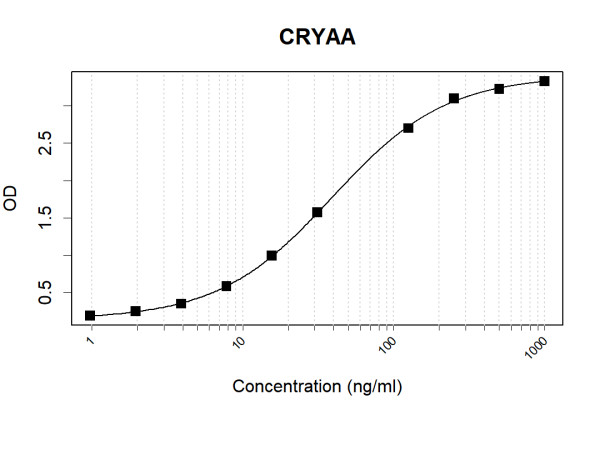
Product information "Anti-Human alpha A Crystallin Antibody Pair"
Product Description: Crystallin alpha A (CRYAA) is a protein encoded by the CRYAA gene in humans, primarily found in the vertebrate eye lens. It belongs to the small heat-shock protein family and plays a crucial role in maintaining the transparency and refractive index of the lens. Alpha crystallins are composed of two gene products: alpha-A and alpha-B, with alpha-A being preferentially restricted to the lens and alpha-B expressed widely in many tissues and organs. The protein acts as a molecular chaperone, holding proteins in large soluble aggregates rather than renaturing them, and its post-translational modifications can decrease its chaperone activity. The alpha-A and alpha-B subunits form heterogeneous aggregates with a 3:1 ratio, respectively, and are involved in the intracellular architecture and autokinase activity. Defects in the CRYAA gene can cause autosomal dominant congenital cataract (ADCC), a condition characterized by lens opacity at birth. Protein Function: Contributes to the transparency and refractive index of the lens (PubMed:18302245). In its oxidized form (absence of intramolecular disulfide bond), acts as a chaperone, preventing aggregation of various proteins under a wide range of stress conditions (PubMed:18199971, PubMed:19595763, PubMed:22120592, PubMed:31792453). Required for the correct formation of lens intermediate filaments as part of a complex composed of BFSP1, BFSP2 and CRYAA (PubMed:28935373) [The Uniprot Consortium]
| Keywords: | Anti-CRYAA, Anti-Alpha-crystallin A chain, Anti-Heat shock protein beta-4, Anti-Heat shock protein family B member 4, Human alpha A Crystallin Antibody Pair |
| Supplier: | Absea |
| Supplier-Nr: | ES-1025 |
Properties
| Application: | ELISA |
| Antibody Type: | Monoclonal |
| Clone: | K8U013_18B6/K8U013_11C4 |
| Conjugate: | No |
| Host: | Mouse/Mouse |
| Species reactivity: | human |
| Purity: | >85% |
| Format: | Solution |
Database Information
| KEGG ID : | K09541 | Matching products |
| UniProt ID : | P02489 | Matching products |
| Gene ID : | GeneID 102724652 | Matching products |
Handling & Safety
| Storage: | -20°C (avoid repeat freezing and thawing cycles) |
| Shipping: | -20°C (International: +4°C) |
Caution
Our products are for laboratory research use only: Not for administration to humans!
Our products are for laboratory research use only: Not for administration to humans!
You will get a certificate here
Viewed