
Cookie preferences
This website uses cookies, which are necessary for the technical operation of the website and are always set. Other cookies, which increase the comfort when using this website, are used for direct advertising or to facilitate interaction with other websites and social networks, are only set with your consent.
Configuration
Technically required
These cookies are necessary for the basic functions of the shop.
"Allow all cookies" cookie
"Decline all cookies" cookie
CSRF token
Cookie preferences
Currency change
Customer-specific caching
FACT-Finder tracking
Individual prices
Selected shop
Session
Comfort functions
These cookies are used to make the shopping experience even more appealing, for example for the recognition of the visitor.
Note
Show the facebook fanpage in the right blod sidebar
Statistics & Tracking
Affiliate program
Conversion and usertracking via Google Tag Manager
Track device being used

| Item number | Size | Datasheet | Manual | SDS | Delivery time | Quantity | Price |
|---|---|---|---|---|---|---|---|
| ABS-ES-1797.1 | 1 pair (100 µg/100 µg) | - | - |
10 - 14 business days* |
1,080.00€
|
If you have any questions, please use our Contact Form.
You can also order by e-mail: info@biomol.com
Larger quantity required? Request bulk
You can also order by e-mail: info@biomol.com
Larger quantity required? Request bulk
Product Description: Adhesion G protein-coupled receptor E2 (ADGRE2) is a cell surface receptor... more
Product information "Anti-Human ADGRE2 Antibody Pair"
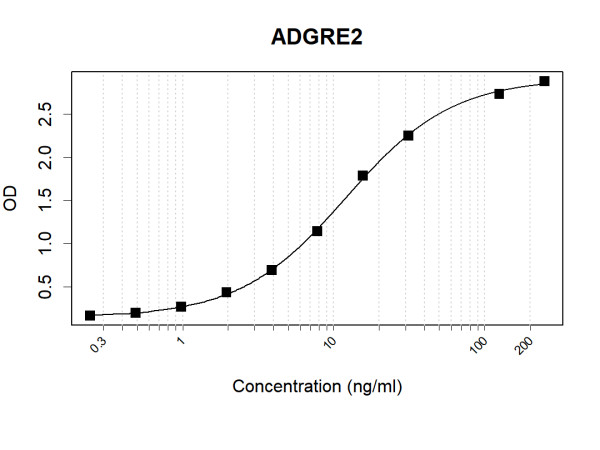
Product Description: Adhesion G protein-coupled receptor E2 (ADGRE2) is a cell surface receptor found in various immune system cells, particularly mast cells. It consists of two subunits: an alpha subunit on the cell's outer surface and a beta subunit spanning the cell membrane. ADGRE2 plays a role in cell adhesion by binding to chondroitin sulfate on glycosaminoglycan chains. The protein promotes granulocyte chemotaxis, degranulation, and adhesion, and in macrophages, it stimulates the release of inflammatory cytokines. ADGRE2 undergoes GPS autoproteolysis before reaching the plasma membrane, and its distribution within lipid rafts may affect cell signaling. A mutation in the ADGRE2 gene (Cys492Tyr) has been associated with vibratory urticaria, a condition where vibration or friction on the skin causes allergy symptoms. This mutation leads to a less stable interaction between the protein's subunits, potentially triggering mast cell reactions upon mechanical stimulation. Protein Function: Cell surface receptor that binds to the chondroitin sulfate moiety of glycosaminoglycan chains and promotes cell attachment. Promotes granulocyte chemotaxis, degranulation and adhesion. In macrophages, promotes the release of inflammatory cytokines, including IL8 and TNF. Signals probably through G-proteins. Is a regulator of mast cell degranulation (PubMed:26841242) [The Uniprot Consortium]
| Keywords: | Anti-ADGRE2, Anti-EGF-like module receptor 2, Anti-Adhesion G protein-coupled receptor E2, Anti-EGF-like module-containing mucin-like hormone receptor-like 2, Human ADGRE2 Antibody Pair |
| Supplier: | Absea |
| Supplier-Nr: | ES-1797 |
Properties
| Application: | ELISA |
| Antibody Type: | Monoclonal |
| Clone: | K9N028_16E4/K9N028_7B8 |
| Conjugate: | No |
| Host: | Mouse/Mouse |
| Species reactivity: | human |
| Purity: | >85% |
| Format: | Solution |
Database Information
| KEGG ID : | K08443 | Matching products |
| UniProt ID : | Q9UHX3 | Matching products |
| Gene ID : | GeneID 30817 | Matching products |
Handling & Safety
| Storage: | -20°C (avoid repeat freezing and thawing cycles) |
| Shipping: | -20°C (International: +4°C) |
Caution
Our products are for laboratory research use only: Not for administration to humans!
Our products are for laboratory research use only: Not for administration to humans!
You will get a certificate here
Viewed