
Cookie-Einstellungen
Diese Website benutzt Cookies, die für den technischen Betrieb der Website erforderlich sind und stets gesetzt werden. Andere Cookies, die den Komfort bei Benutzung dieser Website erhöhen, der Direktwerbung dienen oder die Interaktion mit anderen Websites und sozialen Netzwerken vereinfachen sollen, werden nur mit Ihrer Zustimmung gesetzt.
Konfiguration
Technisch erforderlich
Diese Cookies sind für die Grundfunktionen des Shops notwendig.
"Alle Cookies ablehnen" Cookie
"Alle Cookies annehmen" Cookie
Ausgewählter Shop
CSRF-Token
Cookie-Einstellungen
FACT-Finder Tracking
Individuelle Preise
Kundenspezifisches Caching
Session
Währungswechsel
Komfortfunktionen
Diese Cookies werden genutzt um das Einkaufserlebnis noch ansprechender zu gestalten, beispielsweise für die Wiedererkennung des Besuchers.
Facebook-Seite in der rechten Blog - Sidebar anzeigen
Merkzettel
Statistik & Tracking
Endgeräteerkennung
Kauf- und Surfverhalten mit Google Tag Manager
Partnerprogramm


| Artikelnummer | Größe | Datenblatt | Manual | SDB | Lieferzeit | Menge | Preis |
|---|---|---|---|---|---|---|---|
| NSJ-R32089 | 100 µg | - | - |
3 - 10 Werktage* |
790,00 €
|
Bei Fragen nutzen Sie gerne unser Kontaktformular.
Bestellen Sie auch per E-Mail: info@biomol.com
Größere Menge gewünscht? Bulk-Anfrage
Bestellen Sie auch per E-Mail: info@biomol.com
Größere Menge gewünscht? Bulk-Anfrage
0.5mg/ml if reconstituted with 0.2ml sterile DI water. The transcription factor, signal... mehr
Produktinformationen "Anti-STAT3"
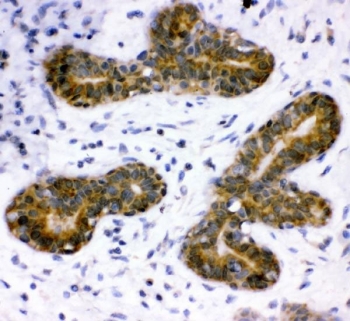
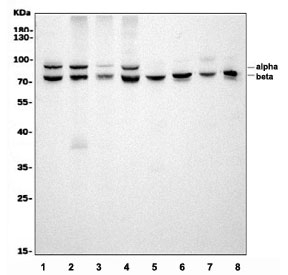
0.5mg/ml if reconstituted with 0.2ml sterile DI water. The transcription factor, signal transducer and activator of transcription-3 (STAT-3) is the most pleiotropic member of the signal transducer and activator of transcription (STAT) family of transcription factors and mediates pivotal responses for the cytokine family. The mouse STAT3 gene contains 24 exons and spans 30 kb. The translation initiation codon is in exon 2, and the stop codon is in exon 24. STAT3 is mapped to 17q21. It contributes to various physiological processes. Hepatic STAT-3 signaling is thus essential for normal glucose homeostasis and may provide new therapeutic targets for diabetes mellitus. Protein function: Signal transducer and transcription activator that mediates cellular responses to interleukins, KITLG/SCF, LEP and other growth factors (PubMed:10688651, PubMed:12359225, PubMed:12873986, PubMed:15194700, PubMed:15653507, PubMed:16285960, PubMed:17344214, PubMed:18242580, PubMed:18782771, PubMed:22306293, PubMed:23084476, PubMed:28262505, PubMed:32929201, PubMed:38404237). Once activated, recruits coactivators, such as NCOA1 or MED1, to the promoter region of the target gene (PubMed:15653507, PubMed:16285960, PubMed:17344214, PubMed:18782771, PubMed:28262505, PubMed:32929201). May mediate cellular responses to activated FGFR1, FGFR2, FGFR3 and FGFR4 (PubMed:12873986). Upon activation of IL6ST/gp130 signaling by interleukin-6 (IL6), binds to the IL6-responsive elements identified in the promoters of various acute-phase protein genes (PubMed:12359225). Activated by IL31 through IL31RA (PubMed:15194700). Acts as a regulator of inflammatory response by regulating differentiation of naive CD4(+) T-cells into T-helper Th17 or regulatory T-cells (Treg): acetylation promotes its transcription activity and cell differentiation while deacetylation and oxidation of lysine residues by LOXL3 inhibits differentiation (PubMed:28065600, PubMed:28262505). Involved in cell cycle regulation by inducing the expression of key genes for the progression from G1 to S phase, such as CCND1 (PubMed:17344214). Mediates the effects of LEP on melanocortin production, body energy homeostasis and lactation. May play an apoptotic role by transctivating BIRC5 expression under LEP activation (PubMed:18242580). Cytoplasmic STAT3 represses macroautophagy by inhibiting EIF2AK2/PKR activity (PubMed:23084476). Plays a crucial role in basal beta cell functions, such as regulation of insulin secretion. Following JAK/STAT signaling activation and as part of a complex with NFATC3 and NFATC4, binds to the alpha-beta E4 promoter region of CRYAB and activates transcription in cardiomyocytes. [The UniProt Consortium]
| Schlagworte: | Anti-Acute-phase response factor, Anti-Signal transducer and activator of transcription 3, STAT3 Antibody |
| Hersteller: | NSJ Bioreagents |
| Hersteller-Nr: | R32089 |
Eigenschaften
| Anwendung: | WB, IF, IP, FC |
| Antikörper-Typ: | Polyclonal |
| Konjugat: | No |
| Wirt: | Rabbit |
| Spezies-Reaktivität: | human, mouse, rat |
| Immunogen: | Amino acids EKQQMLEQHLQDVRKRVQDLEQKMKVVEN of human STAT3 |
| Format: | Purified |
Datenbank Information
| KEGG ID : | K04692 | Passende Produkte |
| UniProt ID : | P40763 | Passende Produkte |
| Gene ID : | GeneID 6774 | Passende Produkte |
Handhabung & Sicherheit
| Lagerung: | +4°C |
| Versand: | +4°C (International: +4°C) |
Achtung
Nur für Forschungszwecke und Laboruntersuchungen: Nicht für die Anwendung im oder am Menschen!
Nur für Forschungszwecke und Laboruntersuchungen: Nicht für die Anwendung im oder am Menschen!
Hier folgen Informationen zur Produktreferenz.
mehr
Hier kriegen Sie ein Zertifikat
Loggen Sie sich ein oder registrieren Sie sich, um Analysenzertifikate anzufordern.
Bewertungen lesen, schreiben und diskutieren... mehr
Kundenbewertungen für "Anti-STAT3"
Bewertung schreiben
Loggen Sie sich ein oder registrieren Sie sich, um eine Produktbewertung abzugeben.

Zuletzt angesehen