
Cookie-Einstellungen
Diese Website benutzt Cookies, die für den technischen Betrieb der Website erforderlich sind und stets gesetzt werden. Andere Cookies, die den Komfort bei Benutzung dieser Website erhöhen, der Direktwerbung dienen oder die Interaktion mit anderen Websites und sozialen Netzwerken vereinfachen sollen, werden nur mit Ihrer Zustimmung gesetzt.
Konfiguration
Technisch erforderlich
Diese Cookies sind für die Grundfunktionen des Shops notwendig.
"Alle Cookies ablehnen" Cookie
"Alle Cookies annehmen" Cookie
Ausgewählter Shop
CSRF-Token
Cookie-Einstellungen
FACT-Finder Tracking
Individuelle Preise
Kundenspezifisches Caching
Session
Währungswechsel
Komfortfunktionen
Diese Cookies werden genutzt um das Einkaufserlebnis noch ansprechender zu gestalten, beispielsweise für die Wiedererkennung des Besuchers.
Facebook-Seite in der rechten Blog - Sidebar anzeigen
Merkzettel
Statistik & Tracking
Endgeräteerkennung
Kauf- und Surfverhalten mit Google Tag Manager
Partnerprogramm


| Artikelnummer | Größe | Datenblatt | Manual | SDB | Lieferzeit | Menge | Preis |
|---|---|---|---|---|---|---|---|
| NSJ-FY13394 | 100 µg | - | - |
3 - 10 Werktage* |
790,00 €
|
Bei Fragen nutzen Sie gerne unser Kontaktformular.
Bestellen Sie auch per E-Mail: info@biomol.com
Größere Menge gewünscht? Bulk-Anfrage
Bestellen Sie auch per E-Mail: info@biomol.com
Größere Menge gewünscht? Bulk-Anfrage
Adding 0.2 ml of distilled water will yield a concentration of 500 ug/ml. SIRT3 antibody detects... mehr
Produktinformationen "Anti-SIRT3"
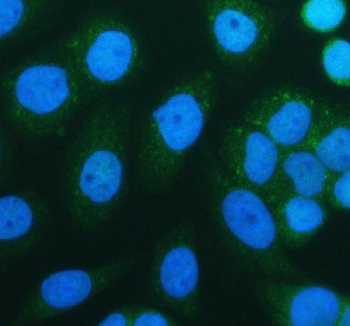
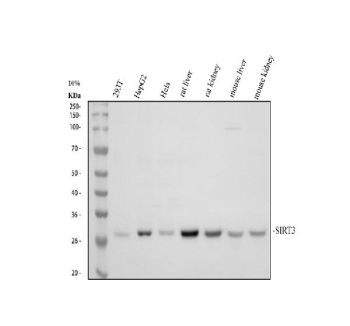
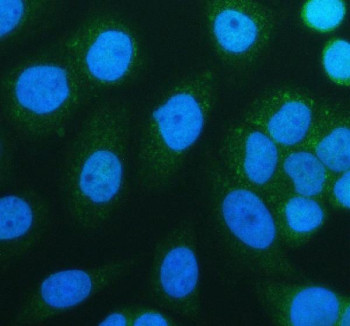
Adding 0.2 ml of distilled water will yield a concentration of 500 ug/ml. SIRT3 antibody detects Sirtuin 3, a mitochondrial NAD-dependent deacetylase that plays a central role in regulating cellular energy metabolism, oxidative stress responses, and mitochondrial protein homeostasis. The UniProt recommended name is NAD-dependent protein deacetylase sirtuin-3 (SIRT3). As a member of the sirtuin family, SIRT3 responds to nutrient availability, stress conditions, and metabolic cues by modifying the acetylation status of key mitochondrial enzymes. This activity influences ATP production, antioxidant defense, fatty acid oxidation, and overall mitochondrial fitness.SIRT3 antibody identifies a protein synthesized as a long precursor that undergoes proteolytic processing within the mitochondria, yielding an active mature form. Sirtuin 3 resides primarily in the mitochondrial matrix, where it deacetylates numerous targets, including components of the electron transport chain, tricarboxylic acid (TCA) cycle enzymes, and antioxidant regulators such as SOD2. Through these actions, SIRT3 maintains mitochondrial respiration efficiency and protects cells from oxidative damage. Its regulatory role in metabolic adaptation becomes especially important during fasting, caloric restriction, endurance exercise, and other physiological stresses that require energy reallocation and enhanced mitochondrial resilience.The SIRT3 gene is located on chromosome 11p15.5 and is broadly expressed in tissues with high metabolic demand, including heart, liver, skeletal muscle, brown adipose tissue, and kidney. In hepatocytes, SIRT3 promotes fatty acid oxidation and ketogenesis during fasting. In skeletal muscle, it supports mitochondrial biogenesis and contractile efficiency. Cardiomyocytes rely on SIRT3 to maintain redox balance and prevent oxidative injury, making it essential for cardiac stress adaptation. In brown adipose tissue, SIRT3 participates in thermogenic regulation by modulating mitochondrial uncoupling and lipid catabolism.Functionally, SIRT3 acts as a metabolic gatekeeper by coordinating mitochondrial output with cellular energy needs. It becomes activated when intracellular NAD levels rise, a condition associated with nutrient scarcity or increased respiration. Activated Sirtuin 3 deacetylates enzymes that enhance oxidative phosphorylation, stabilize mitochondrial DNA integrity, and reduce reactive oxygen species (ROS) production. By regulating mitochondrial permeability transition pore components, SIRT3 also contributes to apoptosis control and cell survival pathways. These interconnected functions position SIRT3 as a central integrator of metabolism, redox balance, and mitochondrial quality control.Pathologically, dysregulation of SIRT3 expression or activity has been linked to metabolic disorders, neurodegenerative diseases, cardiovascular injury, aging-related decline, and cancer. Reduced SIRT3 levels are associated with obesity-induced metabolic dysfunction, insulin resistance, and hepatic steatosis due to impaired mitochondrial fatty acid oxidation. In neurodegenerative settings, diminished SIRT3 activity contributes to increased oxidative stress vulnerability and mitochondrial damage. Conversely, in cancer, SIRT3 can act as either a tumor suppressor or a facilitator of metabolic reprogramming depending on tissue context. Loss of SIRT3 may lead to elevated ROS and genomic instability, while in some tumors, elevated SIRT3 supports mitochondrial bioenergetic demands that enable rapid proliferation. Its dual nature reflects the complexity of mitochondrial signaling across diverse biological environments.Within the immune system, SIRT3 influences macrophage activation and inflammatory tone by modulating mitochondrial ROS and metabolic flux. Emerging studies suggest that SIRT3 participates in T-cell memory formation and stress-adaptive immune functions, further underscoring its importance beyond classical bioenergetics. In aging research, SIRT3 has attracted interest due to its association with longevity and resilience to age-related mitochondrial decline. Caloric restriction and exercise-two interventions known to extend healthspan-consistently enhance SIRT3 expression and activity.Research using SIRT3 antibody supports investigations into mitochondrial metabolism, oxidative stress biology, aging, metabolic disease, and tumor bioenergetics. SIRT3 antibody is validated for use in relevant research applications to detect Sirtuin 3 expression and examine its involvement in mitochondrial regulation and metabolic adaptation. NSJ Bioreagents provides SIRT3 antibody reagents optimized for studies in cell metabolism, redox signaling, mitochondrial physiology, and disease pathogenesis.Researchers studying mitochondrial metabolism, oxidative stress adaptation, and cellular energy regulation pathways may also be interested in our SIRT3 Antibody / Mitochondrial Metabolism Regulator page featuring validated immunofluorescence, flow cytometry, and protein microarray specificity data for mitochondrial biology research.
| Schlagworte: | Anti-SIRT3, Anti-SIR2-like protein 3, Anti-Regulatory protein SIR2 homolog 3, Anti-NAD-dependent protein delactylase sirtuin-3, Anti-NAD-dependent protein deacetylase sirtuin-3, mitochondrial, SIRT3 Antibody |
| Hersteller: | NSJ Bioreagents |
| Hersteller-Nr: | FY13394 |
Eigenschaften
| Anwendung: | WB, IF, ELISA |
| Antikörper-Typ: | Polyclonal |
| Konjugat: | No |
| Wirt: | Rabbit |
| Spezies-Reaktivität: | human, mouse, rat |
| Immunogen: | Synthetic peptide corresponding to a sequence in the middle region of human SIRT3, which shares 80% amino acid (aa) sequence identity with mouse and rat SIRT3 |
| Format: | Purified |
Datenbank Information
| KEGG ID : | K11413 | Passende Produkte |
| UniProt ID : | Q9NTG7 | Passende Produkte |
| Gene ID : | GeneID 23410 | Passende Produkte |
Handhabung & Sicherheit
| Lagerung: | +4°C |
| Versand: | +4°C (International: +4°C) |
Achtung
Nur für Forschungszwecke und Laboruntersuchungen: Nicht für die Anwendung im oder am Menschen!
Nur für Forschungszwecke und Laboruntersuchungen: Nicht für die Anwendung im oder am Menschen!
Hier folgen Informationen zur Produktreferenz.
mehr
Hier kriegen Sie ein Zertifikat
Loggen Sie sich ein oder registrieren Sie sich, um Analysenzertifikate anzufordern.
Bewertungen lesen, schreiben und diskutieren... mehr
Kundenbewertungen für "Anti-SIRT3"
Bewertung schreiben
Loggen Sie sich ein oder registrieren Sie sich, um eine Produktbewertung abzugeben.
Zuletzt angesehen