
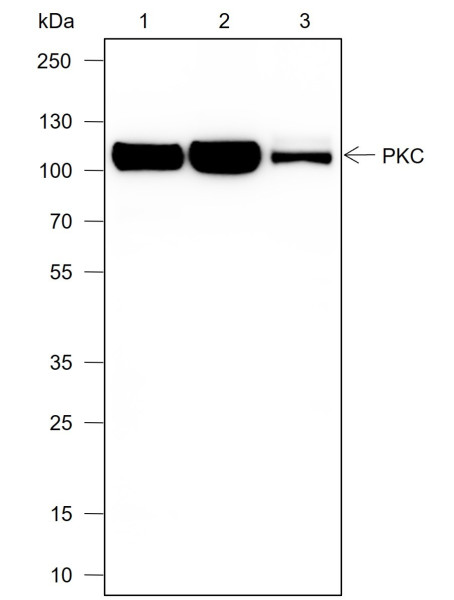
Anti-Recombinant PKC mu, clone A705

| Artikelnummer | Größe | Datenblatt | Manual | SDB | Lieferzeit | Menge | Preis |
|---|---|---|---|---|---|---|---|
| E-AN301985L.50 | 50 µl | - |
7 - 16 Werktage* |
304,00 €
|
|||
| E-AN301985L.100 | 100 µl | - |
7 - 16 Werktage* |
464,00 €
|
Bei Fragen nutzen Sie gerne unser Kontaktformular.
Bestellen Sie auch per E-Mail: info@biomol.com
Größere Menge gewünscht? Bulk-Anfrage
Bestellen Sie auch per E-Mail: info@biomol.com
Größere Menge gewünscht? Bulk-Anfrage
Activation of protein kinase C (PKC) is one of the earliest events in a cascade that controls a... mehr
Produktinformationen "Anti-Recombinant PKC mu, clone A705"
Activation of protein kinase C (PKC) is one of the earliest events in a cascade that controls a variety of cellular responses, including secretion, gene expression, proliferation, and muscle contraction.PKC isoforms belong to three groups based on calcium dependency and activators. Classical PKCs are calcium-dependent via their C2 domains and are activated by phosphatidylserine (PS), diacylglycerol (DAG), and phorbol esters (TPA, PMA) through their cysteine-rich C1 domains. Both novel and atypical PKCs are calcium-independent, but only novel PKCs are activated by PS, DAG, and phorbol esters. Members of these three PKC groups contain a pseudo-substrate or autoinhibitory domain that binds to substrate-binding sites in the catalytic domain to prevent activation in the absence of cofactors or activators. Control of PKC activity is regulated through three distinct phosphorylation events. Phosphorylation occurs in vivo at Thr500 in the activation loop, at Thr641 through autophosphorylation, and at the carboxy-terminal hydrophobic site Ser660. Atypical PKC isoforms lack hydrophobic region phosphorylation, which correlates with the presence of glutamic acid rather than the serine or threonine residues found in more typical PKC isoforms. The enzyme PDK1 or a close relative is responsible for PKC activation. A recent addition to the PKC superfamily is PKCµ (PKD), which is regulated by DAG and TPA through its C1 domain. PKD is distinguished by the presence of a PH domain and by its unique substrate recognition and Golgi localization. PKC-related kinases (PRK) lack the C1 domain and do not respond to DAG or phorbol esters. Phosphatidylinositol lipids activate PRKs, and small Rho-family GTPases bind to the homology region 1 (HR1) to regulate PRK kinase activity.
| Schlagworte: | Anti-PRKD1, Anti-nPKC-D1, Anti-nPKC-mu, Anti-Protein kinase D, Anti-Protein kinase C mu type, Anti-Serine/threonine-protein kinase D1, Recombinant PKC mu Monoclonal Antibody |
| Hersteller: | Elabscience |
| Hersteller-Nr: | E-AN301985L |
Eigenschaften
| Anwendung: | WB |
| Antikörper-Typ: | Monoclonal |
| Klon: | A705 |
| Konjugat: | No |
| Wirt: | Rabbit |
| Spezies-Reaktivität: | human |
| Immunogen: | Peptide. This information is proprietary to PTMab. |
| MW: | 110 kD |
Datenbank Information
| KEGG ID : | K06070 | Passende Produkte |
| UniProt ID : | Q15139 | Passende Produkte |
| Gene ID : | GeneID 5587 | Passende Produkte |
Handhabung & Sicherheit
| Lagerung: | -20°C |
| Versand: | -20°C (International: -20°C) |
| Signalwort: | Warning |
| GHS-Piktogramme: |

|
| H-Sätze: | H317 |
| P-Sätze: | P261, P272, P280, P302+352, P333+313 |
Achtung
Nur für Forschungszwecke und Laboruntersuchungen: Nicht für die Anwendung im oder am Menschen!
Nur für Forschungszwecke und Laboruntersuchungen: Nicht für die Anwendung im oder am Menschen!
Hier folgen Informationen zur Produktreferenz.
mehr
Hier kriegen Sie ein Zertifikat
Loggen Sie sich ein oder registrieren Sie sich, um Analysenzertifikate anzufordern.
Bewertungen lesen, schreiben und diskutieren... mehr
Kundenbewertungen für "Anti-Recombinant PKC mu, clone A705"
Bewertung schreiben
Loggen Sie sich ein oder registrieren Sie sich, um eine Produktbewertung abzugeben.
Zuletzt angesehen