
Cookie-Einstellungen
Diese Website benutzt Cookies, die für den technischen Betrieb der Website erforderlich sind und stets gesetzt werden. Andere Cookies, die den Komfort bei Benutzung dieser Website erhöhen, der Direktwerbung dienen oder die Interaktion mit anderen Websites und sozialen Netzwerken vereinfachen sollen, werden nur mit Ihrer Zustimmung gesetzt.
Konfiguration
Technisch erforderlich
Diese Cookies sind für die Grundfunktionen des Shops notwendig.
"Alle Cookies ablehnen" Cookie
"Alle Cookies annehmen" Cookie
Ausgewählter Shop
CSRF-Token
Cookie-Einstellungen
FACT-Finder Tracking
Individuelle Preise
Kundenspezifisches Caching
Session
Währungswechsel
Komfortfunktionen
Diese Cookies werden genutzt um das Einkaufserlebnis noch ansprechender zu gestalten, beispielsweise für die Wiedererkennung des Besuchers.
Facebook-Seite in der rechten Blog - Sidebar anzeigen
Merkzettel
Statistik & Tracking
Endgeräteerkennung
Kauf- und Surfverhalten mit Google Tag Manager
Partnerprogramm

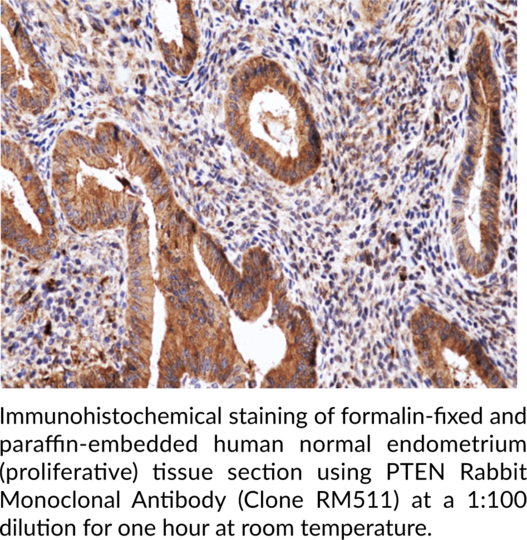
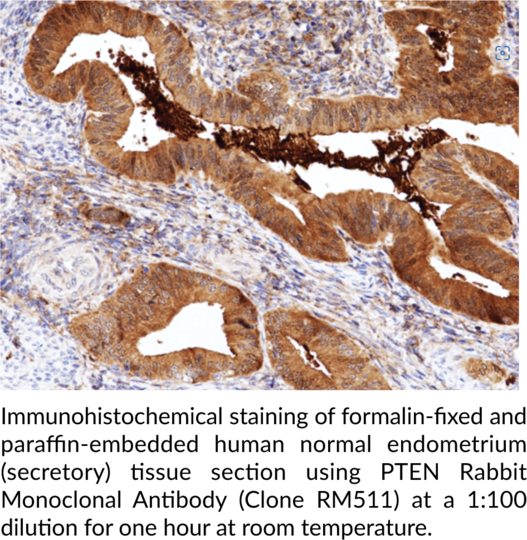
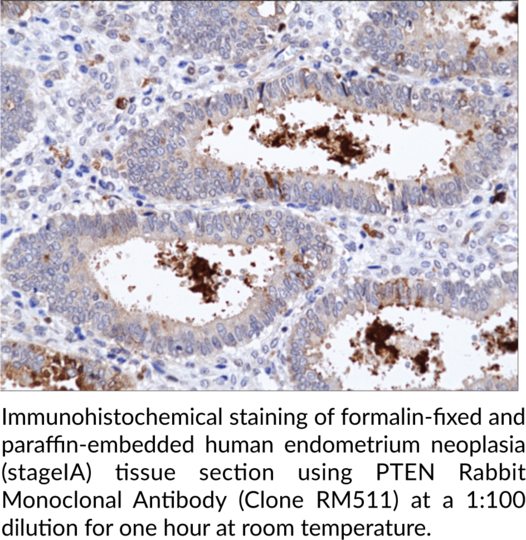
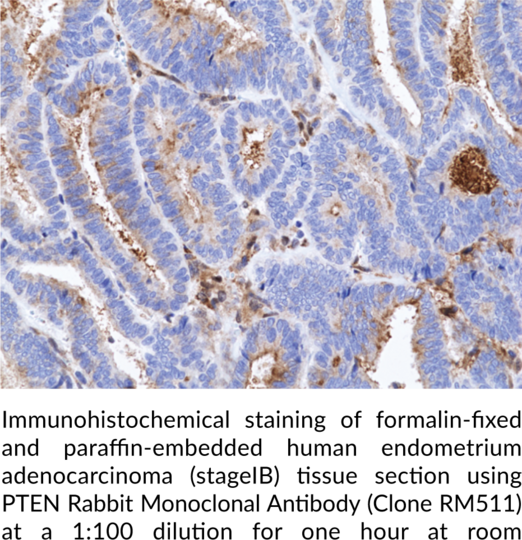
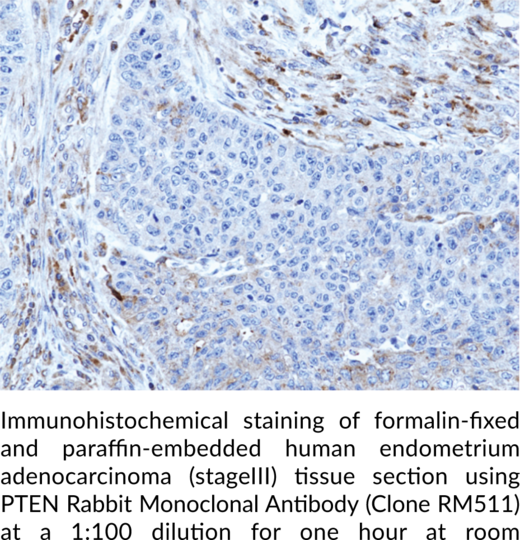
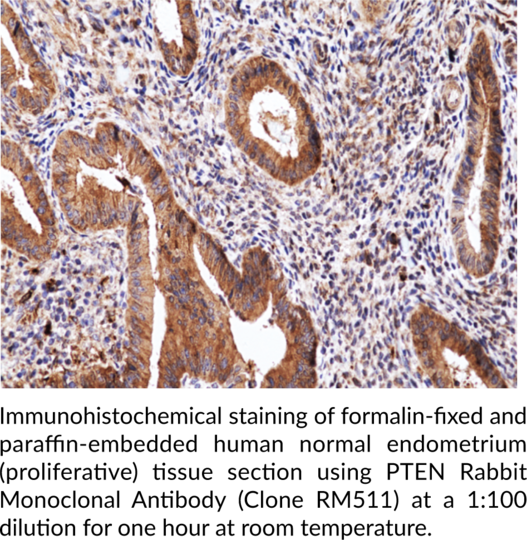


| Artikelnummer | Größe | Datenblatt | Manual | SDB | Lieferzeit | Menge | Preis |
|---|---|---|---|---|---|---|---|
| Cay42778-100 | 100 µl | - |
5 - 10 Werktage* |
571,00 €
|
Bei Fragen nutzen Sie gerne unser Kontaktformular.
Bestellen Sie auch per E-Mail: info@biomol.com
Größere Menge gewünscht? Bulk-Anfrage
Bestellen Sie auch per E-Mail: info@biomol.com
Größere Menge gewünscht? Bulk-Anfrage
Phosphatase and tensin homolog (PTEN) is a tumor suppressor with roles in cell division, cell... mehr
Produktinformationen "Anti-PTEN Rabbit (Clone RM511)"
Phosphatase and tensin homolog (PTEN) is a tumor suppressor with roles in cell division, cell migration, and apoptosis. It is ubiquitously expressed and localized to the cytosol and nucleus where it dephosphorylates phosphatidylinositol-(3,4,5)-triphosphate (PIP3) to phosphatidylinositol-(3,4)-diphosphate (PIP2) to antagonize PI3K signaling and regulates spliceosome assembly and pre-mRNA splicing, respectively. PTEN inhibits cell cycle progression and induces apoptosis, as well as inhibits cell adhesion and migration in vitro. PTEN deletions have been found in various cancers, including glioblastomas and prostate, breast, and kidney cells. Germline mutations in PTEN induce a variety of syndromes, including Cowden, Bannayan-Riley-Ruvalcaba, Proteus, and Proteus-like syndromes, which are characterized by increased risk of cancers, developmental delays, autism spectrum disorders, and macroencephaly. Cayman's PTEN Rabbit Monoclonal Antibody (Clone RM511) can be used for immunohistochemistry (IHC).. Cross reactivity: (+) PTEN: . (+) Human: .. Protein function: Tumor suppressor. Acts as a dual-specificity protein phosphatase, dephosphorylating tyrosine-, serine- and threonine- phosphorylated proteins. Also acts as a lipid phosphatase, removing the phosphate in the D3 position of the inositol ring from phosphatidylinositol 3,4,5-trisphosphate, phosphatidylinositol 3,4- diphosphate, phosphatidylinositol 3-phosphate and inositol 1,3,4,5- tetrakisphosphate with order of substrate preference in vitro PtdIns(3,4,5)P3 > PtdIns(3,4)P2 > PtdIns3P > Ins(1,3,4,5)P4 (PubMed:26504226, PubMed:16824732). The lipid phosphatase activity is critical for its tumor suppressor function. Antagonizes the PI3K- AKT/PKB signaling pathway by dephosphorylating phosphoinositides and thereby modulating cell cycle progression and cell survival. The unphosphorylated form cooperates with AIP1 to suppress AKT1 activation. Dephosphorylates tyrosine-phosphorylated focal adhesion kinase and inhibits cell migration and integrin-mediated cell spreading and focal adhesion formation. Plays a role as a key modulator of the AKT-mTOR signaling pathway controlling the tempo of the process of newborn neurons integration during adult neurogenesis, including correct neuron positioning, dendritic development and synapse formation. May be a negative regulator of insulin signaling and glucose metabolism in adipose tissue. The nuclear monoubiquitinated form possesses greater apoptotic potential, whereas the cytoplasmic nonubiquitinated form induces less tumor suppressive ability. In motile cells, suppresses the formation of lateral pseudopods and thereby promotes cell polarization and directed movement. [The UniProt Consortium]
| Schlagworte: | MMAC1, Mutated in Multiple Advanced Cancers 1, Phosphatase and Tensin Homolog, TEP1 |
| Hersteller: | Cayman Chemical |
| Hersteller-Nr: | 42778 |
Eigenschaften
| Anwendung: | IHC |
| Antikörper-Typ: | Monoclonal |
| Klon: | RM511 |
| Konjugat: | No |
| Wirt: | Rabbit |
| Spezies-Reaktivität: | human |
| Immunogen: | A peptide corresponding to residues at the C-terminus of human PTEN |
| Format: | Purified |
Datenbank Information
| KEGG ID : | K01110 | Passende Produkte |
| UniProt ID : | P60484 | Passende Produkte |
| Gene ID : | GeneID 5728 | Passende Produkte |
Handhabung & Sicherheit
| Lagerung: | -20°C |
| Versand: | -20°C (International: -20°C) |
Achtung
Nur für Forschungszwecke und Laboruntersuchungen: Nicht für die Anwendung im oder am Menschen!
Nur für Forschungszwecke und Laboruntersuchungen: Nicht für die Anwendung im oder am Menschen!
Hier folgen Informationen zur Produktreferenz.
mehr
Hier kriegen Sie ein Zertifikat
Loggen Sie sich ein oder registrieren Sie sich, um Analysenzertifikate anzufordern.
Bewertungen lesen, schreiben und diskutieren... mehr
Kundenbewertungen für "Anti-PTEN Rabbit (Clone RM511)"
Bewertung schreiben
Loggen Sie sich ein oder registrieren Sie sich, um eine Produktbewertung abzugeben.
Zuletzt angesehen