
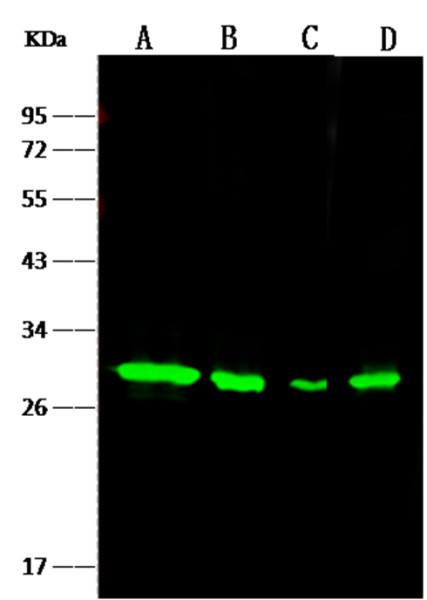
Anti-NQO1 Monoclonal Recombinant Antibody

| Artikelnummer | Größe | Datenblatt | Manual | SDB | Lieferzeit | Menge | Preis |
|---|---|---|---|---|---|---|---|
| E-AN300158P.100 | 100 µl | - |
7 - 16 Werktage* |
462,00 €
|
Bei Fragen nutzen Sie gerne unser Kontaktformular.
Bestellen Sie auch per E-Mail: info@biomol.com
Größere Menge gewünscht? Bulk-Anfrage
Bestellen Sie auch per E-Mail: info@biomol.com
Größere Menge gewünscht? Bulk-Anfrage
This gene is a member of the NAD(P)H dehydrogenase (quinone) family and encodes a cytoplasmic... mehr
Produktinformationen "Anti-NQO1 Monoclonal Recombinant Antibody"
This gene is a member of the NAD(P)H dehydrogenase (quinone) family and encodes a cytoplasmic 1-electron reductase. This FAD-binding protein forms homodimers and reduces quinones to hydroquinones. This protein's enzymatic activity prevents the one electron reduction of quinones that results in the production of radical species. Mutations in this gene have been associated with tardive dyskinesia (TD), an increased risk of hematotoxicity after exposure to benzene, and susceptibility to various forms of cancer. Altered expression of this protein has been seen in many tumors and is also associated with Alzheimer's disease (AD). Alternate transcriptional splice variants, encoding different isoforms, have been characterized. Protein function: Flavin-containing quinone reductase that catalyzes two- electron reduction of quinones to hydroquinones using either NADH or NADPH as electron donors. In a ping-pong kinetic mechanism, the electrons are sequentially transferred from NAD(P)H to flavin cofactor and then from reduced flavin to the quinone, bypassing the formation of semiquinone and reactive oxygen species (PubMed:8999809, PubMed:9271353). Regulates cellular redox state primarily through quinone detoxification. Reduces components of plasma membrane redox system such as coenzyme Q and vitamin quinones, producing antioxidant hydroquinone forms. In the process may function as superoxide scavenger to prevent hydroquinone oxidation and facilitate excretion (PubMed:15102952, PubMed:8999809, PubMed:9271353). Alternatively, can activate quinones and their derivatives by generating redox reactive hydroquinones with DNA cross-linking antitumor potential (PubMed:8999809). Acts as a gatekeeper of the core 20S proteasome known to degrade proteins with unstructured regions. Upon oxidative stress, interacts with tumor suppressors TP53 and TP73 in a NADH-dependent way and inhibits their ubiquitin-independent degradation by the 20S proteasome (PubMed:15687255, PubMed:28291250). [The UniProt Consortium]
| Schlagworte: | QR1, DTD, DIA4, Azoreductase, DT-diaphorase, Quinone reductase 1, Menadione reductase, Phylloquinone reductase, NAD(P)H:quinone oxidoreductase 1, NAD(P)H dehydrogenase [quinone] 1, Recombinant NQO1 Monoclonal Antibody |
| Hersteller: | Elabscience |
| Hersteller-Nr: | E-AN300158P |
Eigenschaften
| Anwendung: | WB |
| Antikörper-Typ: | Monoclonal |
| Klon: | 5B11 |
| Konjugat: | No |
| Wirt: | Rabbit |
| Spezies-Reaktivität: | human |
| Immunogen: | Recombinant Human NQO1 Protein |
| Format: | Purified |
Datenbank Information
| KEGG ID : | K00355 | Passende Produkte |
| UniProt ID : | P15559 | Passende Produkte |
| Gene ID : | GeneID 1728 | Passende Produkte |
Handhabung & Sicherheit
| Lagerung: | +4°C (avoid repeat freezing and thawing cycles) |
| Versand: | +4°C (International: +4°C) |
| Signalwort: | Warning |
| GHS-Piktogramme: |

|
| H-Sätze: | H317 |
| P-Sätze: | P261, P272, P280, P302+352, P333+313 |
Achtung
Nur für Forschungszwecke und Laboruntersuchungen: Nicht für die Anwendung im oder am Menschen!
Nur für Forschungszwecke und Laboruntersuchungen: Nicht für die Anwendung im oder am Menschen!
Hier folgen Informationen zur Produktreferenz.
mehr
Hier kriegen Sie ein Zertifikat
Loggen Sie sich ein oder registrieren Sie sich, um Analysenzertifikate anzufordern.
Bewertungen lesen, schreiben und diskutieren... mehr
Kundenbewertungen für "Anti-NQO1 Monoclonal Recombinant Antibody"
Bewertung schreiben
Loggen Sie sich ein oder registrieren Sie sich, um eine Produktbewertung abzugeben.
Zuletzt angesehen