
Cookie-Einstellungen
Diese Website benutzt Cookies, die für den technischen Betrieb der Website erforderlich sind und stets gesetzt werden. Andere Cookies, die den Komfort bei Benutzung dieser Website erhöhen, der Direktwerbung dienen oder die Interaktion mit anderen Websites und sozialen Netzwerken vereinfachen sollen, werden nur mit Ihrer Zustimmung gesetzt.
Konfiguration
Technisch erforderlich
Diese Cookies sind für die Grundfunktionen des Shops notwendig.
"Alle Cookies ablehnen" Cookie
"Alle Cookies annehmen" Cookie
Ausgewählter Shop
CSRF-Token
Cookie-Einstellungen
FACT-Finder Tracking
Individuelle Preise
Kundenspezifisches Caching
Session
Währungswechsel
Komfortfunktionen
Diese Cookies werden genutzt um das Einkaufserlebnis noch ansprechender zu gestalten, beispielsweise für die Wiedererkennung des Besuchers.
Facebook-Seite in der rechten Blog - Sidebar anzeigen
Merkzettel
Statistik & Tracking
Endgeräteerkennung
Kauf- und Surfverhalten mit Google Tag Manager
Partnerprogramm

| Artikelnummer | Größe | Datenblatt | Manual | SDB | Lieferzeit | Menge | Preis |
|---|---|---|---|---|---|---|---|
| NSJ-F41149-0.08ML | 80 µl | - | - |
3 - 10 Werktage* |
361,00 €
|
||
| NSJ-F41149-0.4ML | 400 µl | - | - |
3 - 10 Werktage* |
772,00 €
|
Bei Fragen nutzen Sie gerne unser Kontaktformular.
Bestellen Sie auch per E-Mail: info@biomol.com
Größere Menge gewünscht? Bulk-Anfrage
Bestellen Sie auch per E-Mail: info@biomol.com
Größere Menge gewünscht? Bulk-Anfrage
In 1X PBS, pH 7.4, with 0.09% sodium azide. DNA is wrapped around histone proteins to form... mehr
Produktinformationen "Anti-HDAC4"
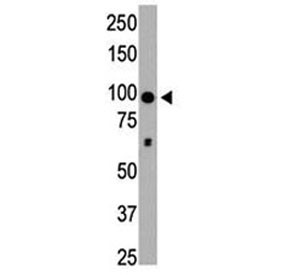
In 1X PBS, pH 7.4, with 0.09% sodium azide. DNA is wrapped around histone proteins to form nucleosomes and chromatin fiber, a higher-order structure. Chromatin can become alternatively revealed to or concealed from transcription factors. Acetylation of lysine residues induces conformational changes in core histones by destabilizing nucleosomes and allowing transcription factors access to recognition elements in DNA. Deacetylation of histones by histone deacetylases (HDACs) reseals the chromosomal package, leading to a repression of transcription. HDAC4 does not bind DNA directly, but rather through MEF2C and MEF2D. Binding of the N terminus of HDAC4 to MEF2C represses MEF2C transcription activity. The catalytic domain of HDAC4 interacts with HDAC3 via the transcriptional corepressor NCOR2. Experimental conditions leading to the suppression of HDAC4 binding to NCOR2 and to HDAC3 result in loss of enzymatic activity associated with HDAC4, indicating regulation of transcription by bridging the enzymatically active NCOR2-HDAC3 complex and select transcription factors. HDAC4 and MITR contain calmodulin-binding domains that overlap with their MEF2 binding domains. Binding of calmodulin to HDAC4 leads to its dissociation from MEF2, relieving MEF2 from the transcriptional repression by HDAC4. Together, HDAC4, MITR, and CABIN1 constitute a family of calcium-sensitive transcriptional repressors of MEF2. In murine studies, HDAC4, which is expressed in prehypertrophic chondrocytes, interacts with and inhibits the activity of Runx2 in mice, a transcription factor necessary for chondrocyte hypertrophy, establishing HDAC4 as a central regulator of chondrocyte hypertrophy and skeletogenesis. Protein function: Responsible for the deacetylation of lysine residues on the N-terminal part of the core histones (H2A, H2B, H3 and H4). Histone deacetylation gives a tag for epigenetic repression and plays an important role in transcriptional regulation, cell cycle progression and developmental events. Histone deacetylases act via the formation of large multiprotein complexes. Involved in muscle maturation via its interaction with the myocyte enhancer factors such as MEF2A, MEF2C and MEF2D. Involved in the MTA1-mediated epigenetic regulation of ESR1 expression in breast cancer. [The UniProt Consortium]
| Schlagworte: | Anti-HD4, Anti-HDAC4, Anti-KIAA0288, EC=3.5.1.98, Anti-Histone deacetylase 4, HDAC4 Antibody |
| Hersteller: | NSJ Bioreagents |
| Hersteller-Nr: | F41149 |
Eigenschaften
| Anwendung: | WB, ELISA |
| Antikörper-Typ: | Polyclonal |
| Konjugat: | No |
| Wirt: | Rabbit |
| Spezies-Reaktivität: | human, mouse |
| Immunogen: | A portion of amino acids 1052-1084 from the human protein was used as the immunogen for this HDAC4 antibody. |
| Format: | Purified |
Datenbank Information
| KEGG ID : | K11406 | Passende Produkte |
| UniProt ID : | P56524 | Passende Produkte |
| Gene ID : | GeneID 9759 | Passende Produkte |
Handhabung & Sicherheit
| Lagerung: | -20°C |
| Versand: | +4°C (International: +4°C) |
Achtung
Nur für Forschungszwecke und Laboruntersuchungen: Nicht für die Anwendung im oder am Menschen!
Nur für Forschungszwecke und Laboruntersuchungen: Nicht für die Anwendung im oder am Menschen!
Hier folgen Informationen zur Produktreferenz.
mehr
Hier kriegen Sie ein Zertifikat
Loggen Sie sich ein oder registrieren Sie sich, um Analysenzertifikate anzufordern.
Bewertungen lesen, schreiben und diskutieren... mehr
Kundenbewertungen für "Anti-HDAC4"
Bewertung schreiben
Loggen Sie sich ein oder registrieren Sie sich, um eine Produktbewertung abzugeben.


Zuletzt angesehen